
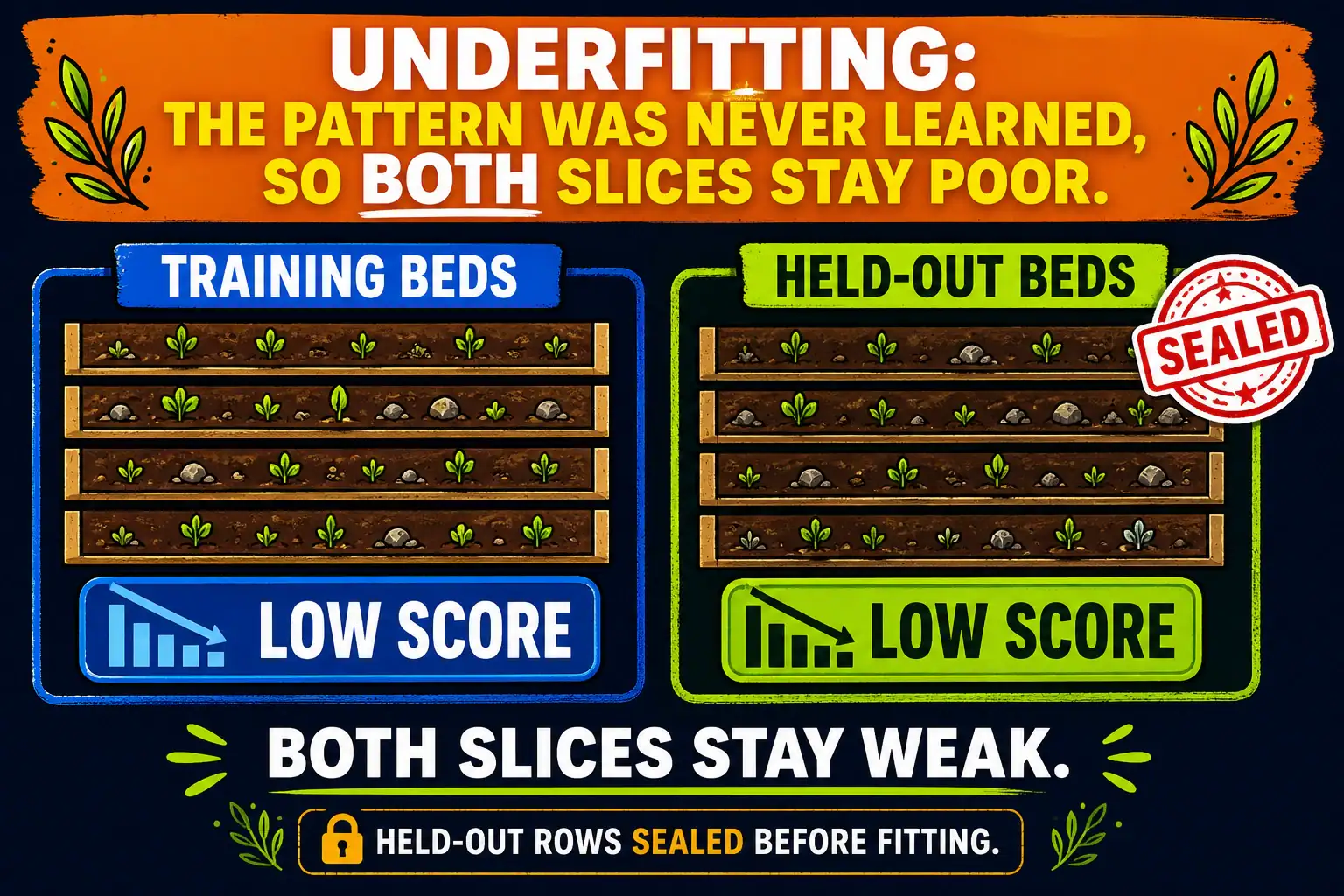
A community-garden soil model is weak on the training beds and still weak on the held-out beds. The held-out rows were sealed before fitting, so they did not leak into training. What is the team seeing?
Select an answer to reveal the explanation.
Short Explanation
Think of a student who never learned the material, so homework and the quiz both look bad. Weak on training beds and weak on held-out beds is underfitting. Leakage usually makes lab scores look too good, and two weak scores do not cancel into a win.
Full Explanation
A community-garden soil model that is weak on the training beds and still weak on sealed held-out beds is underfitting: the pattern was never learned, so both slices stay poor. That reading is correct because simultaneous train and holdout failure indicates insufficient model capacity, weak features, or inadequate training rather than memorization of quirks or leakage of labels. Data leakage is a poor explanation here; leakage usually inflates lab scores by letting future or target-related information into training, and these held-out rows were sealed before fitting so they did not leak. Overfitting would look strong on training beds and weak on held-out beds, which is not the pattern described in the stem. Calling two weak scores a successful fit because they "cancel" is nonsense; agreement on failure is still model failure and does not authorize deployment. Distinguish the two classic failure signatures by where the weakness appears. Exam caveat: train-poor and test-poor means underfit; train-strong and test-poor means overfit—do not swap those signatures on the exam. Operational check: inspect learning curves, enrich soil features or increase model capacity, retrain, and confirm both training and held-out metrics rise before considering deployment to the garden beds.