
A volunteer-fire grant office must later explain each denied hose-replacement request to a state auditor using a short list of contributing fields. The office is not asking the system to draft open-ended letters or read diagrams. Which approach fits?
Select an answer to reveal the explanation.
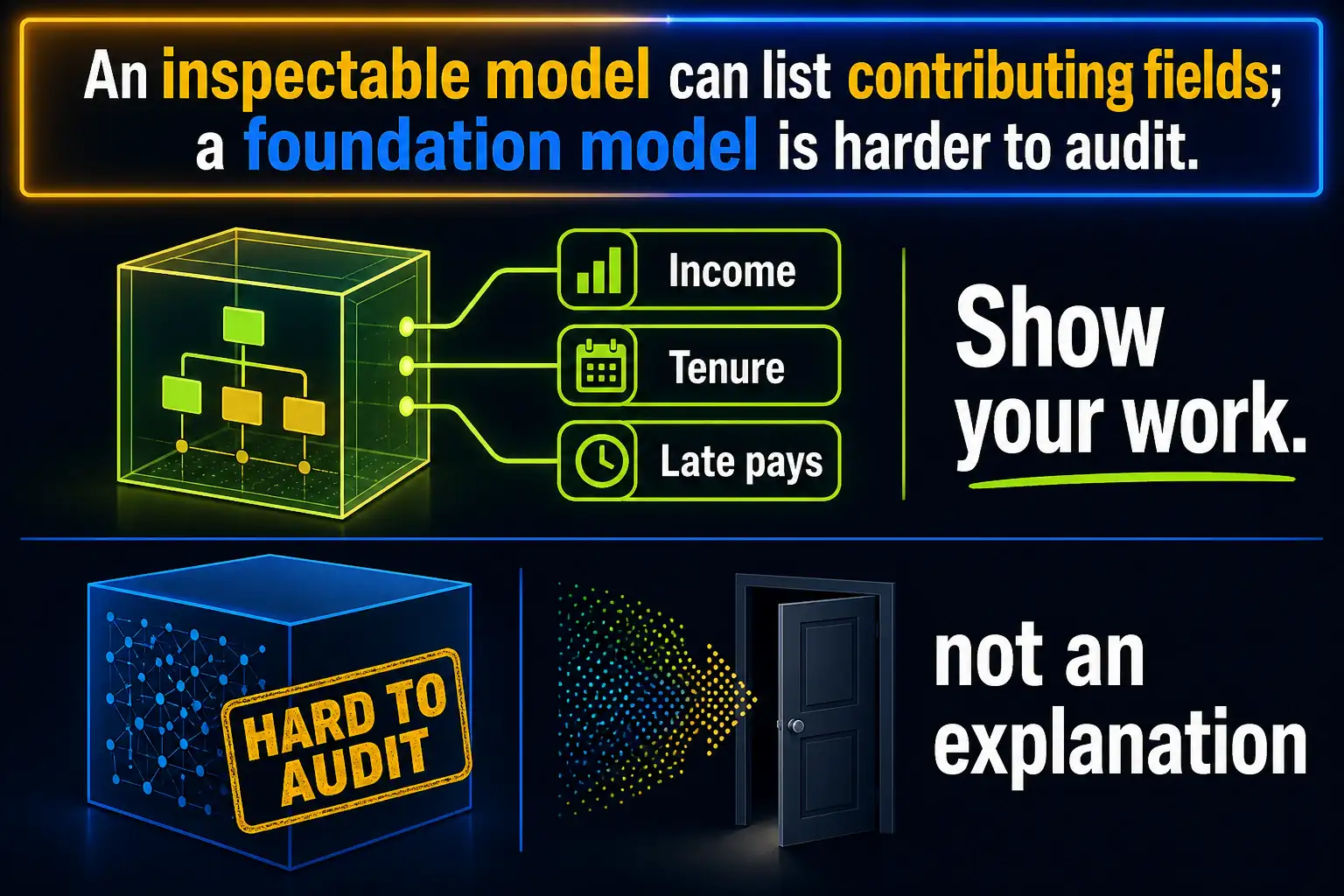
Short Explanation
Think of a tax auditor who wants the three boxes you checked, not a mysterious essay. A small inspectable model can show the contributing fields. A flashy foundation model is harder to open, a spoken denial is not an explanation, and clustering hose colors does not say why the request died.
Full Explanation
A volunteer-fire grant office that must later explain each denied hose-replacement request to a state auditor using a short list of contributing fields needs an inspectable traditional machine-learning model whose features can be shown. That approach fits because auditability of denial drivers is the requirement, not open-ended letter drafting and not reading diagrams. An opaque general foundation model is harder to explain field-by-field; flashier generative capability does not make auditor explanations easier when the ask is a short list of contributing inputs tied to the decision. Amazon Polly produces spoken audio of whatever text you feed it and does not by itself supply a structured denial rationale linked to model features. Unsupervised clustering of hose colors yields unlabeled groups with no per-request explanation of why a particular denial occurred, so an auditor cannot reconstruct the decision logic. Prefer simpler, inspectable models when the business success criterion is explainability to a third party. Exam caveat: when the stem emphasizes explaining decisions with contributing fields, prefer traditional inspectable models over opaque generative systems. Operational check: for a sample of denials, export the top contributing features with their directions, walk one case with a mock auditor, and confirm the explanation cites model inputs rather than a free-form essay.