
A youth rabbit-show Q&A must refuse veterinary dosing advice and filter hate or sexual content. Which control should the team apply?
Select an answer to reveal the explanation.
Short Explanation
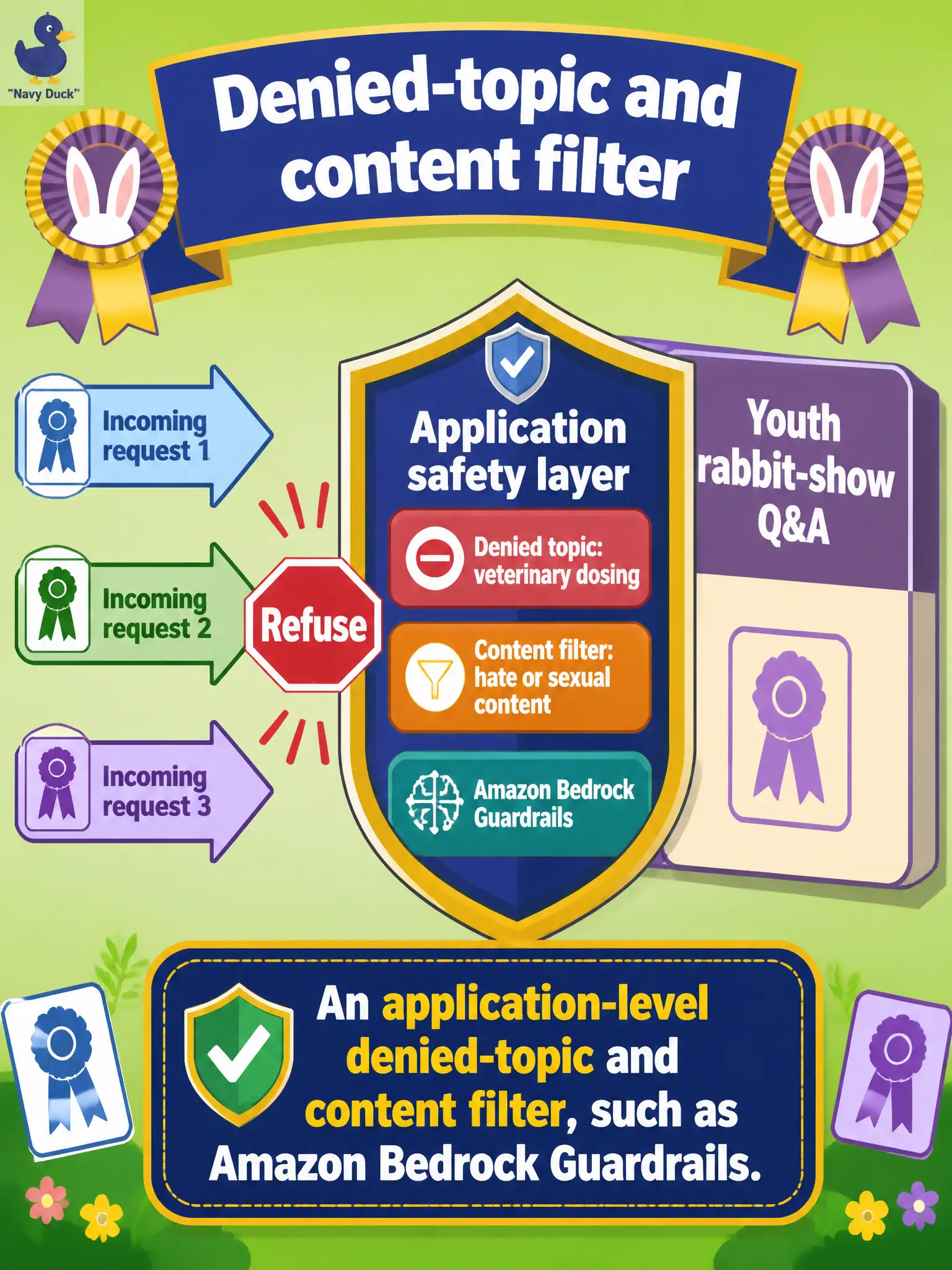
Think of a rabbit-show Q&A that must refuse dosing advice and filter hate or sexual content. That is an application denied-topic filter, like Bedrock Guardrails. A polite fine-tune and a chart do not block those topics.
Full Explanation
A youth rabbit-show Q&A that must refuse veterinary dosing advice and block hate or sexual content needs an application safety layer, not a weight change aimed at politeness. An application-level denied-topic and content filter such as Amazon Bedrock Guardrails works because refusals and category blocks are enforced outside the model’s free generation path and can be updated without retraining. A fine-tune whose only goal is politeness may soften tone while still answering dosing questions or missing restricted content categories entirely. Raising temperature makes outputs more varied, which tends to increase—not reduce—unsafe or off-topic completions. A dashboard chart visualizes metrics; it does not intercept prompts or completions to filter denied topics. Exam caveat: Guardrails and similar filters reduce risk but can still miss novel phrasing or coded requests, so combine them with logging and human escalation for high-stakes animal-care advice. Operational check: run a red-team suite of dosing, hate, and sexual prompts against the Q&A and confirm each is blocked or refused before the experience goes live for youth visitors. Document which topics are denied so volunteer moderators know what the filter is supposed to catch.