
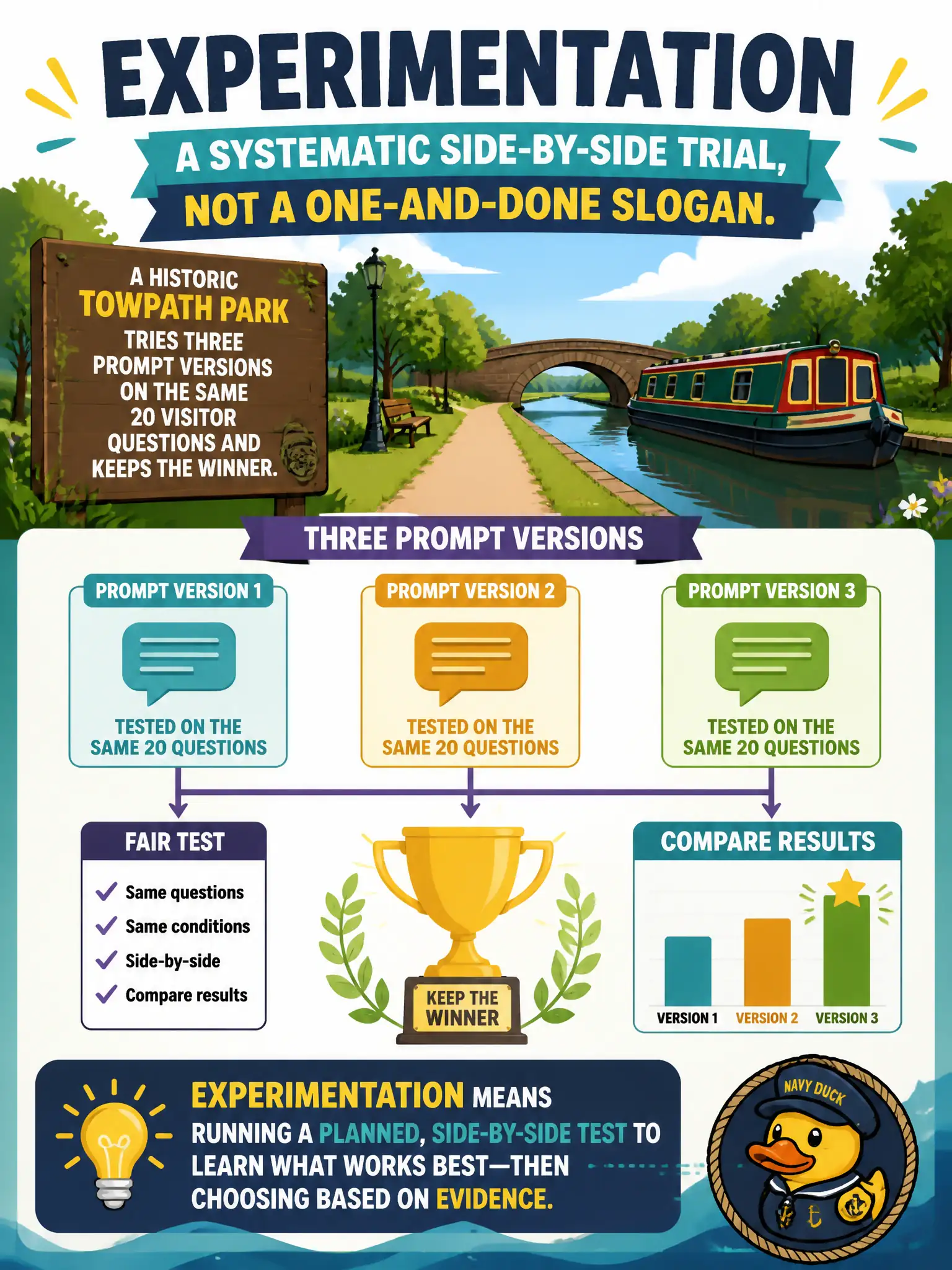
A historic towpath park tries three prompt versions on the same 20 visitor questions and keeps the winner. Which prompt practice is that?
Select an answer to reveal the explanation.
Short Explanation
Think of three prompt versions on the same 20 visitor questions, then keep the winner. That is experimentation, not shipping the first slogan.
Full Explanation
Trying three prompt versions on the same 20 visitor questions and keeping the winner is experimentation: a systematic side-by-side trial rather than a one-and-done slogan. Held-constant inputs let the towpath park attribute answer differences to the prompt wording, not to shifting questions or seasonal visitor mix. Prompt engineering on exams and in operations is an empirical practice—measure, compare, then freeze the winner into production.
Shipping the first slogan without comparison skips evidence and often locks in weak tone or incomplete answers. Fine-tuning a new model for each of the 20 questions is the wrong lever; the variable under test is the prompt, and per-question fine-tunes are neither practical nor what the scenario describes. Treating prompting as finished after one untested sentence abandons evaluation entirely and leaves visitor-facing quality to chance.
Exam caveat: keep the evaluation set somewhat offline from endless iterative tweaking to avoid overfitting prompts to those exact 20 items; refresh with new visitor questions periodically.
Operational check: document the three prompt variants, score all 20 answers with a simple rubric (correctness, tone, length), pick the winner by total score, and store that prompt as the production version with the rubric and date attached.