
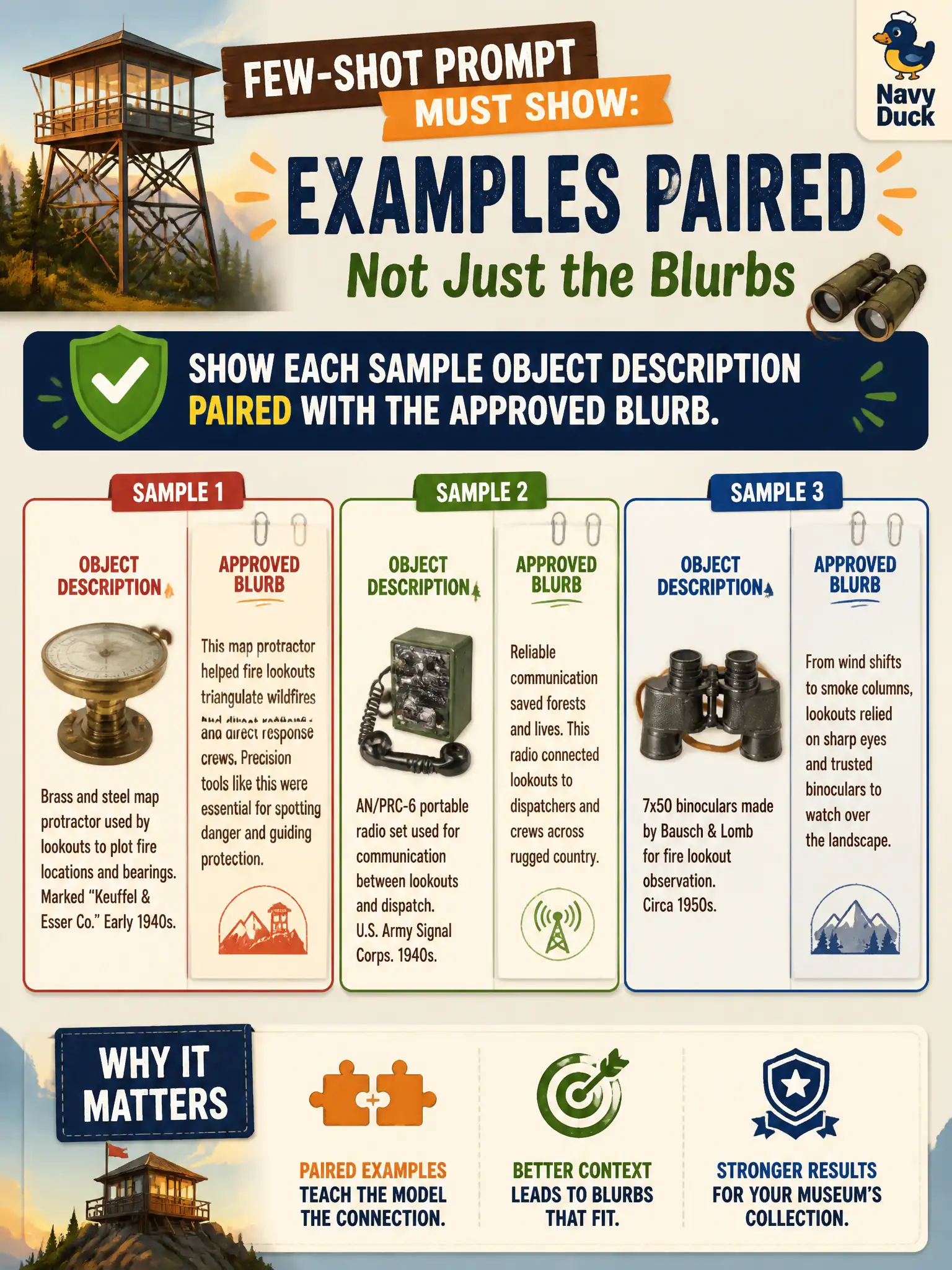
A historic fire-lookout museum wants accession blurbs that match three approved cards. What must the few-shot prompt show?
Select an answer to reveal the explanation.
Short Explanation
Think of three approved accession cards. Few-shot has to show each object paired with the approved blurb, not the blurbs alone. A dashboard is not a demonstration pair.
Full Explanation
Few-shot prompting for accession blurbs must show paired demonstrations: each sample object description together with its approved blurb. The fire-lookout museum model learns the mapping from input object features to output text; blurbs alone do not teach which details of the object drove the approved wording. Input–output pairs are the core of few-shot technique for generation tasks, especially when style must match a curated museum voice.
Showing only the three approved blurbs with no sample object descriptions leaves the model without the input side of the mapping, so it cannot generalize to a new accession. A pile of model answers with no inputs likewise fails to demonstrate the task and often amplifies prior model quirks. A dashboard of last year's attendance is unrelated analytics and is not a few-shot demonstration pair for writing accession text.
Exam caveat: pairs should be representative and consistent across the three cards; mixed tones teach mixed behavior. Curate examples as carefully as you would label a tiny fine-tune set, and retire cards that no longer match policy.
Operational check: build three true object-to-blurb pairs, generate blurbs for three held-out objects, and have the collections lead score fidelity to the approved style—revise the pairs if the model drifts toward blurbs-only imitation.