
A community bocce-league clerk asks “rewrite this in plain language” with no examples and gets a usable notice. Which prompting approach is that, and when is it appropriate?
Select an answer to reveal the explanation.
Short Explanation
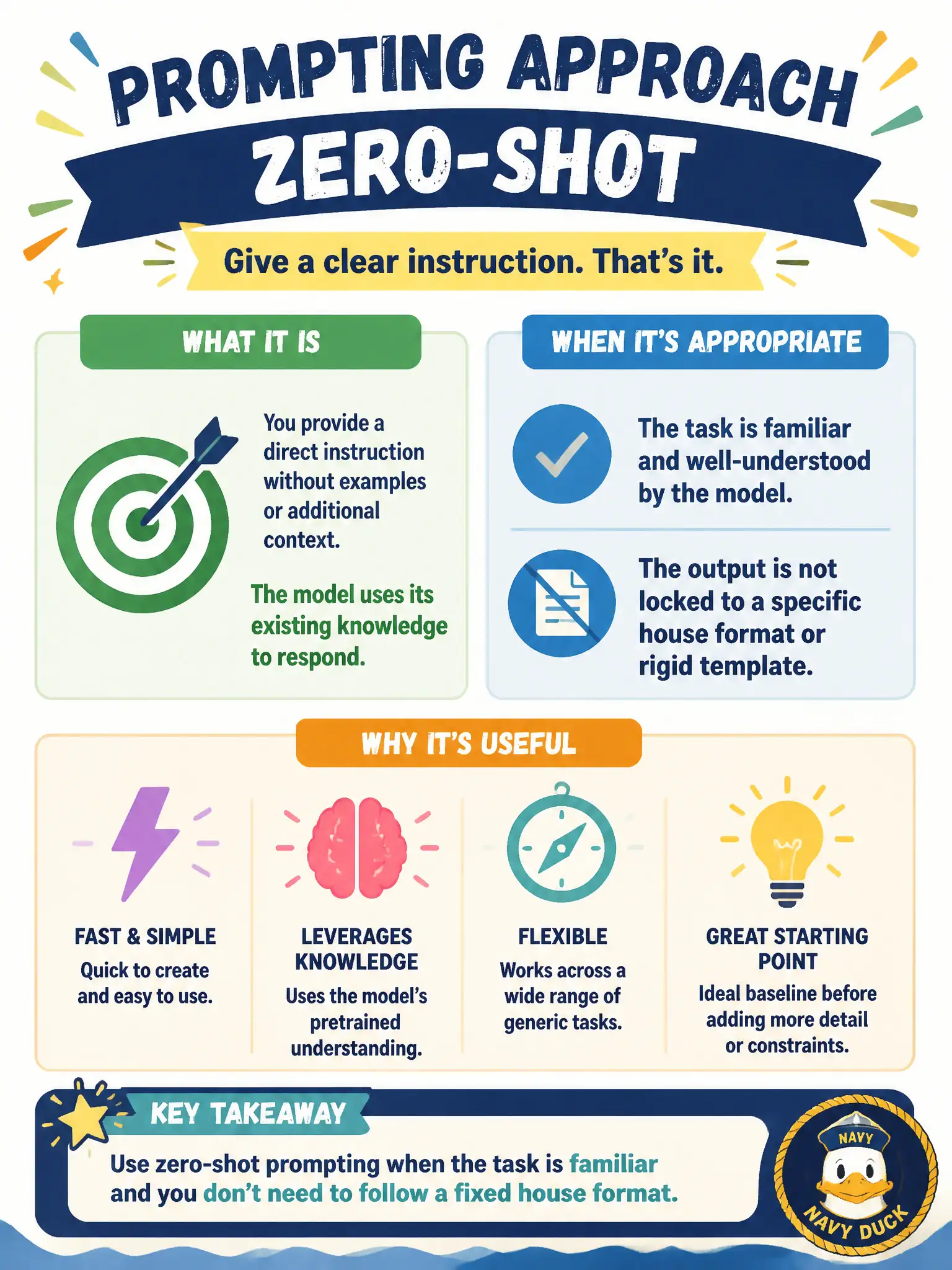
Think of rewrite this in plain language with no examples, and it works. That is zero-shot, fine when the task is familiar and not locked to a house format. Few-shot would add pairs nobody needed.
Full Explanation
Asking 'rewrite this in plain language' with no examples is zero-shot prompting: the model performs a familiar task from the instruction alone. Zero-shot is appropriate when the task is broadly understood—simplify wording for players and families—and is not locked to a proprietary house format that must be demonstrated with pairs. The bocce-league clerk gets a usable notice without paying for example curation, retrieval setup, or fine-tuning delay.
Fine-tuning is not required for a familiar rewrite with no house format; that would add unnecessary cost and delay for a task general models already handle. Few-shot means supplying demonstration pairs—zero examples cannot be redefined as a pile of paired cards. From-scratch pre-training is unrelated to a plain-language rewrite and is never justified by this clerk scenario or by community-league notice volume.
Exam caveat: zero-shot fails when format, tone, or policy is highly specific; the moment the league adopts a mandatory template or legal disclaimer layout, move to single-shot or few-shot rather than blaming the model for missing structure.
Operational check: run the same source notice through zero-shot plain-language rewrites for three audiences (players, parents, park staff) and confirm clarity; if one audience needs a rigid layout, add an example instead of jumping to fine-tuning.