
The same rookery’s old helper invented a species name that sounded right. Which application change reduces those fluent-but-false answers?
Select an answer to reveal the explanation.
Short Explanation
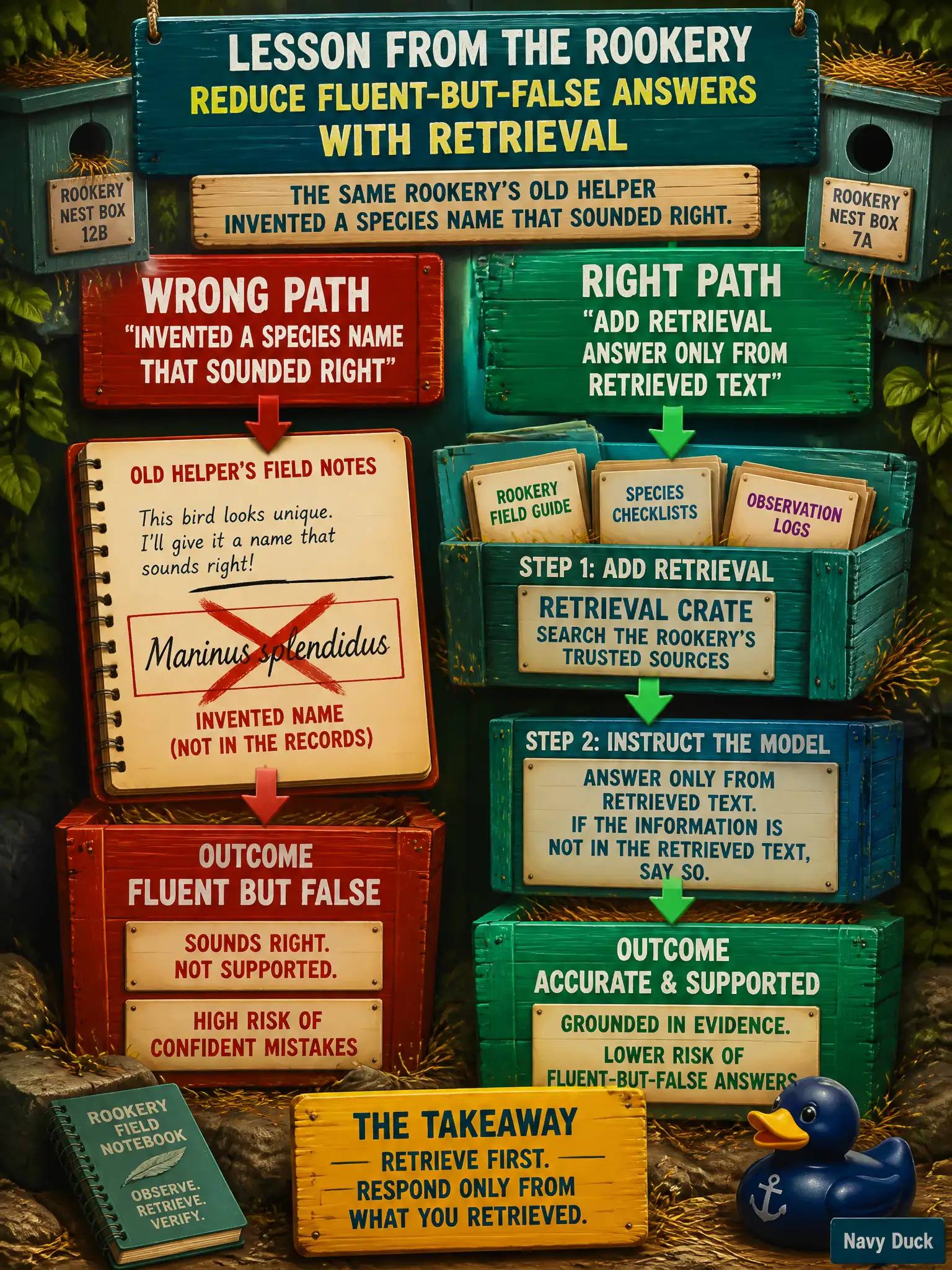
Think of the old helper inventing a species that sounded right. Add retrieval and tell the model to answer only from that text. Repeating the word hallucination, or tossing the brochures, does not ground it.
Full Explanation
The rookery’s old helper invented a species name that sounded right—an ungrounded, fluent-but-false answer. The application change that reduces those failures is to add retrieval and instruct the model to answer only from retrieved text. Constraining generation to brochure passages shrinks the space where the model can invent plausible species names that are not in the source material.
Restating the word hallucination and leaving the helper ungrounded fails because naming the failure mode does not change architecture or prompts; the helper remains free to invent. Removing the brochures fails because it forces the model to invent every species name and removes the only grounding material. Switching to a dashboard that never answers visitor questions fails because it abandons the desk’s Q&A job rather than grounding it.
Exam caveat: reducing hallucinations in knowledge Q&A is primarily an architecture and instruction change—retrieve and constrain—not a vocabulary exercise. Operational check: enable retrieval against the rookery brochures, add an instruction to answer only from retrieved text, ask for species that appear in the brochures and ones that do not, and confirm invented names no longer appear when evidence is missing.