
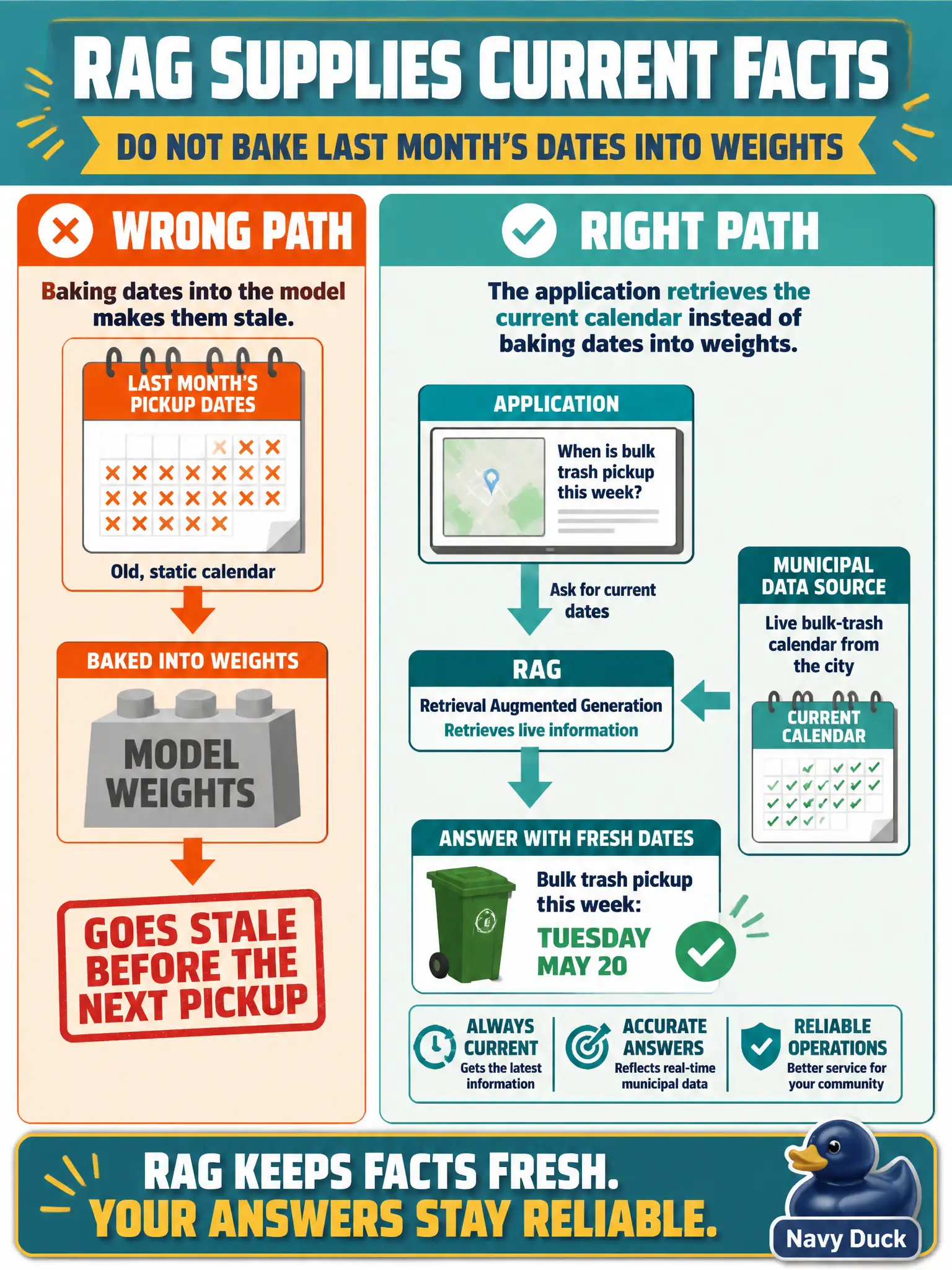
A municipal bulk-trash calendar changes every week. Baking last month’s dates into model weights would go stale before the next pickup. Which approach should supply those operational facts?
Select an answer to reveal the explanation.
Short Explanation
Think of a bulk-trash calendar that changes every week. Retrieve this week's dates. Baking last month into the weights goes stale before the next pickup.
Full Explanation
A municipal bulk-trash calendar that changes every week is volatile operational knowledge. Baking last month’s dates into model weights would go stale before the next pickup, so the facts should be supplied by RAG: the application retrieves the current calendar instead of customizing weights around old dates. Retrieval keeps the calendar outside the model and refreshable whenever public-works updates the schedule.
Fine-tuning on last month’s dates and leaving those weights in place all season fails because the baked facts expire weekly and would mislead residents. Treating changing pickup dates as a reason to never retrieve documents fails because volatility is precisely when retrieval helps most. Ignoring the calendar and inventing pickup days from pretraining fails because pretraining does not know this municipality’s current schedule and will hallucinate convenient but wrong days.
Exam caveat: prefer retrieval over customization when knowledge is current, local, and frequently updated; fine-tuning is a poor fit for weekly calendars. Operational check: update the calendar document mid-week, ask the helper for this week’s pickup day without redeploying model weights, and confirm the answer reflects the retrieved current calendar.