
The same animal-control desk used to paste all 80 stray-hold PDFs into each request. The context window overflowed and the bill exploded. Which approach should replace that pattern?
Select an answer to reveal the explanation.
Short Explanation
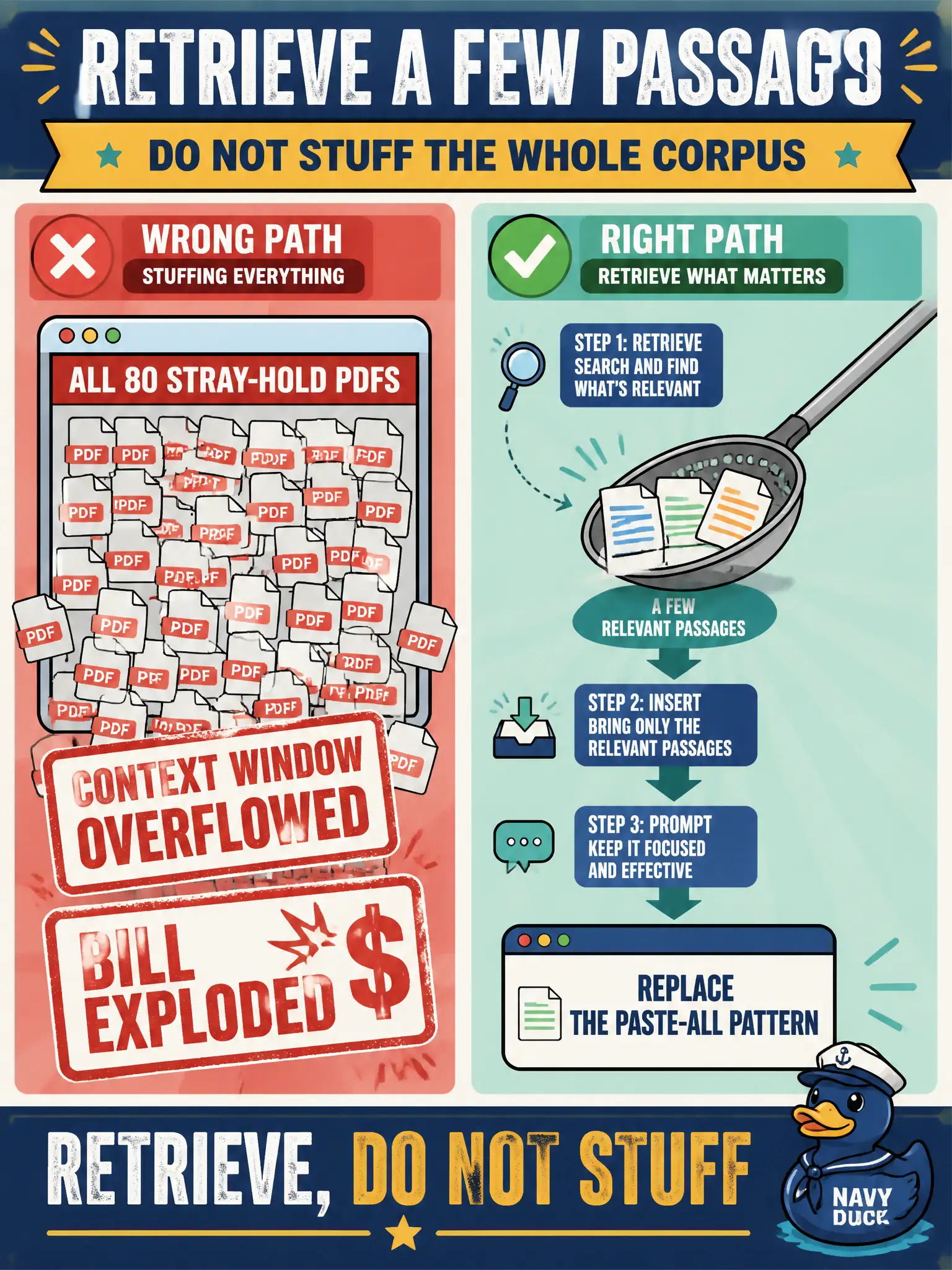
Think of stuffing all 80 PDFs into every request until the window overflows. Retrieve a few relevant passages instead. Daily fine-tuning, or dropping the PDFs, is not the application fix.
Full Explanation
The animal-control desk used to paste all 80 stray-hold PDFs into each request until the context window overflowed and the bill exploded. The replacement pattern is to retrieve a few relevant passages instead of stuffing the entire corpus into every prompt. Targeted retrieval keeps prompts inside the window, cuts token spend, and still supplies the hold text needed to answer—exactly what full-corpus stuffing attempted poorly.
Keeping the habit of stuffing all 80 PDFs fails because it recreates overflow and cost; more documents per request is not better retrieval. Fine-tuning a new model each morning on the full unused corpus fails because daily training is the wrong fix for an application context problem and still leaves most of the corpus unused at answer time. Dropping the PDFs and answering only from training memory fails because the desk’s facts live in the documents; removing them abandons grounding.
Exam caveat: RAG’s value includes selecting a small relevant subset—retrieval quality and economy—not merely attaching storage to a prompt. Operational check: compare prompt token counts and answer accuracy for “all 80 PDFs in prompt” versus “top retrieved passages only,” and adopt retrieval once window errors and cost drop without losing hold-rule fidelity.