
An ambulance-dispatch desk needs every generated radio script nearly identical. A festival slogan can wander. Which inference setting should the team change, and when?
Select an answer to reveal the explanation.
Short Explanation
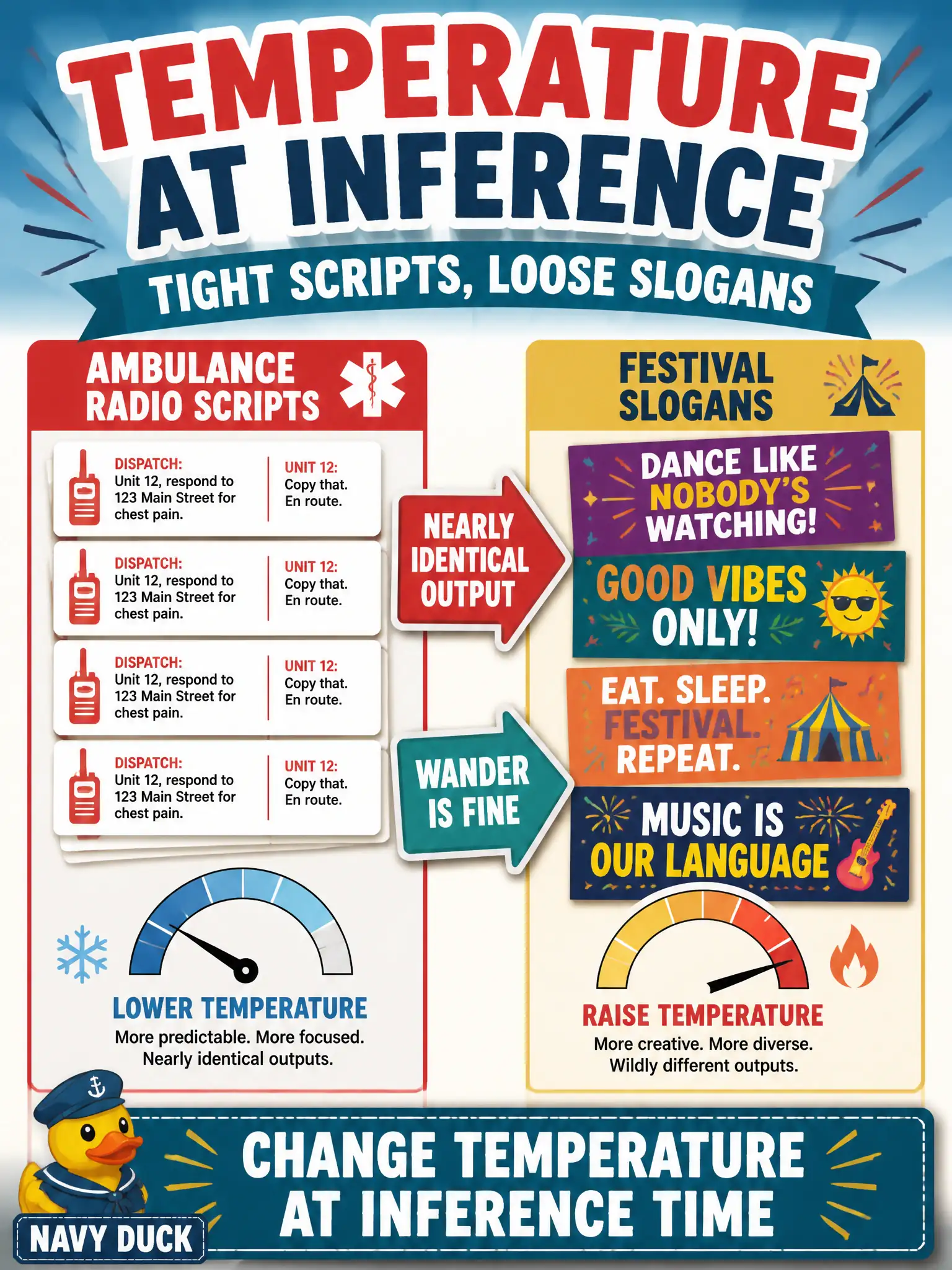
Think of ambulance radio scripts that have to sound the same, and festival slogans that can wander. Lower temperature on the scripts, raise it on the slogans, at inference time. It is not a training-job knob.
Full Explanation
Ambulance-dispatch radio scripts must stay nearly identical across successive generations, while festival slogans can wander. Temperature is the inference-time randomness control that matches those needs: lower it when successive answers must stay tightly similar, and raise it when creative copy can vary. Changing temperature at inference time—not by retuning weights—lets the same desk apply different similarity targets to different jobs.
Treating temperature as a training-job hyperparameter and retuning weights for each slogan fails because temperature is applied at generation time; slogans do not require a new training run to allow more variation. Raising temperature on the radio scripts fails because higher randomness is the opposite of nearly identical dispatch wording and introduces unsafe surprise phrasing. Claiming temperature never affects how similar successive responses are fails because temperature is specifically the knob that increases or decreases sampling variability across runs.
Exam caveat: inference parameters such as temperature are separate from training hyperparameters; exams often punish answers that send the team back into a training loop for a generation-time control. Operational check: generate several radio scripts at low temperature and several slogans at higher temperature, measure wording drift, and lock the dispatch setting only after successive scripts stay acceptably consistent.