
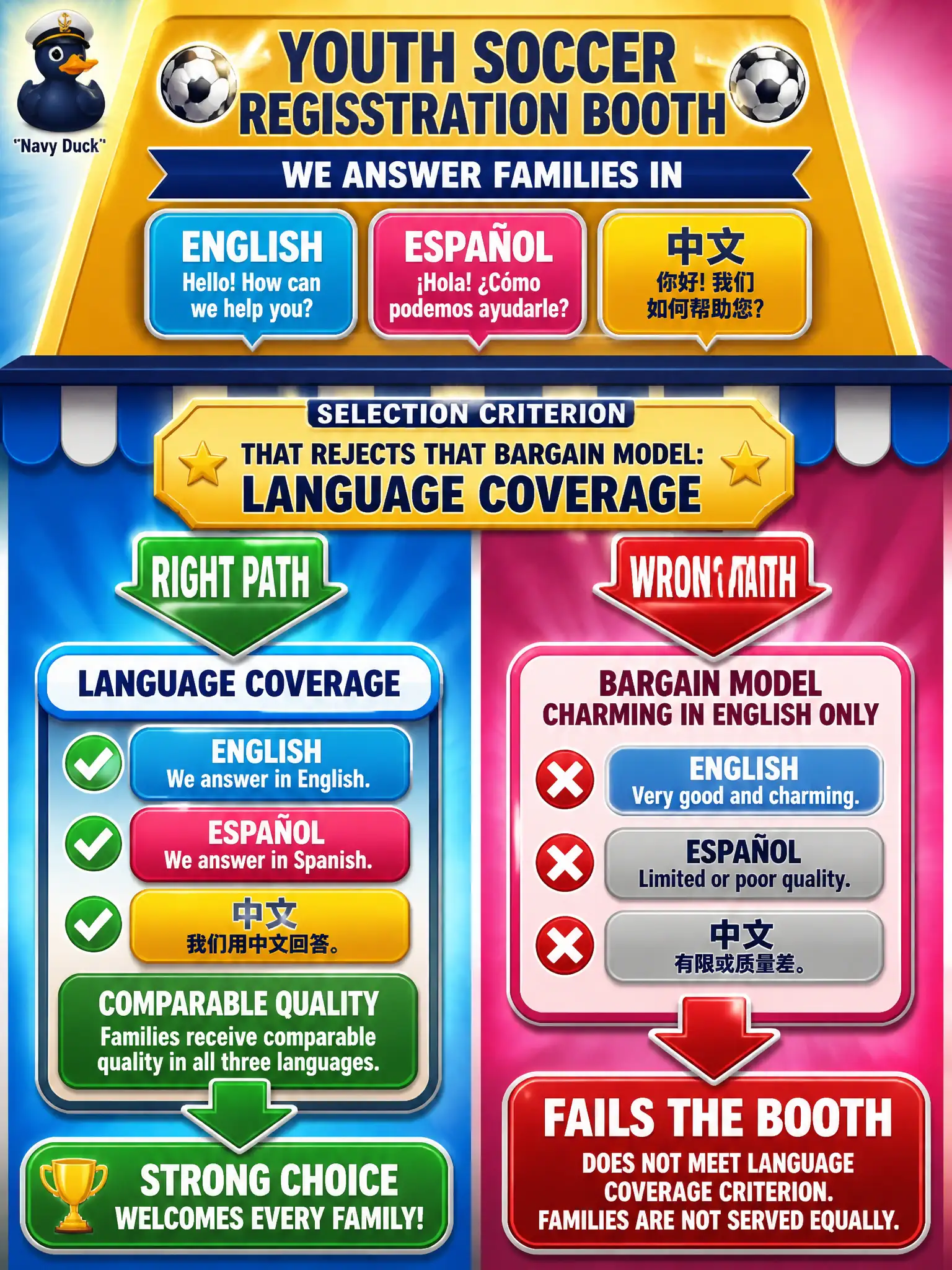
A youth-soccer registration booth must answer families in English, Spanish, and Mandarin with comparable quality. A bargain model is charming in English only. Which selection criterion should reject that bargain model?
Select an answer to reveal the explanation.
Short Explanation
Think of a registration booth that has to sound equally sure in English, Spanish, and Mandarin. A bargain model that only charms in English fails the line. Price and a newer name do not buy missing languages.
Full Explanation
The youth-soccer registration booth must answer families in English, Spanish, and Mandarin with comparable quality, so language coverage is a hard selection criterion. A bargain model that is charming only in English fails the booth even if demos look great in one language, because registration fairness requires comparable service across the languages families actually use. Rejecting that bargain model on language coverage protects the booth’s multi-language objective before price or branding decisions.
Relying on English demo charm fails because a single-language sample does not prove quality in Spanish or Mandarin. Selecting on price only fails because the cheapest model does not automatically cover every language equally; cost and coverage are independent axes. Ignoring language and picking by a newer-sounding model name fails because naming does not create multilingual capability.
Exam caveat: language coverage sits alongside cost, latency, and modality as an application-level filter; practitioner scenarios with multilingual public desks often hinge on this exact rejection. Operational check: run the same registration prompts in English, Spanish, and Mandarin on the candidate model, score quality side by side, and disqualify any model that only performs acceptably in English.