
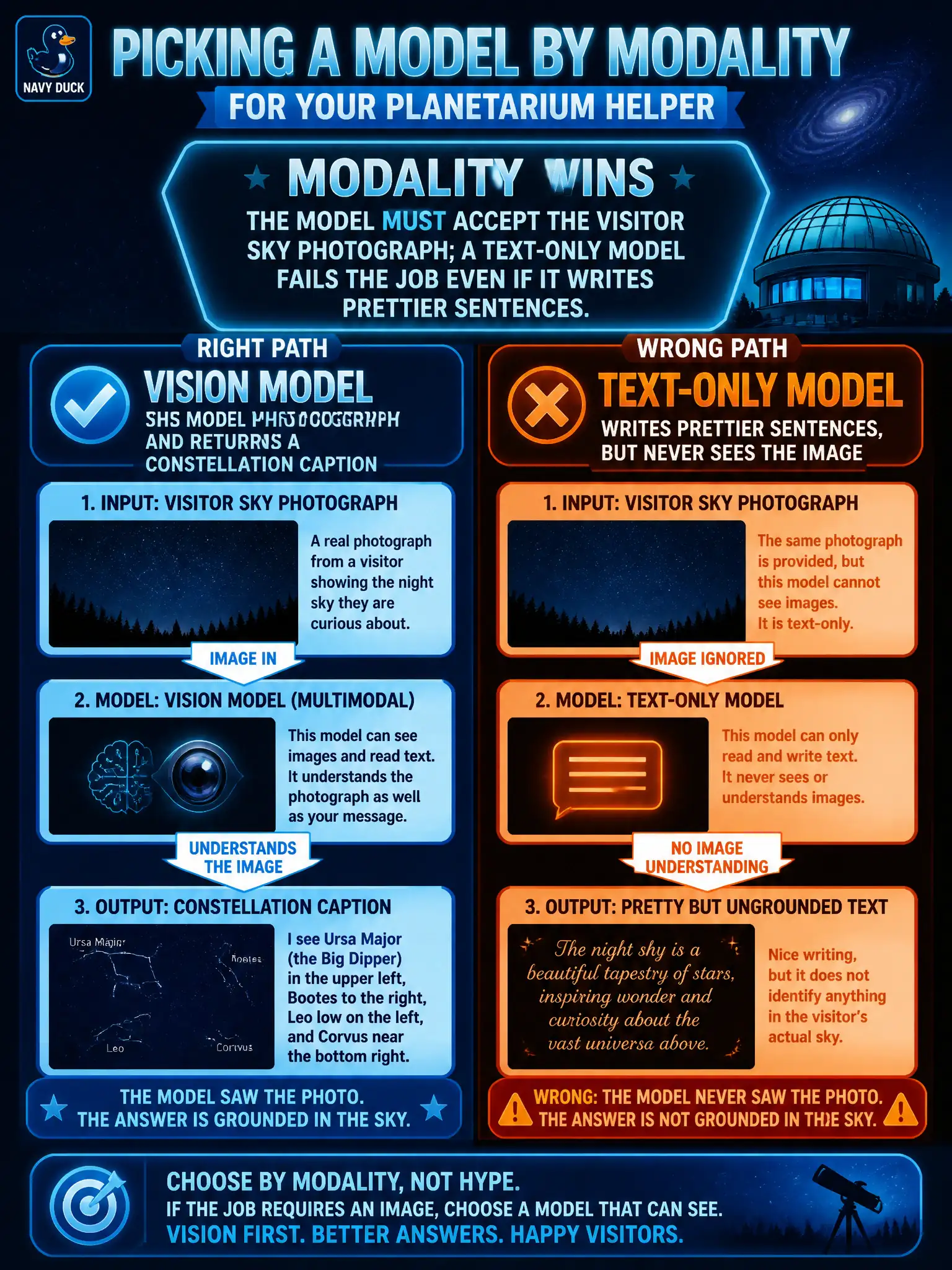
A planetarium helper must accept a visitor's sky photograph and return a constellation caption. A text-only model writes prettier sentences but never sees the image. Which application-level filter should win?
Select an answer to reveal the explanation.
Short Explanation
Think of a visitor holding up a sky photo. The model has to see the picture. Prettier sentences from a text-only model still fail, and a sky photo is not audio.
Full Explanation
The planetarium helper’s real input is a visitor’s sky photograph, and the required output is a constellation caption grounded in that image. Modality is therefore the decisive application-level filter: the selected model must accept the photograph. A text-only model may write prettier sentences, but it never sees the image, so it cannot fulfill the job no matter how polished the prose is.
Picking the text-only model because sentences are prettier fails because linguistic quality does not substitute for vision when the source of truth is a picture. Claiming modality never matters if the caption is well punctuated fails because punctuation cannot invent visual evidence the model was never given. Using a speech-to-text service fails because a sky photo is not audio; that service family addresses the wrong input type entirely.
Exam caveat: modality mismatches are a classic distractor pattern—strong performance in one modality does not transfer to another the application actually requires. Operational check: send a labeled sky photograph through the candidate helper, confirm the model ingests the image bytes (not only a text filename), and reject any path that captions from text alone.