
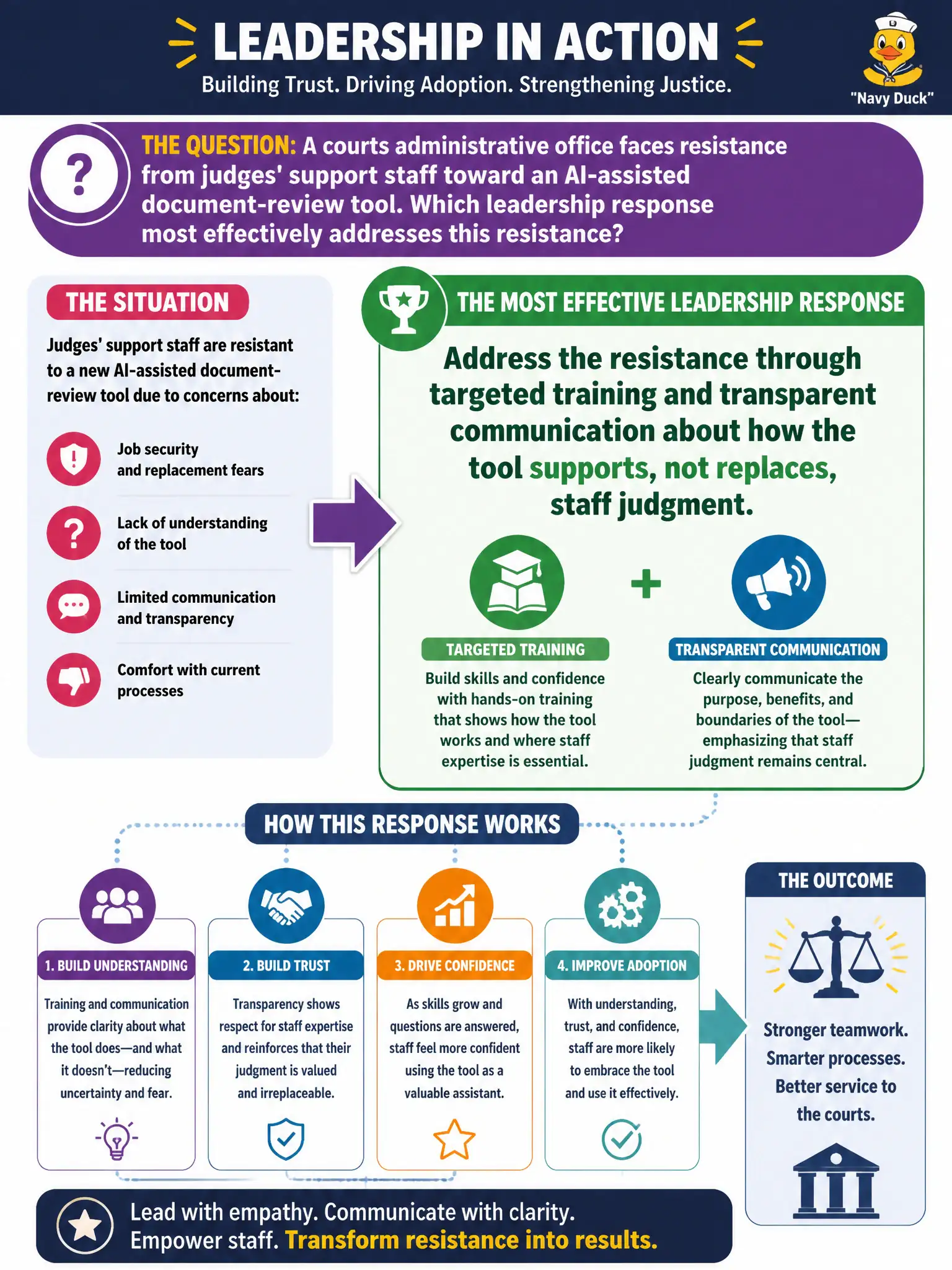
A courts administrative office faces resistance from judges' support staff toward an AI-assisted document-review tool. Which leadership response most effectively addresses this resistance?
Select an answer to reveal the explanation.
Short Explanation
Resistance usually comes from not knowing what's actually changing. Pair real training with an honest explanation of where the tool helps and where staff judgment still rules, and pushback tends to soften into partnership.
Full Explanation
Targeted training paired with transparent communication addresses the root causes of resistance, uncertainty and a perceived threat to professional judgment, by clarifying scope and building capability, which is a core change-management lever for skeptical staff. Waiting passively assumes familiarity alone resolves distrust, but unaddressed concerns often harden into entrenched resistance rather than fading with exposure. Compressing the rollout timeline to limit objections suppresses feedback instead of resolving it, which tends to raise the odds of covert resistance or workarounds later. A single brief email announcement is thin communication for a change that affects daily workflow and professional judgment in a sensitive court environment. Scope caveat: court settings carry added sensitivity around case accuracy, so training should explicitly cover the tool's limitations. Operational check: survey support staff sentiment a few weeks after training to confirm resistance is genuinely declining, not just quieter.