
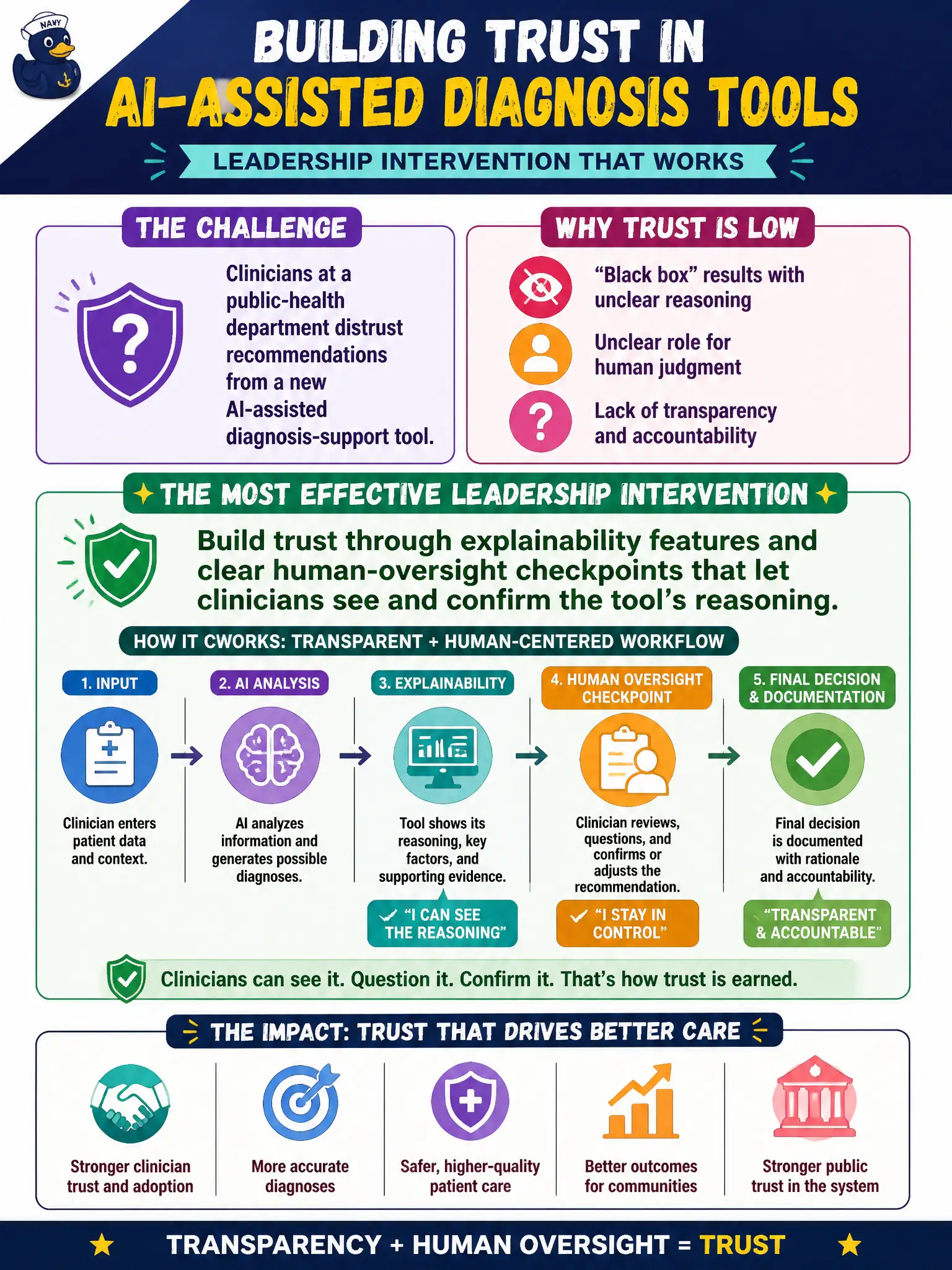
Clinicians at a public-health department distrust recommendations from a new AI-assisted diagnosis-support tool. Which leadership intervention is most likely to build genuine clinician trust?
Select an answer to reveal the explanation.
Short Explanation
Doctors don't trust a black box just because they're told to, they trust something they can question and verify. Show clinicians the reasoning behind a recommendation and keep a human firmly in the loop, and skepticism turns into confidence.
Full Explanation
Explainability paired with human oversight gives clinicians visibility and control, addressing the actual source of distrust rather than just its symptom, which is why it directly supports adoption in a high-stakes clinical setting. A compliance mandate forces behavior without addressing underlying distrust, risking silent workarounds or box-checking rather than genuine reliance on the tool's output. Interface-only training conflates comfort clicking through a screen with confidence in the underlying clinical judgment, which is a different problem entirely. Hiding the reasoning behind the model runs opposite to what builds trust in a clinical context and can undercut the transparency principle responsible AI leadership is meant to uphold. Scope caveat: explainability depth should scale with clinical risk level, higher-stakes recommendations warrant more detailed rationale. Operational check: track how often clinicians question or override flagged recommendations, a sign the oversight mechanism is actually functioning.