
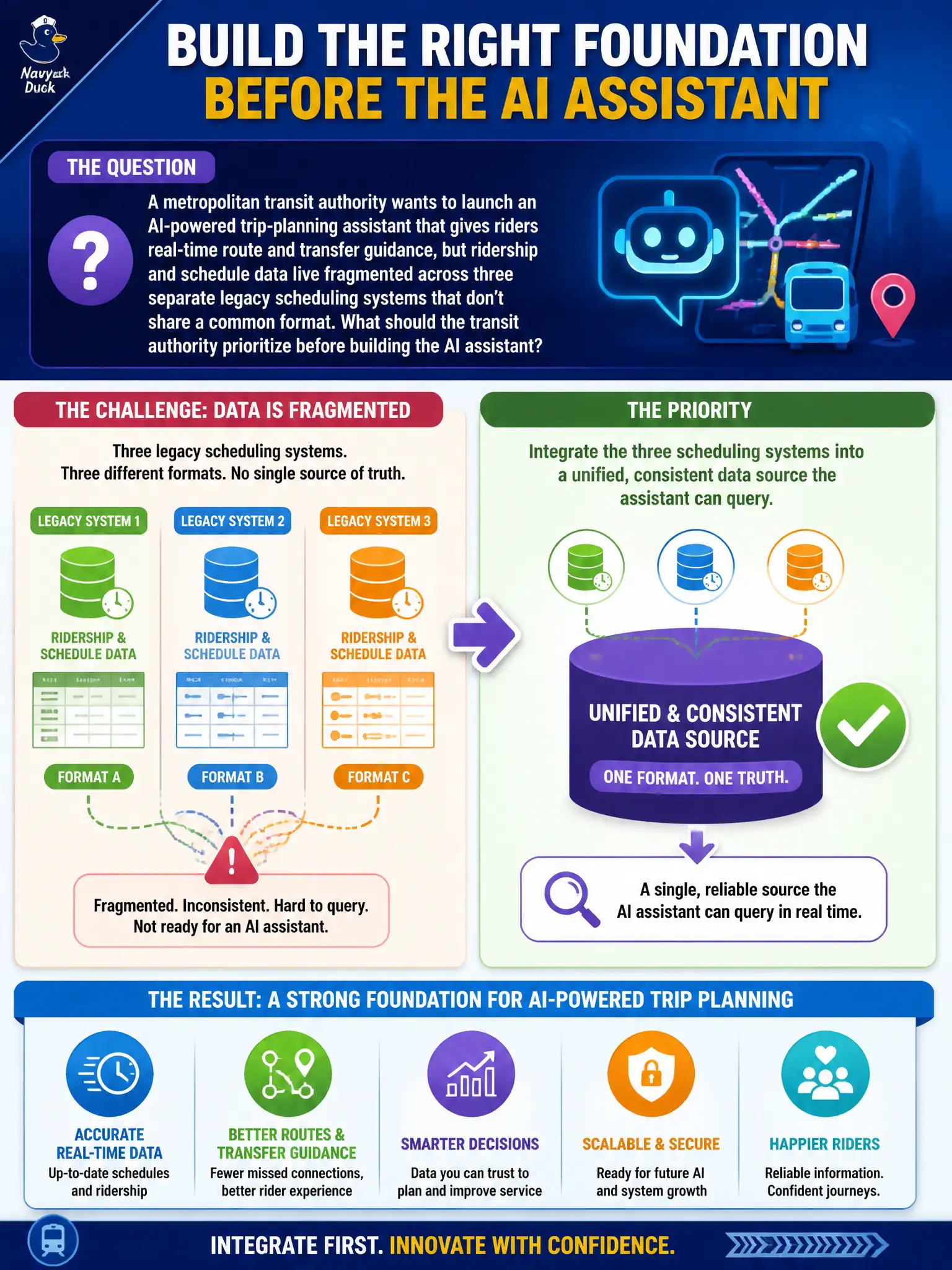
A metropolitan transit authority wants to launch an AI-powered trip-planning assistant that gives riders real-time route and transfer guidance, but ridership and schedule data live fragmented across three separate legacy scheduling systems that don't share a common format. What should the transit authority prioritize before building the AI assistant?
Select an answer to reveal the explanation.
Short Explanation
Think of it like trying to cook one meal from three different recipe books written in three different languages, nothing lines up until someone translates them into a single set of instructions. That's exactly the transit authority's problem: no assistant, however clever, can plan a trip well from fragmented data it can't reliably read. Fixing the data foundation has to come before picking a model or building a feature.
Full Explanation
A trip-planning assistant is only as good as the data feeding it, and three legacy systems using different formats for schedules and ridership create a foundational gap that no amount of AI sophistication can paper over. The right move is a data-integration effort that consolidates these sources into a consistent, queryable format the assistant can trust, because inconsistent inputs produce inconsistent, potentially unsafe routing guidance for riders. Picking a language model vendor addresses a downstream capability, not the upstream problem of unreliable data; even the best model will still generate wrong answers if it's reading contradictory schedule records. Training staff to cover gaps treats a symptom, propping up a tool that isn't ready rather than fixing why it isn't ready. Launching a public beta before the data is trustworthy risks putting inaccurate trip guidance directly in front of riders, which damages public trust in the whole program. In scope, this applies specifically to initiatives where core data is split across incompatible systems; a single well-structured source system wouldn't need this step. As an operational check, an AI strategist should ask, before any pilot, whether one unified query can pull a complete and accurate ridership record across all source systems.