
A state agency is applying for a competitive federal AI-modernization grant, and the application scores applicants on demonstrated innovation maturity relative to peer agencies. The agency has spent two years piloting AI tools for benefits processing and public communications. How should the agency approach the grant narrative?
Select an answer to reveal the explanation.
Short Explanation
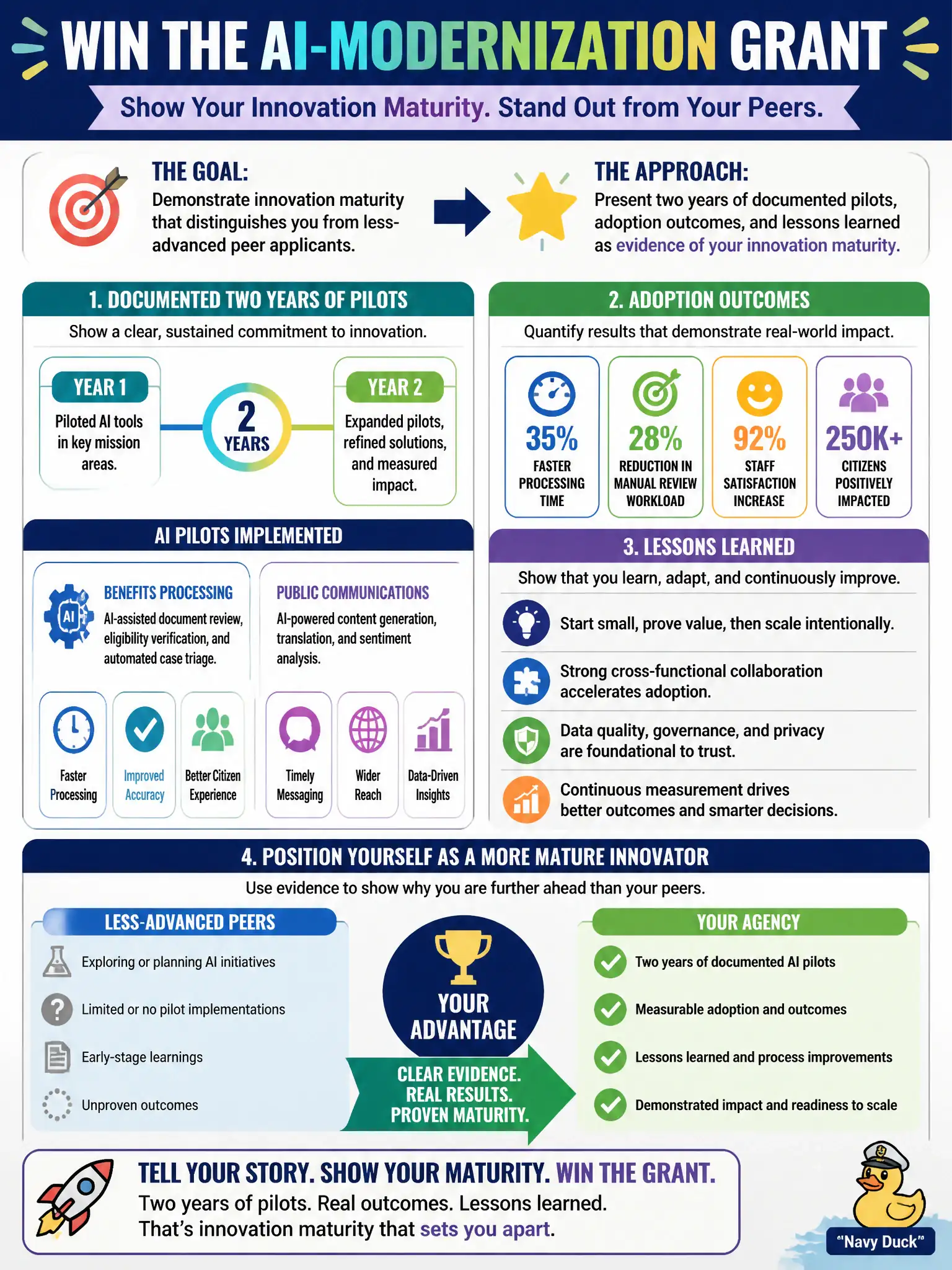
Think of it like a resume for a competitive scholarship: vague promises don't beat a track record. Your agency's two years of documented pilots and outcomes is proof you can execute, which is exactly what maturity scoring rewards over peers who are still starting from zero.
Full Explanation
Competitive grant scoring for innovation maturity is designed to separate applicants who have already demonstrated capability from those proposing to start from scratch. An agency with two years of documented pilots, measured adoption outcomes, and captured lessons learned has concrete evidence of execution capacity, which directly satisfies that scoring criterion and differentiates the application from peer agencies with only conceptual plans. Framing future intent as the main story undersells existing capability and signals the agency is behind rather than ahead. Narrowing the narrative to technical specifications ignores that maturity scoring typically weighs outcomes, governance, and organizational learning alongside technical choices, not technical depth alone. Downplaying prior activity to make the request look more essential risks the opposite effect: reviewers may read it as lack of readiness or an attempt to fund redundant work. A useful caveat is that grant narratives should still tie past outcomes to how additional funding scales or extends impact, not just restate history. Before submitting, the agency should verify that its outcome data (adoption rates, cost or time savings, citizen impact metrics) is quantified and citable rather than anecdotal.