
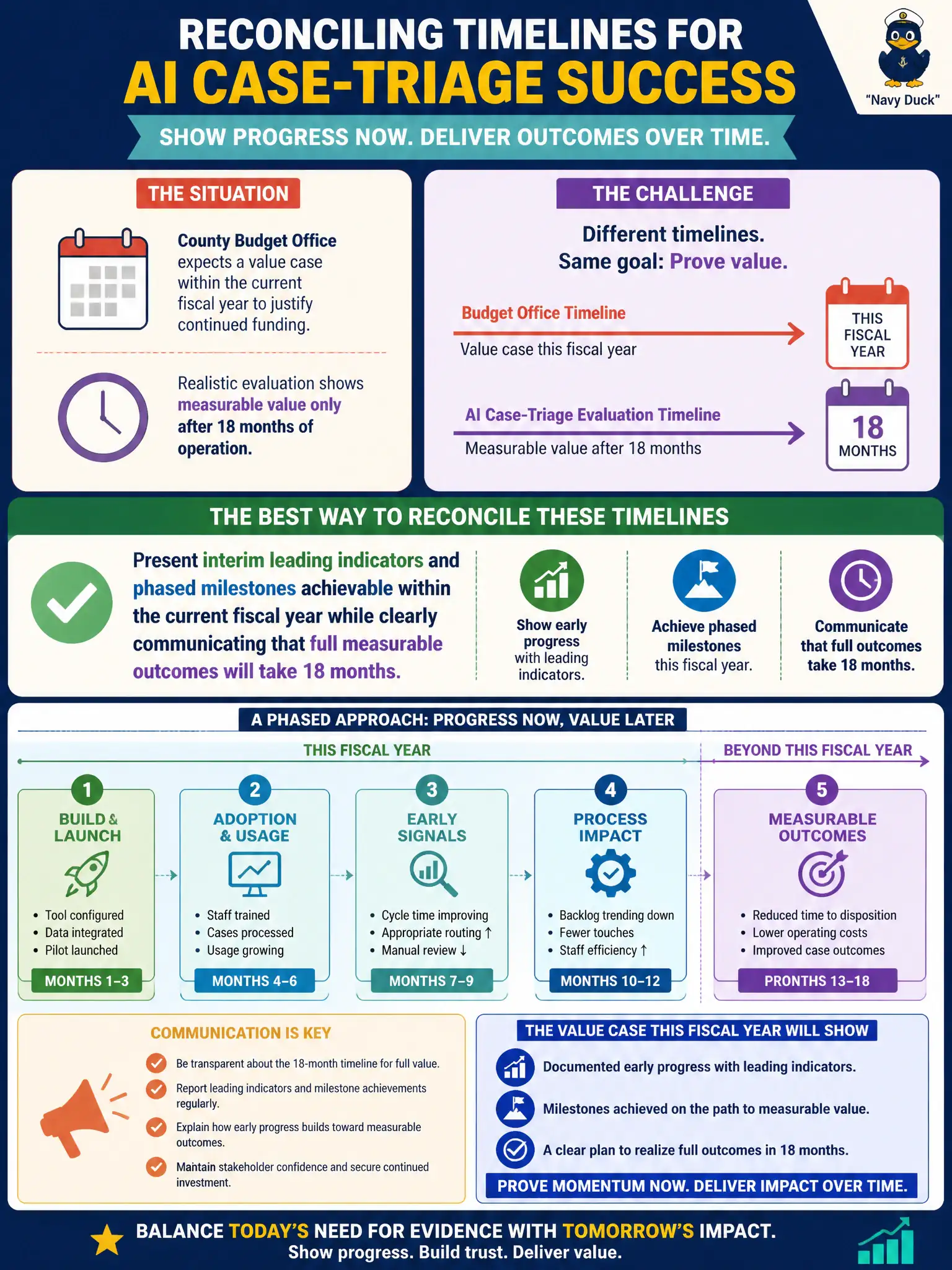
A county courts office is piloting an AI case-triage tool, but a realistic evaluation shows measurable value only after 18 months of operation. The county budget office expects a value case to be presented within the current fiscal year to justify continued funding. What is the best way to reconcile these two timelines?
Select an answer to reveal the explanation.
Short Explanation
Think of it like a home renovation: the contractor can't show you the finished kitchen in week one, but they can show you the demolition's done and the plumbing's roughed in on schedule. You give the budget office leading indicators now, and set expectations for when the full outcome lands.
Full Explanation
A pilot's true value often only shows up once a system has processed enough cases to move a real outcome metric, but budget cycles rarely wait that long. The practical response is to build a bridge: identify interim, leading indicators — cases triaged, staff time saved per batch, early accuracy trends — that can be measured within the fiscal year and that plausibly predict the eventual outcome, while being transparent that the full, measurable value case needs the full 18 months. Shrinking the evaluation window to fit the funding cycle produces misleading or premature conclusions, since the tool hasn't had time to demonstrate its actual effect. Reporting only costs and deferring all benefit discussion leaves budget officials with an incomplete, one-sided picture that makes renewal harder to justify. Asking the funder to change its own cycle ignores the constraint rather than working within it, and is rarely something a budget office will do for one pilot. The caveat: leading indicators must be genuinely predictive of the end outcome, not just easy to report. Before finalizing the summary, check whether each interim metric has a documented or reasoned link to the 18-month outcome it's meant to forecast.