
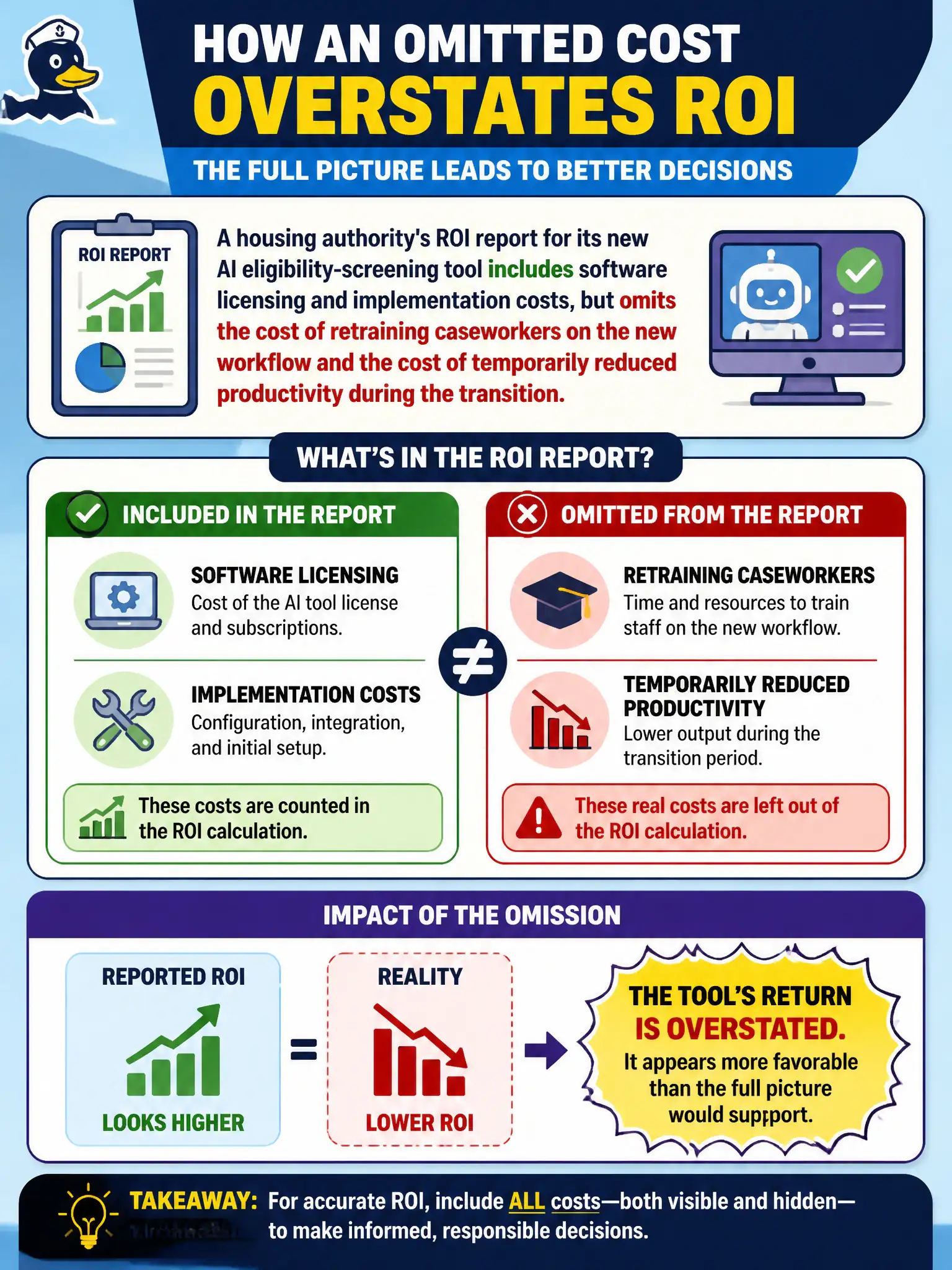
A housing authority's ROI report for its new AI eligibility-screening tool includes software licensing and implementation costs, but omits the cost of retraining caseworkers on the new workflow and the cost of temporarily reduced productivity during the transition. How does this omission affect the ROI report?
Select an answer to reveal the explanation.
Short Explanation
Think about pricing a home renovation by the materials alone, leaving out the cost of living in a hotel while the kitchen's torn apart — the number looks great until you remember you still had to pay for that. Leaving retraining and transition productivity dips out of the ROI report does the same thing: it hides real costs the housing authority actually incurred. That gap makes the tool look like a better deal than it really was.
Full Explanation
ROI overstatement occurs when real costs of adopting an initiative are left out of the calculation, making the return look more favorable than the complete picture supports: retraining caseworkers and the temporary productivity dip during transition are both direct consequences of adopting this specific tool, not background costs unrelated to it, so omitting them inflates the apparent return relative to what the housing authority actually spent. Claiming these costs are absorbed within existing salaries and need no separate accounting ignores that the time caseworkers spend retraining, and the slower throughput while they adapt, represents real displaced capacity that has a cost even if no new line-item invoice was issued. Claiming the omission makes the report more accurate by isolating technology value from organizational factors mischaracterizes change-management costs as unrelated noise, when they're a direct and predictable cost of this specific adoption. Claiming the omission understates the return by treating retraining and productivity costs as sunk costs misapplies that concept — sunk costs are costs already spent regardless of the decision, while retraining and transition costs are costs caused by choosing to adopt the tool, which is precisely what a forward-looking ROI calculation should include. Caveat: some transition costs are one-time and should be clearly separated from ongoing operating costs in the report, not blended together. Operational check: confirm the ROI report includes a distinct change-management cost line covering both retraining hours and estimated productivity impact during rollout.