
A public-health agency's AI tool flags high-risk patients for proactive outreach, reducing avoidable emergency-room visits. The agency wants to build an ROI case for the tool but has no direct revenue to point to, since the agency doesn't bill for outreach calls. Which framework best captures the tool's financial value in this case?
Select an answer to reveal the explanation.
Short Explanation
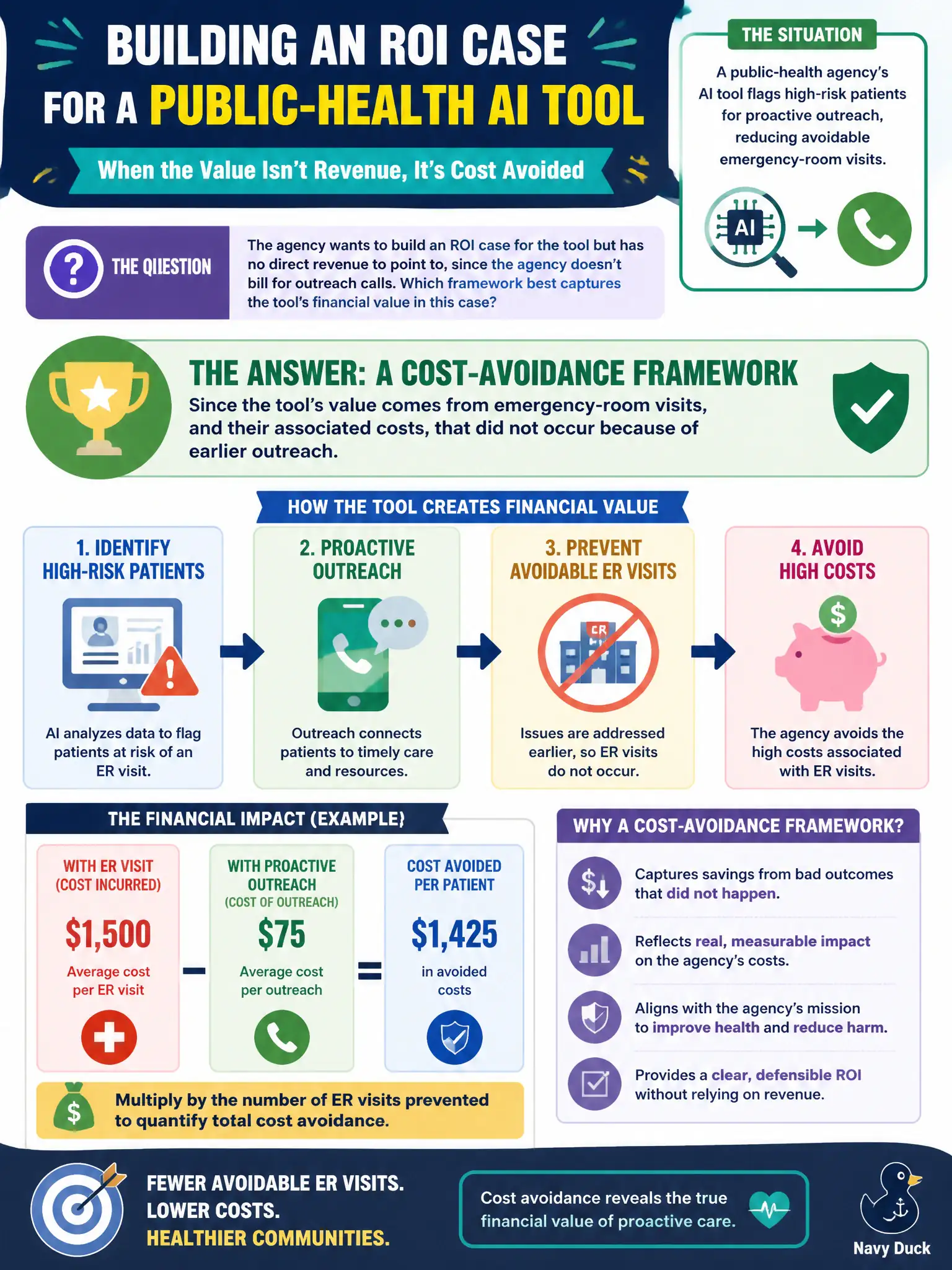
Think about a smoke detector: its value isn't measured by profit it generates, it's measured by the fire damage that never happened because it went off in time. A public-health agency that doesn't bill for outreach calls has the same kind of value story — the ROI case comes from emergency-room visits and costs that were avoided, not revenue that was earned. Cost avoidance is a completely legitimate way to show a dollar-based return.
Full Explanation
A cost-avoidance framework quantifies value by estimating costs that would have been incurred without the intervention — here, the emergency-room visits and their associated treatment costs that proactive outreach prevented — which produces a defensible dollar figure even when the agency generates no direct revenue from the AI tool itself. This approach fits public-sector and mission-driven contexts where value shows up as reduced downstream costs rather than new income. A revenue-growth framework assumes the AI tool's value must appear as a new income stream, but a public-health agency's outreach program was never designed to bill for that service, making revenue growth the wrong lens entirely. A market-share framework substitutes competitive positioning against other agencies for financial value, but comparing adoption levels doesn't quantify what the tool is actually worth in dollars to this agency's budget. A headcount-reduction framework assumes value must come from eliminating staff costs, but the scenario describes avoided emergency-room visits, not staffing changes, so this framework would require justifying a reduction there's no evidence for. Caveat: cost-avoidance figures rely on an estimate of what would have happened without the tool, which is inherently less certain than a directly observed revenue number, so the estimate's methodology should be documented. Operational check: confirm the cost-per-avoided-visit estimate is sourced from the agency's own historical emergency-room cost data before presenting the ROI case.