
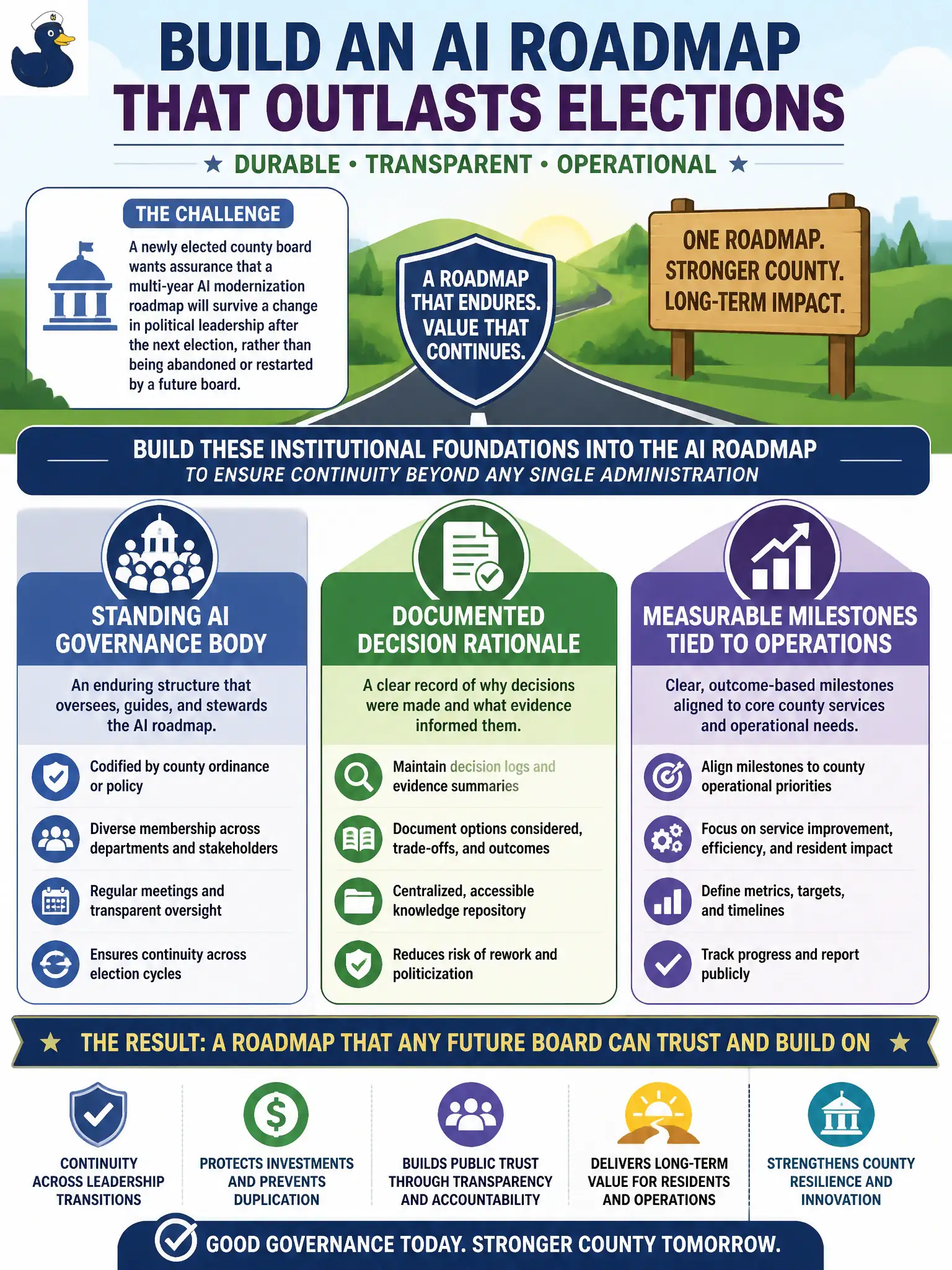
A newly elected county board wants assurance that a multi-year AI modernization roadmap will survive a change in political leadership after the next election, rather than being abandoned or restarted by a future board. What should the AI strategy team build into the roadmap to address this concern?
Select an answer to reveal the explanation.
Short Explanation
Think about a relay race: the baton has to be built to pass cleanly from one runner to the next, not designed around whoever happens to be holding it right now. Political continuity risk gets managed by building institutions — a standing governance body, documented reasoning, milestones tied to operations — not by hoping the next set of runners keeps the same pace. That's what lets a roadmap survive an election the strategy team can't control.
Full Explanation
Political-continuity risk in long-horizon public-sector planning is managed through institutional design, not personal commitment: a standing AI governance body with defined membership, documented rationale for why each initiative was chosen, and milestones framed around county operations all persist independently of who sits on the board, giving a future administration reasons to continue the roadmap on its own merits. Relying on current board members' personal commitment ties the roadmap's survival to specific individuals who may not be re-elected, which is precisely the risk the board is trying to avoid, not a solution to it. Compressing the roadmap to fit the current term avoids the political-risk question rather than answering it, sacrificing genuinely multi-year initiatives that can't be meaningfully delivered on a shortened timeline. Attempting to bind all future boards by county code to a fixed funding level is usually not durable, since future legislative bodies generally retain budget authority, so a rigid mandate tends to be unenforceable or gets revised anyway. Caveat: institutional continuity reduces risk but doesn't eliminate it — a future board can still deprioritize a roadmap it didn't originate. Operational check: confirm the governance body's charter and milestone documentation exist independently of any current board member's name.