
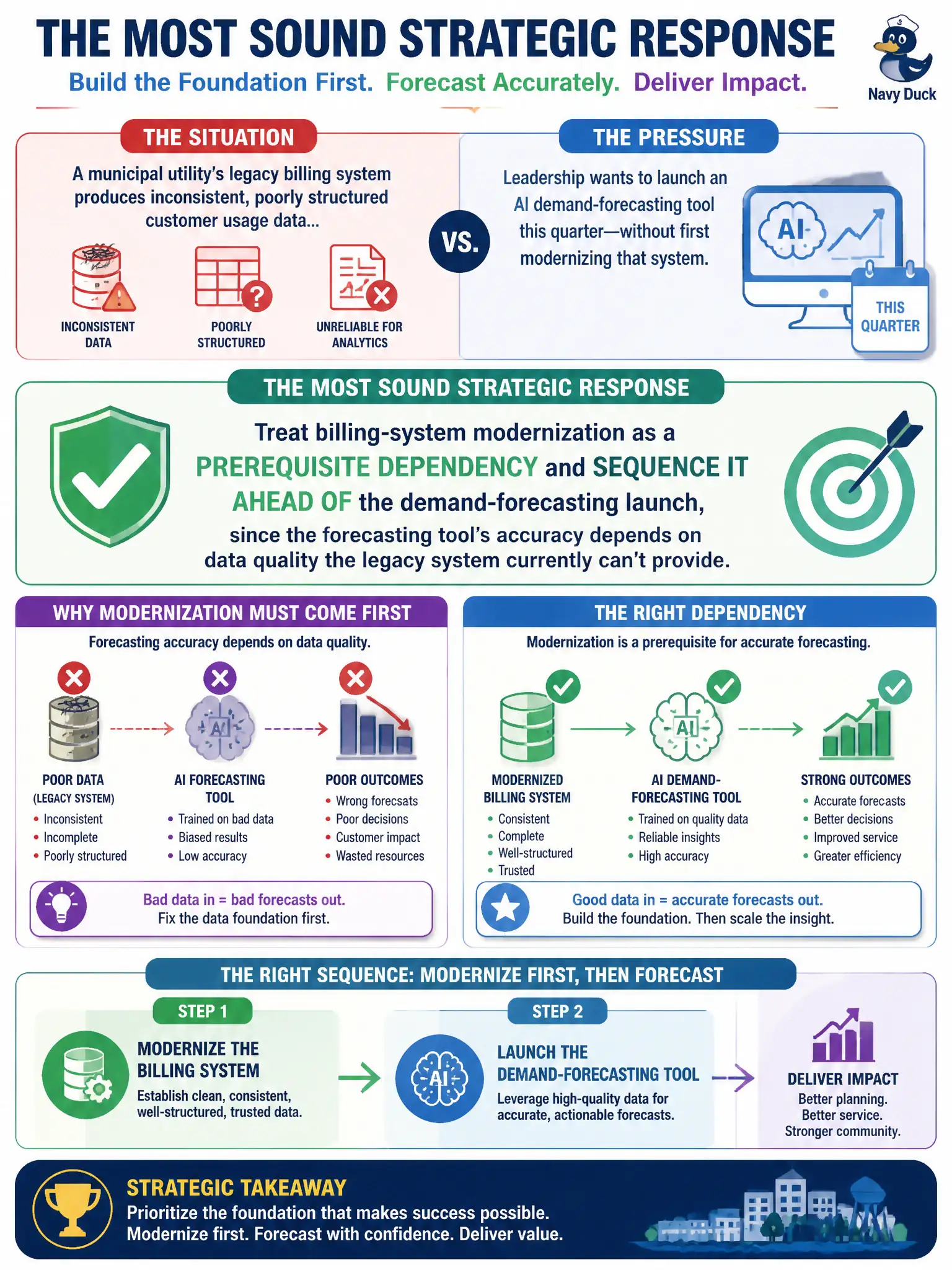
A municipal utility's legacy billing system produces inconsistent, poorly structured customer usage data, but leadership wants to launch an AI demand-forecasting tool this quarter without first modernizing that system. What is the most sound strategic response?
Select an answer to reveal the explanation.
Short Explanation
Think about trying to bake with a scale that reads different numbers every time you use it — no recipe survives bad measurements, no matter how good the recipe is. A demand-forecasting model is only as reliable as the usage data feeding it, so cleaning up that data has to come first, not run as an afterthought. Sequencing modernization ahead of the AI launch isn't a delay tactic — it's what makes the launch worth doing.
Full Explanation
Data readiness is a foundational prerequisite for AI initiatives, and a forecasting model trained on inconsistent, poorly structured billing data will produce unreliable predictions regardless of how sophisticated the model itself is. Sequencing modernization ahead of the demand-forecasting launch addresses the actual bottleneck rather than working around it, and it protects the credibility of whatever the tool eventually produces. Expecting the model to clean and structure the data automatically during training conflates preprocessing with training — a model can tolerate some noise, but it doesn't fix systemic structural inconsistency, it learns from whatever pattern that data contains. Running both projects in parallel on a shared team assumes no real dependency exists, but a forecasting tool built against a schema that's still changing underneath it will need significant rework once modernization lands. Pausing the forecasting initiative until every legacy system utility-wide is modernized overcorrects — only the systems the forecasting tool actually depends on need to come first. Caveat: 'modernize first' doesn't require a multi-year rebuild — a scoped data-cleanup layer can sometimes unblock the dependency faster. Operational check: run a data-quality audit against the forecasting tool's required inputs before setting a go-live date.