
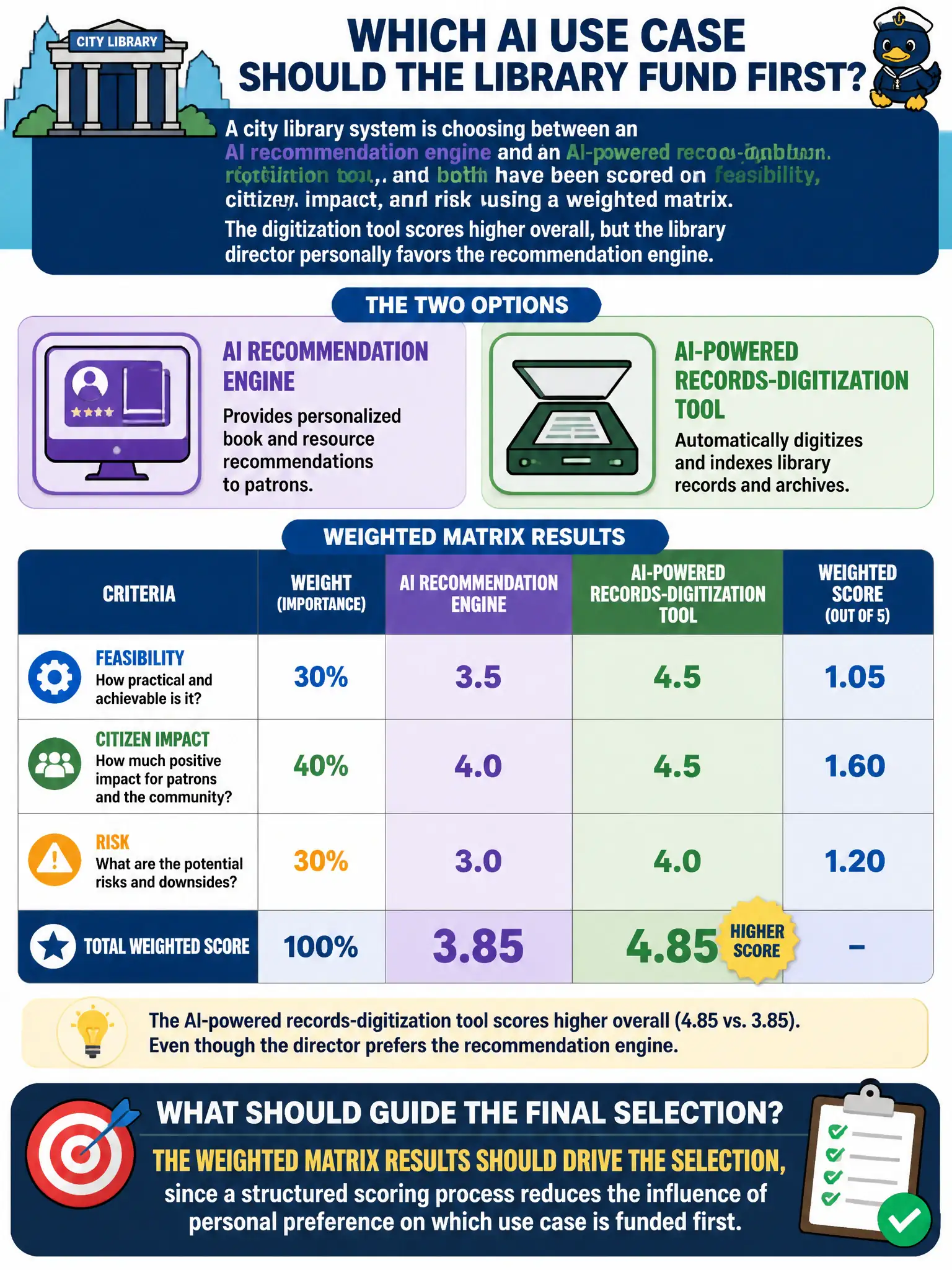
A city library system is choosing between an AI recommendation engine for patrons and an AI-powered records-digitization tool, and both have been scored on feasibility, citizen impact, and risk using a weighted matrix. The digitization tool scores higher overall, but the library director personally favors the recommendation engine. What should guide the final selection?
Select an answer to reveal the explanation.
Short Explanation
Think about picking a restaurant by rolling dice versus checking reviews, price, and how far the drive is — one process actually weighs what matters, the other just feels decisive. A prioritization matrix exists precisely so gut instinct doesn't quietly override the criteria the organization already agreed mattered. When the digitization tool scores higher, that's the signal to follow, not a nudge to overrule.
Full Explanation
A weighted prioritization matrix exists to make selection criteria explicit and consistent, so the outcome reflects feasibility, impact, and risk rather than whoever has the most influence in the room. When the digitization tool scores higher under criteria the organization already agreed to weight, honoring that result is what makes the matrix worth running — reversing it for personal preference defeats its purpose and signals that scoring is optional. Letting the director's preference override the matrix treats leadership judgment as inherently superior to a structured process, but that judgment is exactly what the matrix was built to check against bias, not to be checked by. Funding both initiatives at reduced scope to avoid choosing sounds diplomatic, but it dilutes resources on two half-funded efforts instead of properly resourcing the one the criteria favored. Rerunning the matrix using only citizen impact discards the feasibility and risk inputs simply because they produced an inconvenient result. Caveat: a matrix result should still be sanity-checked for data errors before it's finalized — it's a decision aid, not an oracle. Operational check: have someone outside the scoring team independently verify the inputs and weights.