
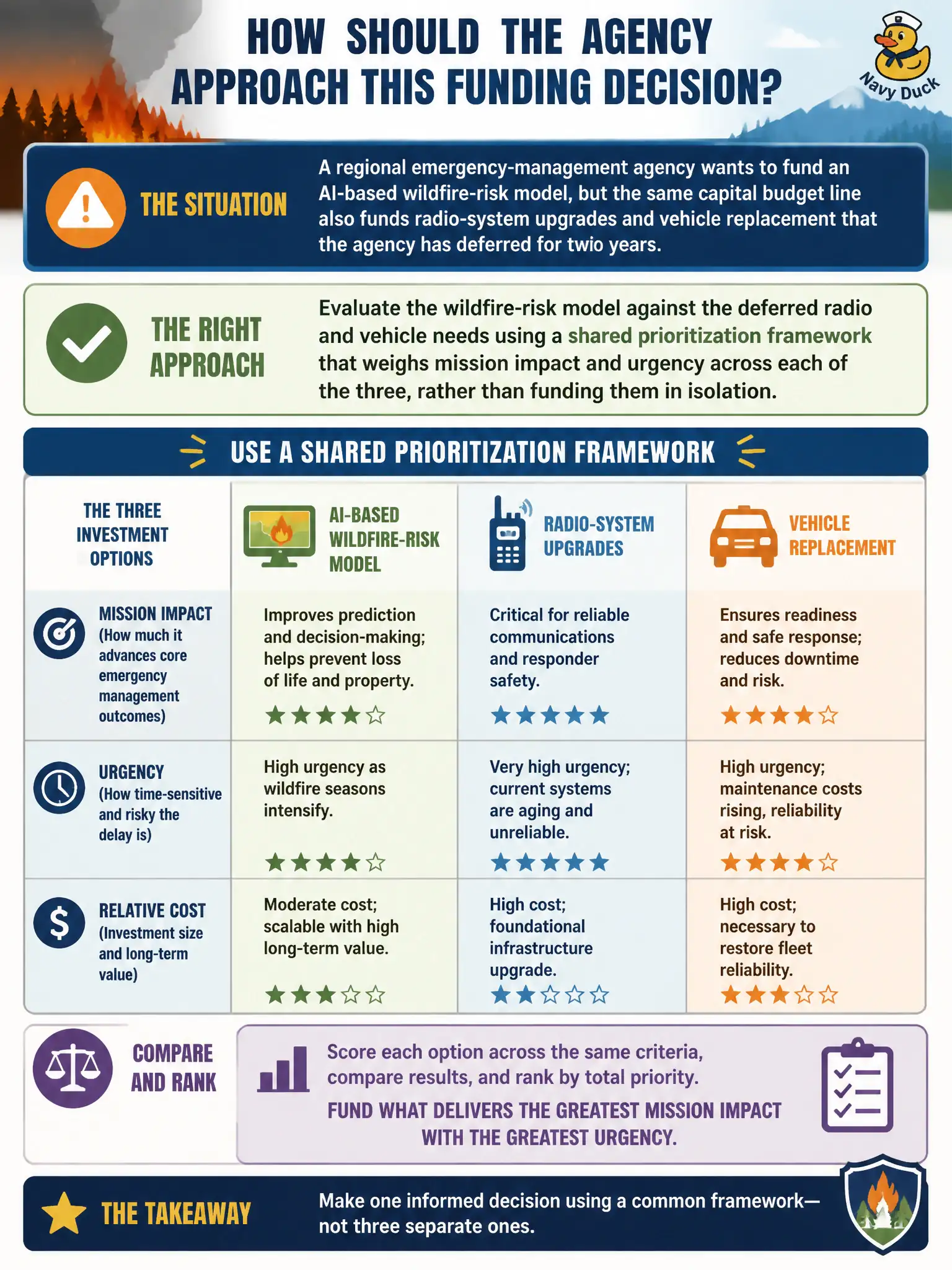
A regional emergency-management agency wants to fund an AI-based wildfire-risk model, but the same capital budget line also funds radio-system upgrades and vehicle replacement that the agency has deferred for two years. How should the agency approach this funding decision?
Select an answer to reveal the explanation.
Short Explanation
Think of a household budget where the roof needs fixing, the car needs new tires, and someone wants a smart thermostat — you don't pick by which one's shiniest, you weigh what actually keeps things running against what's genuinely urgent. Portfolio-level budgeting means putting the wildfire model, the radios, and the vehicles on the same scale using the same criteria. Whichever wins should win because it scored higher, not because it's newer or louder.
Full Explanation
Portfolio-level capital allocation requires comparing competing investments against a common set of criteria — mission impact, urgency, and risk — rather than deciding each item's funding in isolation or by which is trendiest. Since the wildfire model, radio upgrades, and vehicle replacement all draw from the same limited line, the agency needs one prioritization pass that scores all three consistently so the board can defend whichever combination it funds. Prioritizing the AI model for its media appeal substitutes visibility for mission impact, exactly what a disciplined portfolio process is meant to prevent. Treating infrastructure spending as a fixed prerequisite category assumes legacy needs are automatically more urgent than a new capability, when a two-year-deferred upgrade and an unfunded wildfire model could carry very different risk levels. Asking the vendor to arbitrate which project gets cut hands a budget decision to a party with a direct financial interest, undermining the objectivity the process needs. Caveat: urgency doesn't always track dollar cost — a smaller line item can outrank a larger one if it closes a bigger risk gap. Operational check: build a single scoring sheet covering all three requests before the budget cycle closes.