
A housing authority wants to launch an AI-assisted eligibility screening tool for rental assistance applications, but the agency's funding is appropriated one fiscal year at a time and no commitment yet exists for years two and three. What should the housing authority's AI strategy address before launch?
Select an answer to reveal the explanation.
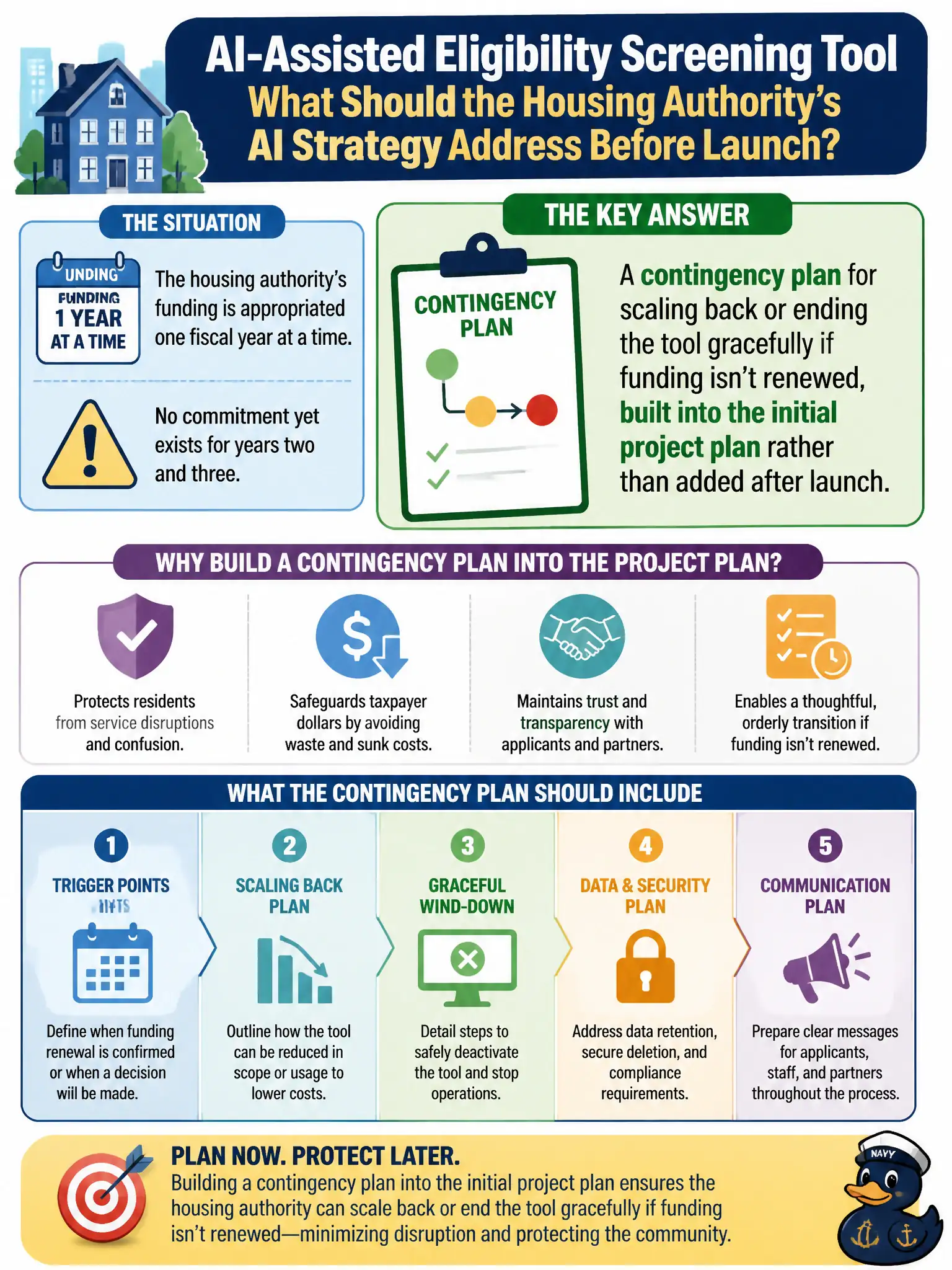
Short Explanation
Picture building a bridge one budget year at a time without knowing if next year's funding shows up — you don't build it so it collapses if construction stops halfway. A funding-cycle risk plan means designing the eligibility tool so it can wind down cleanly, not just planning how it launches. That's the difference between a strategy and a hope.
Full Explanation
Sound AI strategy in a public-sector setting treats appropriation risk as a planning input, not an afterthought — a tool depending on multi-year funding that hasn't been granted yet needs a built-in plan for what happens if year two's budget doesn't materialize, covering data retention, applicant communication, and a fallback manual process. Building that contingency into the initial project plan protects both residents mid-application and the agency's credibility if funding lapses. Assuming grants will typically backfill a funding gap treats an unconfirmed possibility as a plan, leaving the agency exposed if the grant doesn't arrive in time. Treating an informal budget-office signal as a commitment confuses a positive conversation with an appropriated line item — boards can and do change direction between fiscal years. Locking into a multi-year fixed-price vendor contract that assumes automatic renewal shifts the mismatch onto the agency, which may owe payment for years its own appropriation doesn't cover. Caveat: single-year appropriation is common in local government and isn't a reason to avoid AI — it's a reason to design for it. Operational check: confirm the 'funding not renewed' data-handling and notification plan is documented before go-live.