
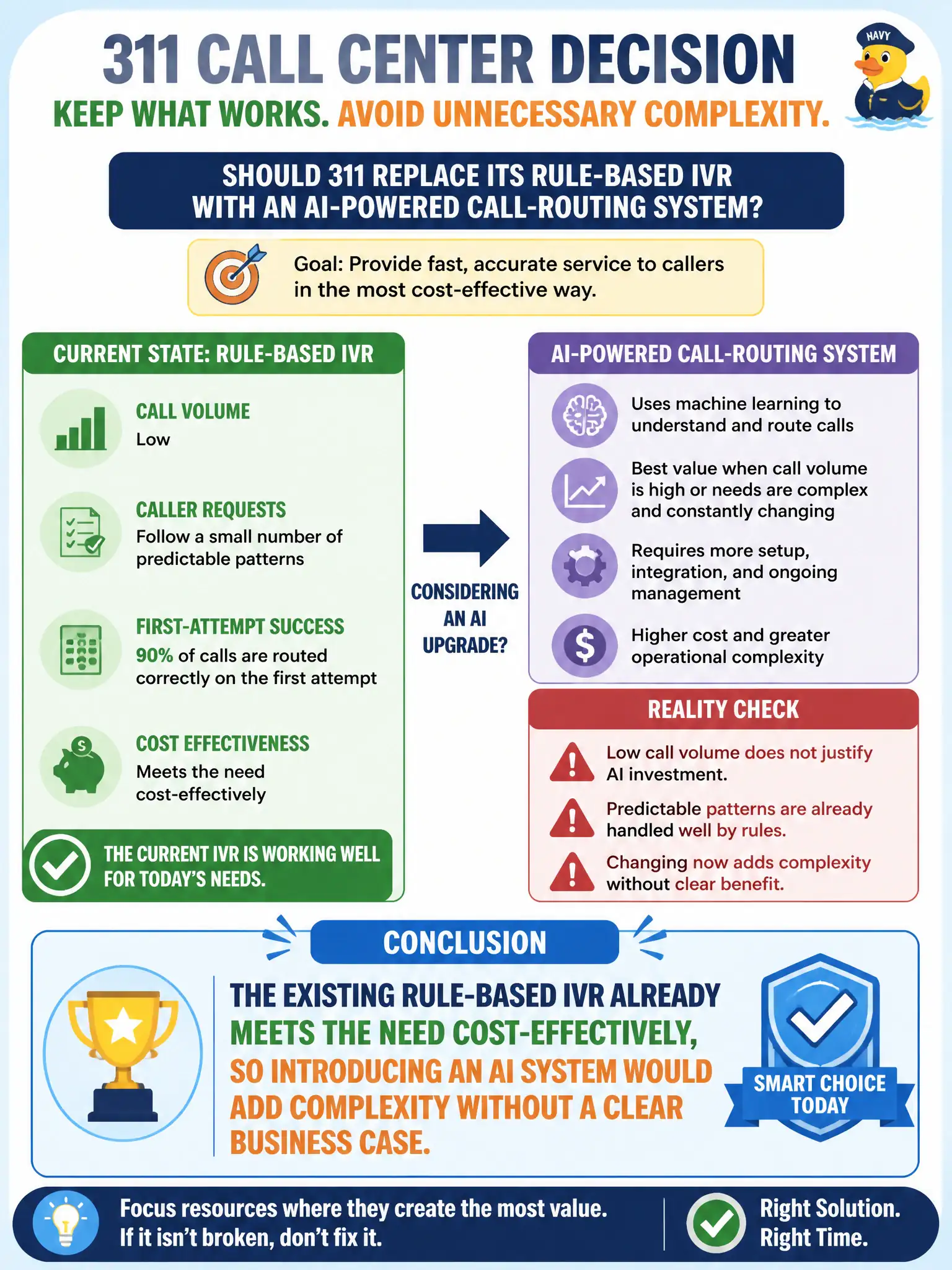
A 311 call center is evaluating whether to replace its rule-based interactive voice response (IVR) tree with an AI-powered call-routing system. Call volume is low, caller requests follow a small number of predictable patterns, and the current IVR already routes 90% of calls correctly on the first attempt. What should the 311 program's leadership conclude?
Select an answer to reveal the explanation.
Short Explanation
Think about swapping a reliable pickup truck for a sports car just to drive to the mailbox: more horsepower doesn't help when the trip is short and the road's already smooth. When call patterns are simple and volume is low, a well-tuned rule-based system can already do the job as well as AI would, at a fraction of the cost and risk. Good AI strategy starts by asking whether AI actually solves a problem that exists, not by assuming newer tech is automatically better.
Full Explanation
AI solution selection begins with matching the tool to the problem, not defaulting to the newest capability available. A 90% first-call resolution rate from a simple rule tree, handling low and predictable volume, is already strong performance — the marginal gain an AI router could offer is small, while training, monitoring, and maintaining a model adds ongoing overhead the current system doesn't require. Recognizing when NOT to use AI is as much a strategic skill as recognizing when to use it. The claim that natural-language systems are inherently more accurate confuses general capability with fit for this narrow use case — accuracy on paper doesn't matter if the simpler tool already clears the bar. Framing adoption as 'future-proofing' skips the actual question of whether a documented business need exists today. Running a parallel pilot sounds cautious, but it still commits budget and governance attention to a problem that isn't demonstrably unsolved. Caveat: this conclusion can flip if call volume grows or patterns diversify, so the metric should be reviewed periodically. Operational check: track the IVR's misroute rate and complaint volume quarterly, and only reopen the AI question if either trend worsens.