
A county CIO needs a document-classification capability to route incoming resident correspondence to the right department. Document classification is a mature, widely available capability across many established vendors, and the county has very limited in-house ML staff. The CIO also wants to avoid being locked into a single vendor's proprietary format for the long term. Which approach best balances these considerations?
Select an answer to reveal the explanation.
Short Explanation
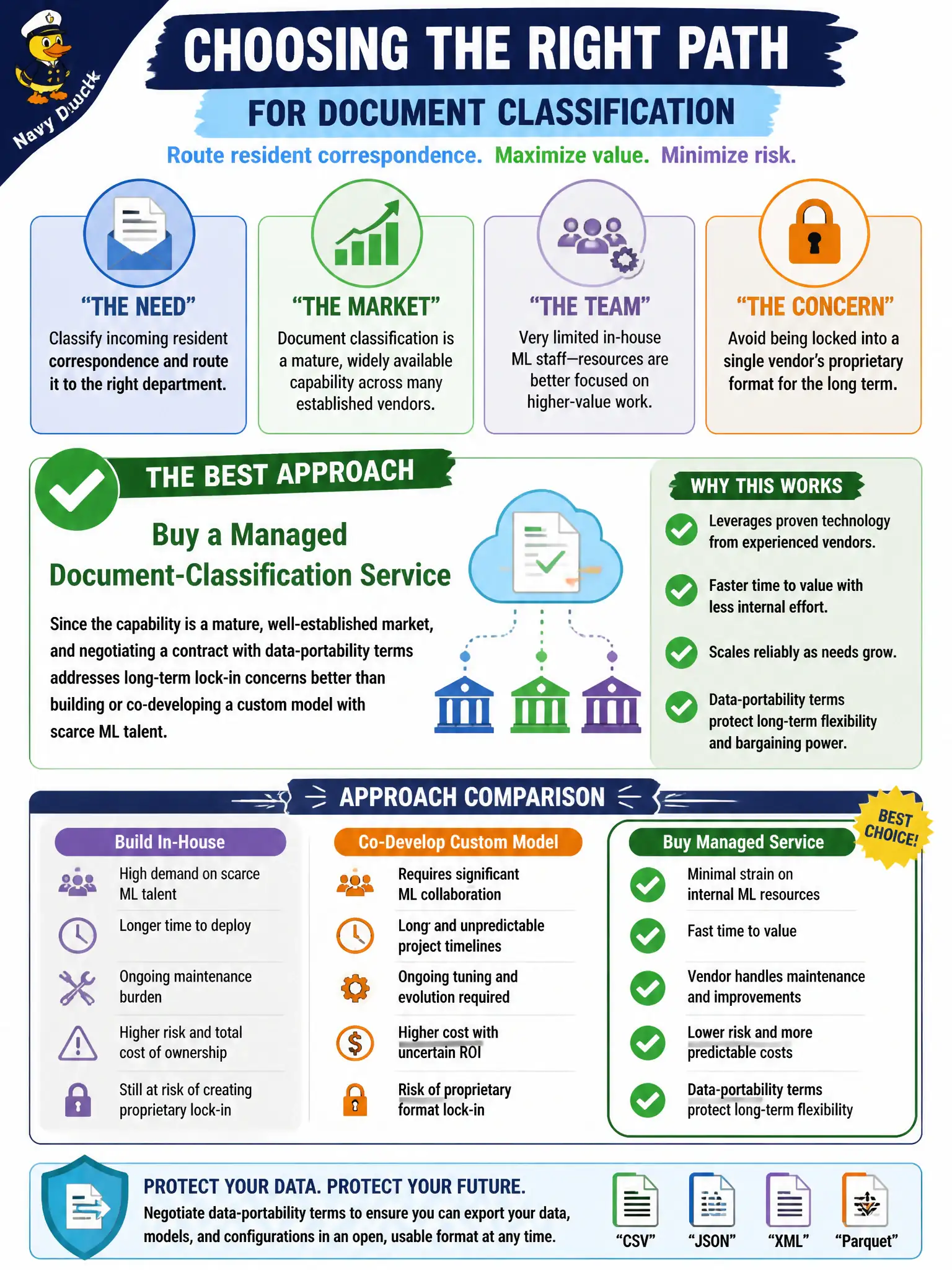
When a capability is already a commodity, like sorting mail into the right department, you don't build a factory to make your own envelopes. Buying a mature managed service and negotiating good portability terms up front gets the county the capability now and keeps the exit door open later, without burning scarce ML staff on a problem that's already been solved.
Full Explanation
Build-buy-partner decisions should weigh how mature and commoditized a capability already is against the organization's own staffing capacity, and document classification is a well-established, widely solved problem with many mature vendor offerings, which makes buying the more efficient path when in-house ML talent is scarce. The real safeguard against long-term lock-in is not avoiding vendors altogether but negotiating contract terms, such as data export rights and portable output formats, that keep switching costs manageable down the road. Partnering with a university lab trades a mature, solved problem for a research-oriented development timeline, which fits genuinely novel capabilities better than a commodity function the county could buy off the shelf today. Building in-house underestimates the ongoing burden of a capability that still needs monitoring, retraining, and maintenance, work that competes directly with the county's limited ML staff for time regardless of how conceptually simple the initial task seems. Buying without addressing portability solves today's need but recreates the lock-in risk the CIO is trying to avoid, since an agreement silent on data export can leave the county stuck with a costly, disruptive migration later. A scope caveat: if the county's correspondence-routing rules are highly unusual or legally sensitive, that could tip the balance toward more customization than a generic managed service offers. A concrete check is having procurement confirm the vendor contract explicitly grants the county the right to export its classification data and mappings in a standard format.