
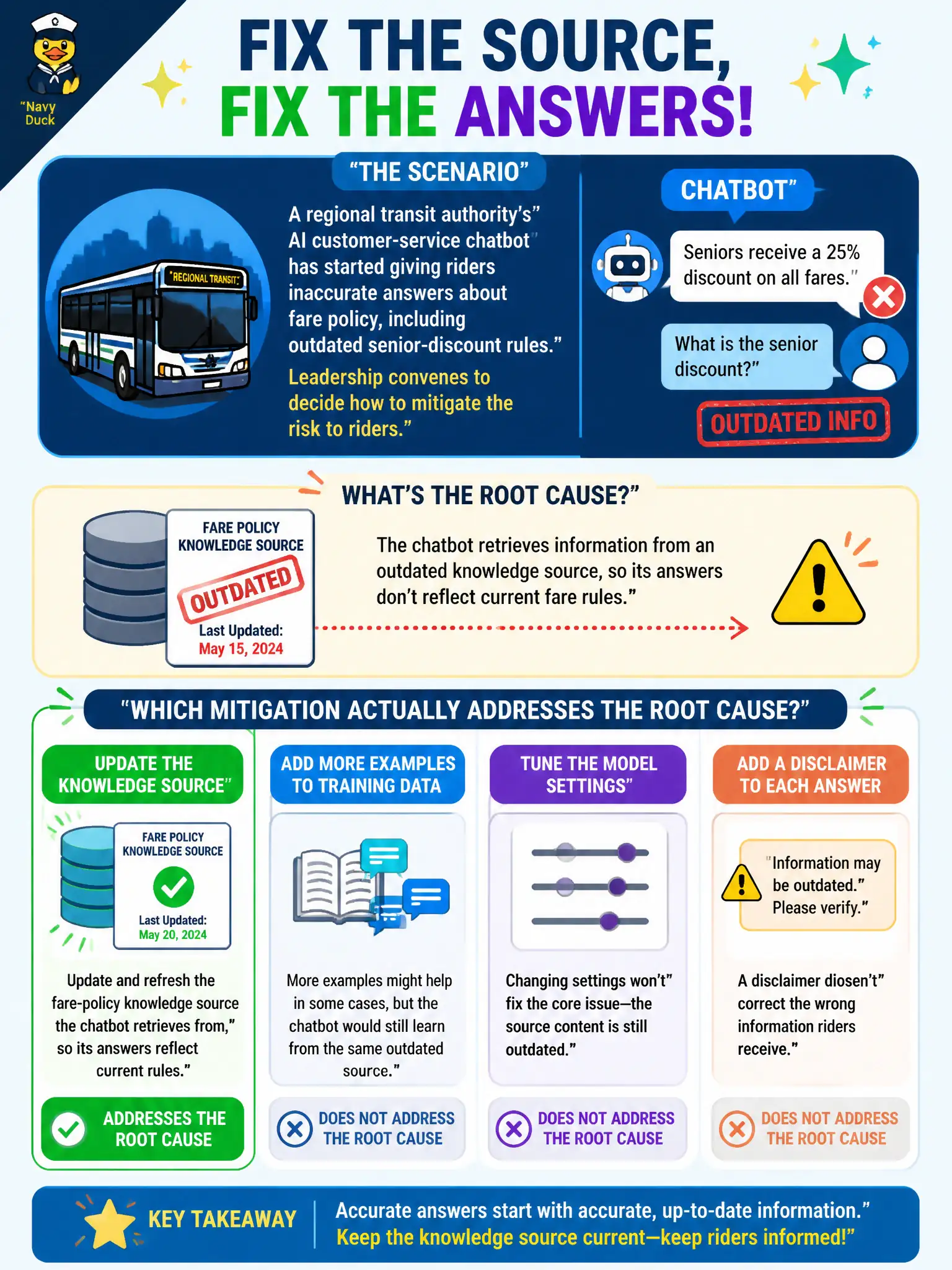
A regional transit authority's AI customer-service chatbot has started giving riders inaccurate answers about fare policy, including outdated senior-discount rules. Leadership convenes to decide how to mitigate the risk to riders. Which mitigation actually addresses the root cause of the chatbot's errors?
Select an answer to reveal the explanation.
Short Explanation
Picture the chatbot as a student reading from an outdated textbook: no matter how polished the essay sounds, the facts inside it are stale. Slapping a disclaimer on the exam doesn't fix the textbook, and neither does asking an aide to fact-check every answer by hand. You've got to swap in the current textbook and refresh the knowledge source the model pulls from before the answers can be trusted again.
Full Explanation
A generative chatbot that answers policy questions typically pulls from a connected knowledge source, such as a fare-policy document, FAQ, or database, rather than inventing rules from nothing. When that source is stale, the model faithfully reproduces stale information, so the fix has to happen at the source: refreshing the retrieved content so the chatbot is grounded in what's actually true today. A disclaimer treats the symptom, leaving every future rider exposed to the same wrong answer, just with a warning label attached. Assigning agents to double-check each response substitutes ongoing human labor for a one-time data fix and does not scale as chat volume grows, nor does it stop the chatbot from publishing wrong answers directly to riders who never talk to an agent. Pausing a marketing announcement addresses public perception, not the underlying accuracy problem, and the chatbot keeps serving incorrect answers in the meantime. Scope note: this assumes a retrieval-based or document-grounded chatbot architecture, which is typical for policy-lookup use cases. Operational check: sample recent chatbot transcripts against the current published fare policy to confirm the retrieved content now matches reality.