
A county CIO office is directing bias-drift monitoring for an AI-based case-prioritization tool shared across multiple county departments. What monitoring cadence best fits a shared, multi-department system like this?
Select an answer to reveal the explanation.
Short Explanation
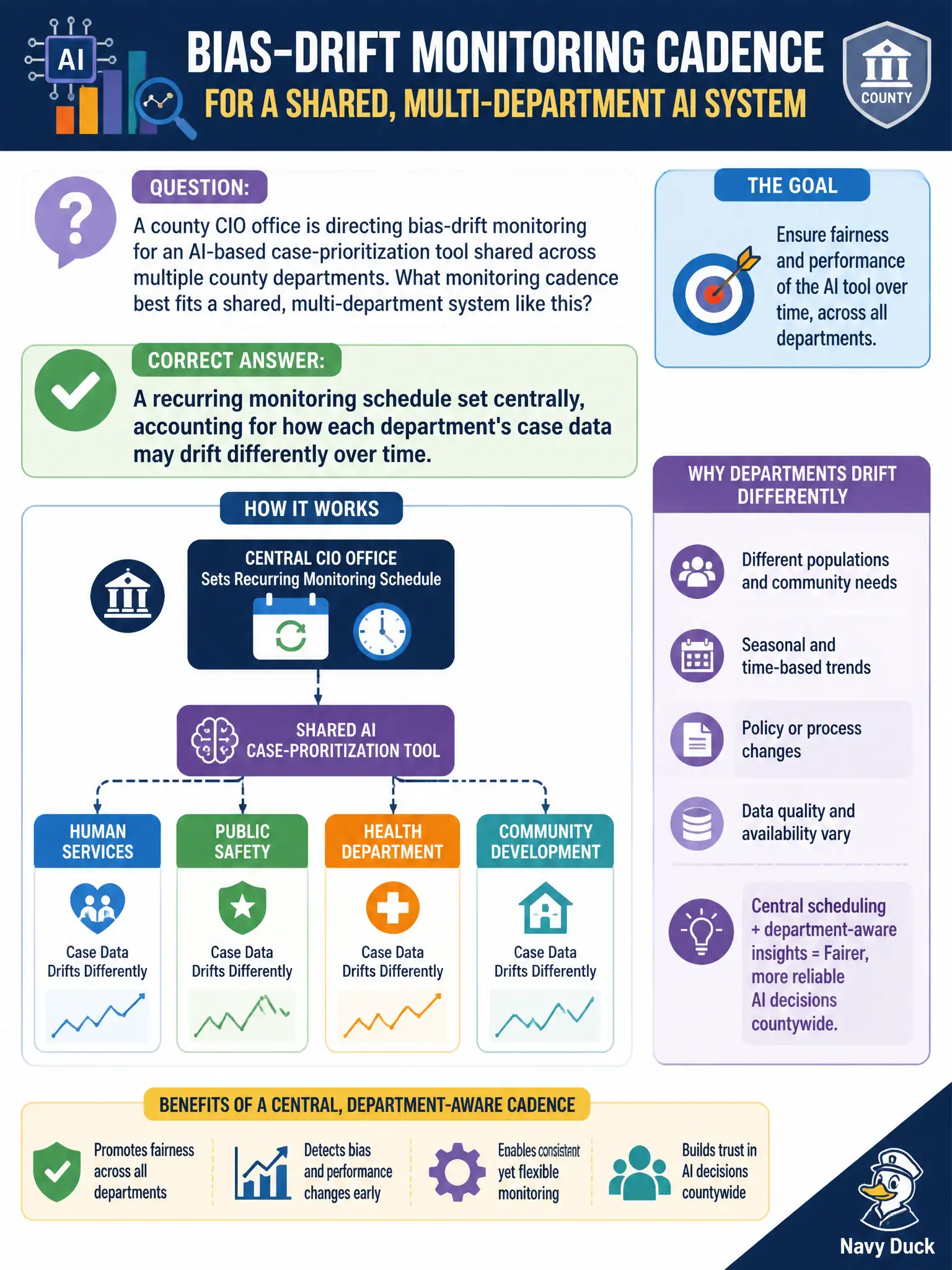
A tool shared across departments doesn't drift the same way everywhere at once, since each department's caseload shifts on its own timeline. A recurring, centrally set monitoring schedule that accounts for those different patterns is what keeps one department's drift from going unnoticed just because another department's data still looks fine.
Full Explanation
A shared AI system used across multiple county departments faces a distinct monitoring challenge: each department's underlying case data can shift independently, so a single fairness snapshot or an inconsistent, department-by-department approach can miss drift happening in one area while another looks stable. Setting a recurring monitoring cadence centrally, with attention to how each department's data may be drifting on its own timeline, ensures no department's bias-drift signal gets buried inside an aggregate view. A single pre-launch check captures fairness only at the moment of rollout and provides no visibility into how departmental usage patterns diverge afterward. Leaving cadence entirely to whichever department uses the tool most heavily that month creates uneven oversight, since a lower-volume department could still experience meaningful drift that never triggers review under a volume-driven approach. Waiting for a formal request from one department makes monitoring reactive and dependent on individual departments recognizing a problem themselves, which defeats the purpose of centralized bias-drift oversight for a tool the whole county relies on. A scope caveat: a central schedule still needs department-level breakdowns in its reporting, or drift specific to one department could be masked within a combined average. A concrete operational check is to require a disaggregated bias-drift report by department on a fixed recurring interval, reviewed by the CIO office rather than by individual departments in isolation.