
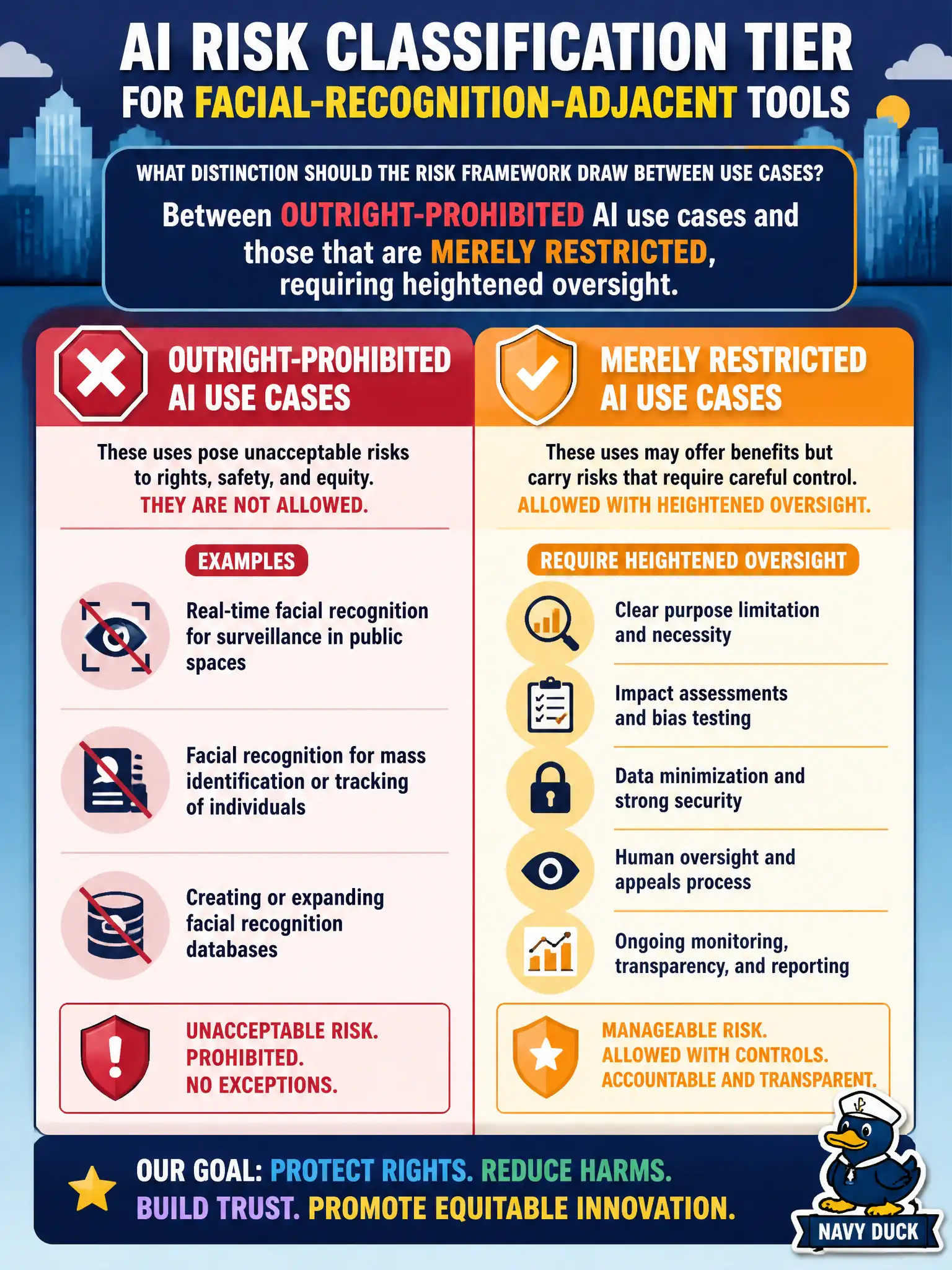
A city equity office is proposing an AI risk classification tier for facial-recognition-adjacent tools. What distinction should the risk framework draw between use cases?
Select an answer to reveal the explanation.
Short Explanation
Not every risky tool belongs in the same bucket. Think of it like a no-fly list versus a watch list: one means never, the other means extra scrutiny every time. A risk framework only works if it separates prohibited uses from ones that are just tightly restricted, because treating them identically either blocks something safe or greenlights something it shouldn't.
Full Explanation
An AI risk classification framework earns its usefulness by mapping different levels of risk to different governance responses, and the sharpest line to draw is between uses that are prohibited outright and uses that are permitted but require heightened restriction, such as extra approval steps or narrower deployment conditions. For facial-recognition-adjacent tools, some applications may cross a line the city has decided never to permit, while others might be acceptable under strict controls like limited scope or mandatory human review. Distinguishing by contract type, whether annual or one-time license, has nothing to do with the actual risk the tool poses to residents; it is a procurement detail, not a governance signal. Splitting by cloud versus on-premises hosting addresses infrastructure, not the nature of the AI use case itself, and a prohibited use case does not become acceptable just because it runs on city-owned servers. Dividing tools by whether they require staff training conflates operational onboarding with risk severity, since even a low-risk tool might need training and a high-risk one might not. A scope caveat: the line between prohibited and merely restricted needs clear, written criteria, or the classification becomes subjective case by case. A concrete operational check is to require every facial-recognition-adjacent proposal to be scored against the framework's criteria before procurement even begins.