
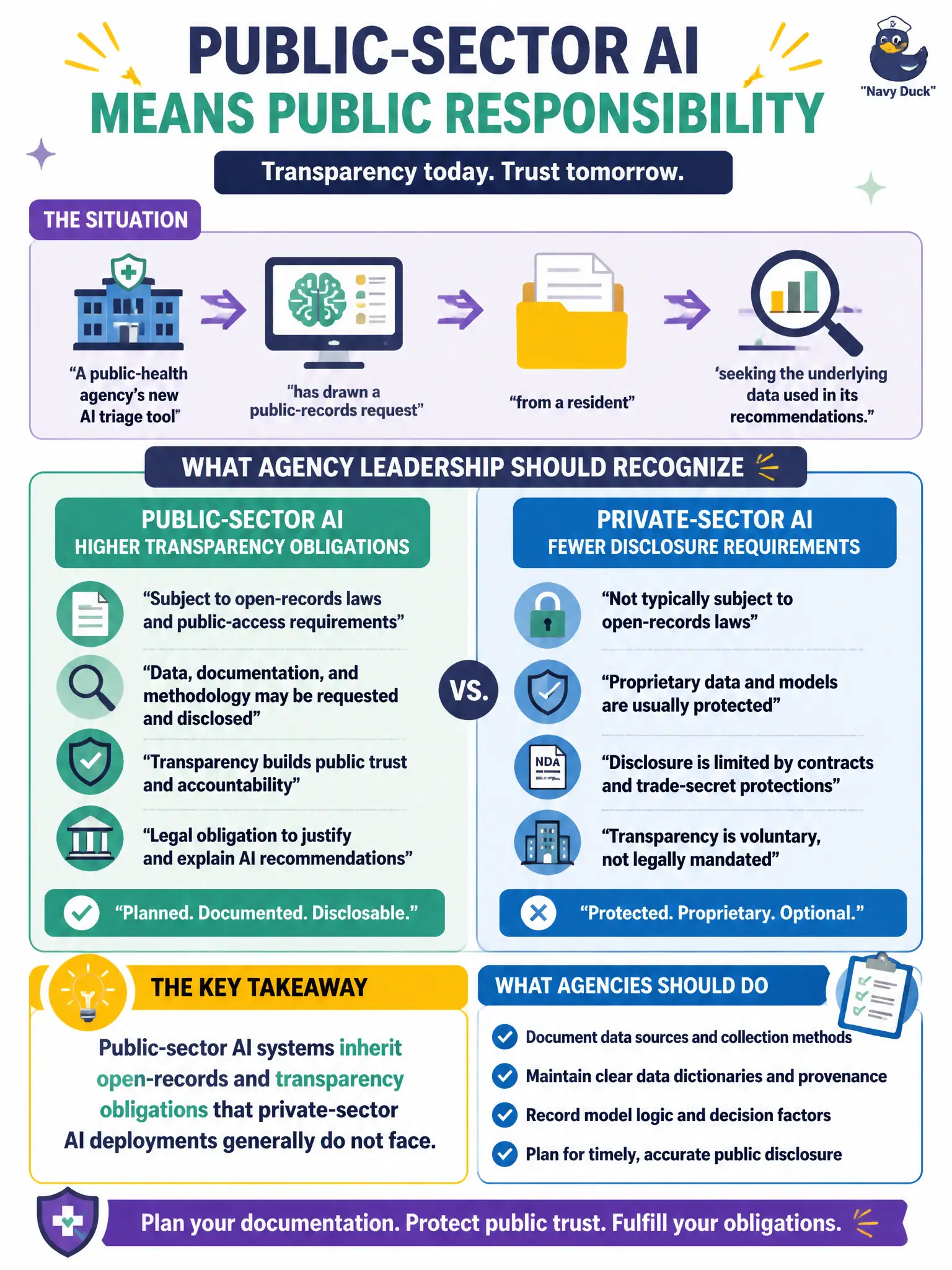
A public-health agency's new AI triage tool has drawn a public-records request from a resident seeking the underlying data used in its recommendations. What should agency leadership recognize about this situation?
Select an answer to reveal the explanation.
Short Explanation
Think about how a private company's internal spreadsheet is nobody's business but its own, while a public agency's file cabinet has always been open to the people who fund it. An AI tool doesn't change that fundamental difference, once it's a public agency running the system, the same openness expectations that applied to paper records now extend to the AI's underlying data and recommendations.
Full Explanation
Public-sector organizations operate under open-records and transparency obligations that don't automatically apply to private companies, and deploying an AI system doesn't create an exemption from those obligations, so a public-health agency should expect and plan for records requests covering the data underlying an AI triage tool's recommendations. Claiming the tool is categorically exempt because it's automated rather than human-created misunderstands how public-records law generally applies to the substance of government decision-making, regardless of what tool produced it. Assuming the vendor bears sole responsibility ignores that the agency, as the public entity using the tool to make government decisions, retains its own legal obligation to respond to records requests, even when a vendor built or hosts the underlying system. Denying the request outright on a blanket trade-secret theory overreaches, since legitimate trade-secret protections are narrow and specific, and can't be invoked wholesale to block disclosure of data the public has a right to request. A scope caveat: some genuinely proprietary vendor information may be legitimately withheld or redacted, but that's a narrower carve-out determined case by case, not a reason to deny the entire request. A concrete check: confirm the agency has a documented process, developed with legal counsel, for what AI-related data and documentation it can produce in response to a public-records request before such a request arrives.