
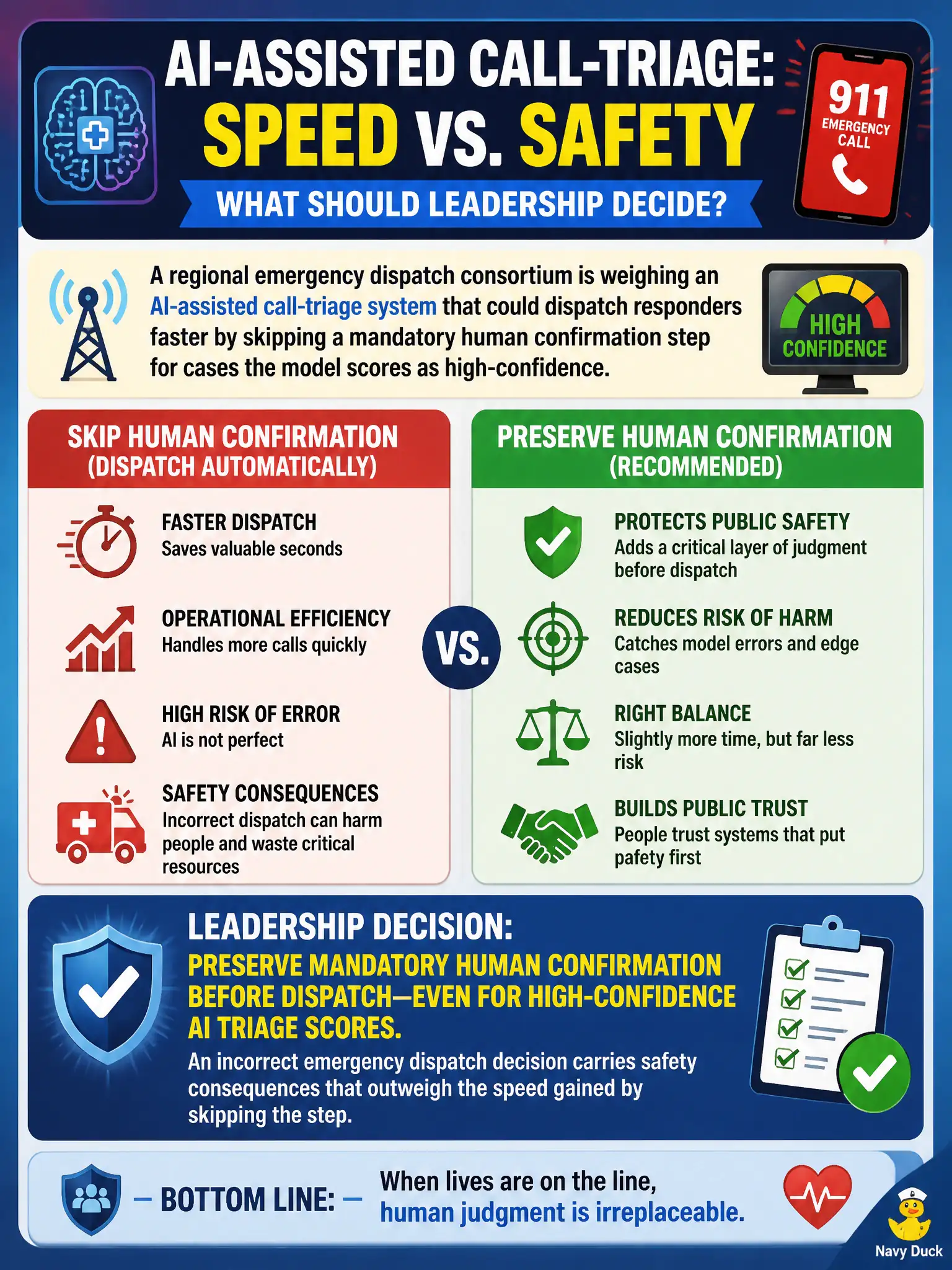
A regional emergency dispatch consortium is weighing an AI-assisted call-triage system that could dispatch responders faster by skipping a mandatory human confirmation step for cases the model scores as high-confidence. What should the consortium's leadership decide?
Select an answer to reveal the explanation.
Short Explanation
Think about a pilot who still runs the pre-flight checklist even after ten thousand smooth flights; the risk of skipping it only shows up on the one flight where something's actually wrong. Emergency dispatch works the same way: a high confidence score doesn't guarantee a correct read of a caller's situation, so keeping a human in the loop before dispatch is what catches that one case where speed alone would have gotten someone hurt.
Full Explanation
Preserving mandatory human confirmation before dispatch, even for triage cases the model scores as high-confidence, reflects that emergency response decisions carry potential safety consequences serious enough that the marginal speed gained by skipping human review doesn't outweigh the risk of an incorrect dispatch, such as sending the wrong unit type or under-prioritizing a genuinely urgent call. Removing confirmation above a confidence threshold assumes a high confidence score is a reliable proxy for correctness, but a model can be confidently wrong, especially on unusual call patterns or ambiguous caller information that don't match its typical training data. Removing the step only during high call volume ties a safety safeguard to operational convenience, which is precisely the scenario, high volume and time pressure, where errors are more likely and human judgment is most valuable, not less. Substituting a second AI model as a cross-check still leaves the decision fully automated between two models that could share similar blind spots or training limitations, rather than introducing an independent human judgment capable of catching an error pattern neither model was designed to recognize. A scope caveat: this doesn't mean AI triage has no role, the model can still prioritize and pre-screen calls to speed up the human dispatcher's decision, but the final dispatch action should retain a human check. A concrete check: confirm the dispatch system technically requires an explicit human action to release a triage recommendation into an actual unit dispatch, regardless of the model's reported confidence score.