
A county human-services agency is configuring a GenAI tool intended to help caseworkers draft summaries and identify relevant policy sections during benefits-eligibility reviews. What guardrail should leadership set regarding the tool's role in the eligibility process?
Select an answer to reveal the explanation.
Short Explanation
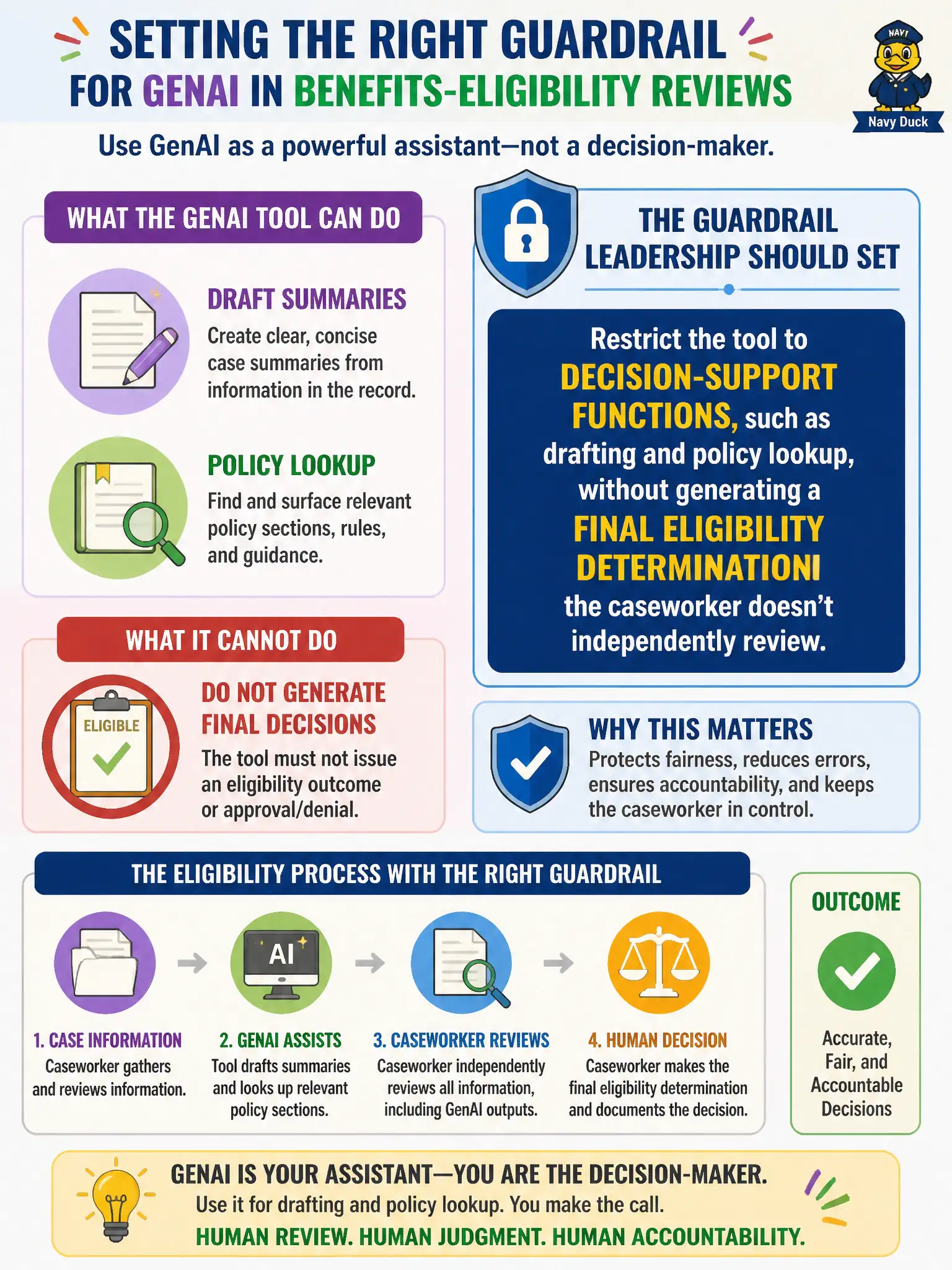
Think about a paralegal who can draft a brief and pull relevant case law, but doesn't get to sign the verdict; that final call stays with the judge. A GenAI tool helping caseworkers is the paralegal here, useful for speeding up the legwork, but the actual eligibility determination, the thing that decides whether someone gets help, needs to stay with a human who reviews the case.
Full Explanation
Restricting the GenAI tool to decision-support functions, like drafting summaries and surfacing relevant policy sections, while requiring a caseworker to independently review and issue the actual eligibility determination, keeps the AI in an assistive role for a high-stakes decision that materially affects an applicant's access to benefits. Allowing the tool to issue determinations directly whenever a confidence score clears a threshold treats a statistical confidence measure as equivalent to a substantive eligibility judgment, when in fact a model can be confidently wrong about a case with unusual or ambiguous facts a caseworker would catch. Carving out an exception for applicants who haven't requested a reasonable accommodation creates an arbitrary and potentially discriminatory dividing line unrelated to whether the case itself is straightforward, and accommodation status isn't a sound proxy for eligibility complexity. Allowing automated determinations for cases below a dollar-value threshold assumes smaller benefit amounts always carry lower risk of harm, but a small benefit can still be essential to the applicant receiving it, and a wrongly denied small benefit is still a wrongful denial. A scope caveat: decision-support tools still need their own monitoring, since even non-final outputs like a flawed policy citation can mislead a caseworker's judgment if unchecked. A concrete check: confirm the system's workflow technically requires a caseworker's affirmative sign-off before any eligibility outcome is finalized and communicated to the applicant.