
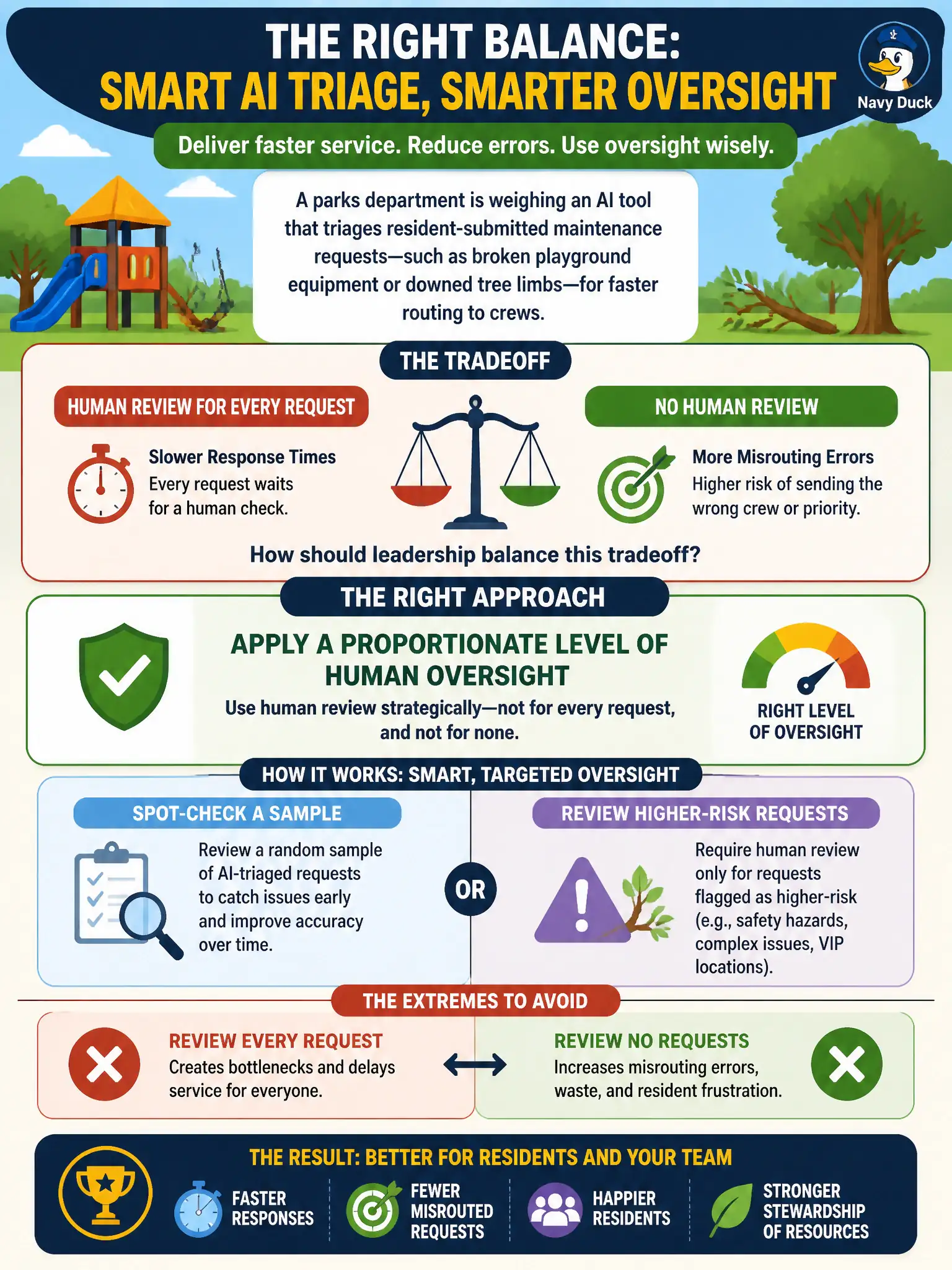
A parks department is weighing an AI tool that triages resident-submitted maintenance requests, such as broken playground equipment or downed tree limbs, for faster routing to crews. Adding a human-review step before each AI-triaged request is dispatched would slow response times but reduce misrouting errors. How should department leadership balance this tradeoff?
Select an answer to reveal the explanation.
Short Explanation
Think about how a restaurant kitchen doesn't have the head chef taste-test every single plate, but does spot-check dishes and pulls anything that looks off before it goes out. A parks maintenance triage tool doesn't need the same ironclad oversight as a life-safety system, but it shouldn't run completely unchecked either; a proportionate middle ground, like sampling requests or flagging the riskier ones, gets speed and accuracy both.
Full Explanation
Balancing a responsible-AI tradeoff for a lower-stakes, still public-facing process means applying oversight proportionate to actual risk, such as spot-checking a sample of AI-triaged requests or reserving full review for requests flagged as higher-risk, like anything involving a potential safety hazard, rather than swinging to either extreme. Eliminating review entirely treats a public-facing municipal process as risk-free, ignoring that misrouted requests, like a downed limb blocking an accessible path, can still create real safety consequences even in a generally low-stakes system. Requiring full human review of every request imports a level of scrutiny appropriate for genuinely high-stakes, life-safety decisions into a context where it isn't justified, and the added review burden would erase the efficiency gain the AI tool was meant to provide. Waiting for a guarantee of zero misrouting errors sets an unattainable bar that no operational system, AI-assisted or fully manual, can realistically meet, and would indefinitely block a tool that could still meaningfully improve response times with reasonable safeguards in place. A scope caveat: what counts as proportionate oversight should be revisited periodically as request volume and error patterns change, not fixed permanently at launch. A concrete check: track the misrouting rate on the sampled or flagged requests and adjust the oversight threshold if errors climb above an acceptable level.