
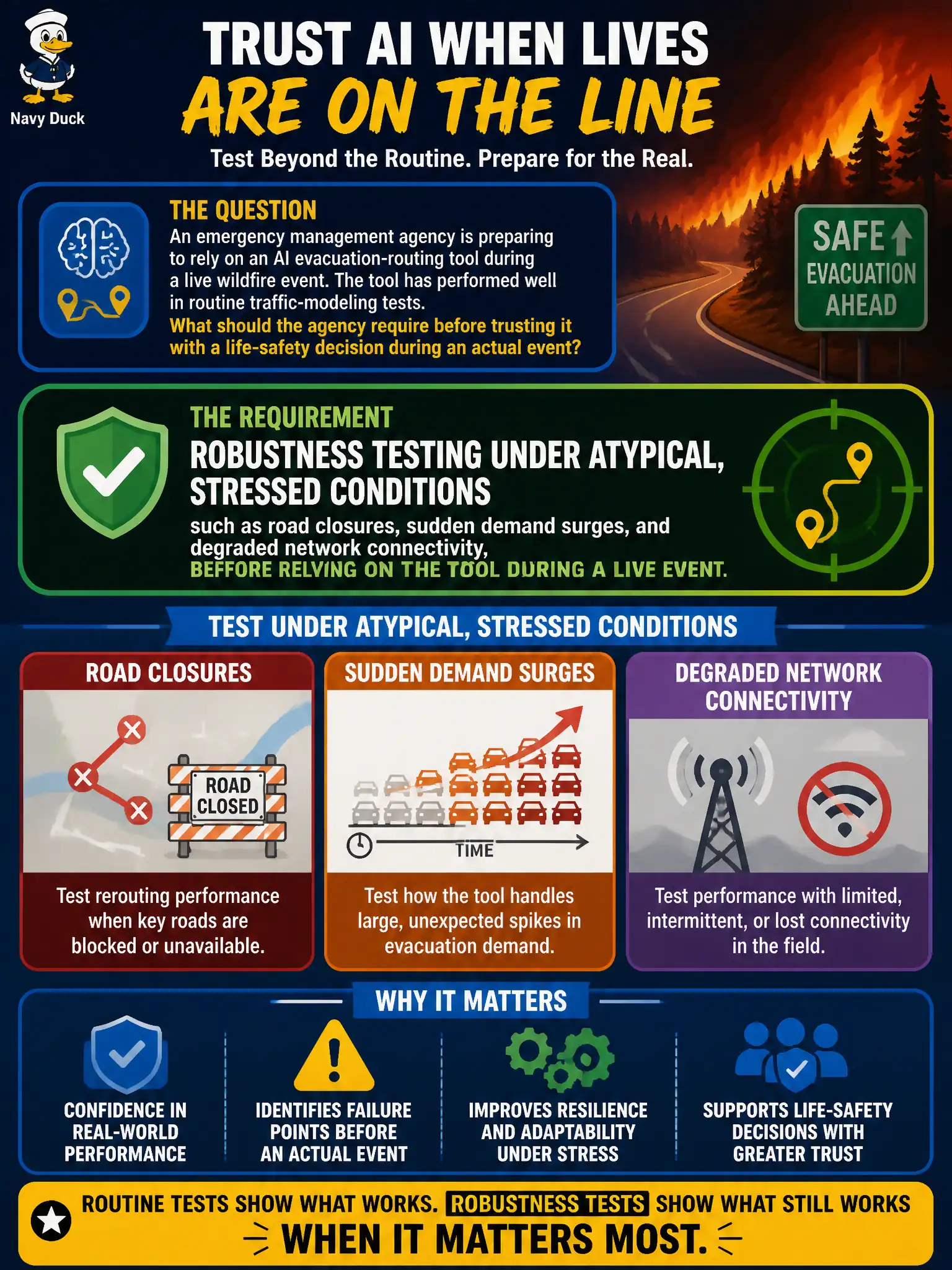
An emergency management agency is preparing to rely on an AI evacuation-routing tool during a live wildfire event. The tool has performed well in routine traffic-modeling tests. What should the agency require before trusting it with a life-safety decision during an actual event?
Select an answer to reveal the explanation.
Short Explanation
Think about a car that handles beautifully on a dry test track but has never been driven in a downpour: routine conditions tell you almost nothing about how it behaves when things get messy. Wildfire evacuations bring exactly the kind of chaos routine traffic testing never simulates, so the tool needs to be stress-tested against road closures and surging demand before anyone bets lives on its routing.
Full Explanation
Robustness for a life-safety AI tool means verifying it performs reliably under the atypical, high-stress conditions an actual emergency creates, such as sudden road closures, evacuation-driven demand surges, or degraded network connectivity, not just under the routine conditions used in standard traffic modeling. Assuming routine performance predicts emergency performance overlooks that wildfire evacuations create exactly the kind of chaotic, non-standard inputs that routine testing doesn't simulate, so a tool untested against those conditions could route evacuees into closed roads or bottlenecks without warning. Restricting the tool to non-emergency planning avoids the risk but also forfeits any potential benefit the tool could offer during an actual evacuation, which isn't a responsible-AI requirement, just an avoidance strategy that sidesteps the real question of how to validate the tool for its intended use. Relying solely on a vendor's benchmark certification substitutes a third party's general claims for the agency's own verification against its specific local road network and emergency scenarios, which the vendor's generic benchmark may not reflect. A scope caveat: robustness testing can't cover every possible emergency permutation, so the agency should pair it with a documented fallback procedure for when the tool's confidence drops or its inputs fall outside tested conditions. A concrete check: run a tabletop exercise simulating a road closure and demand surge scenario and confirm the tool's routing recommendations remain usable under those simulated conditions.