
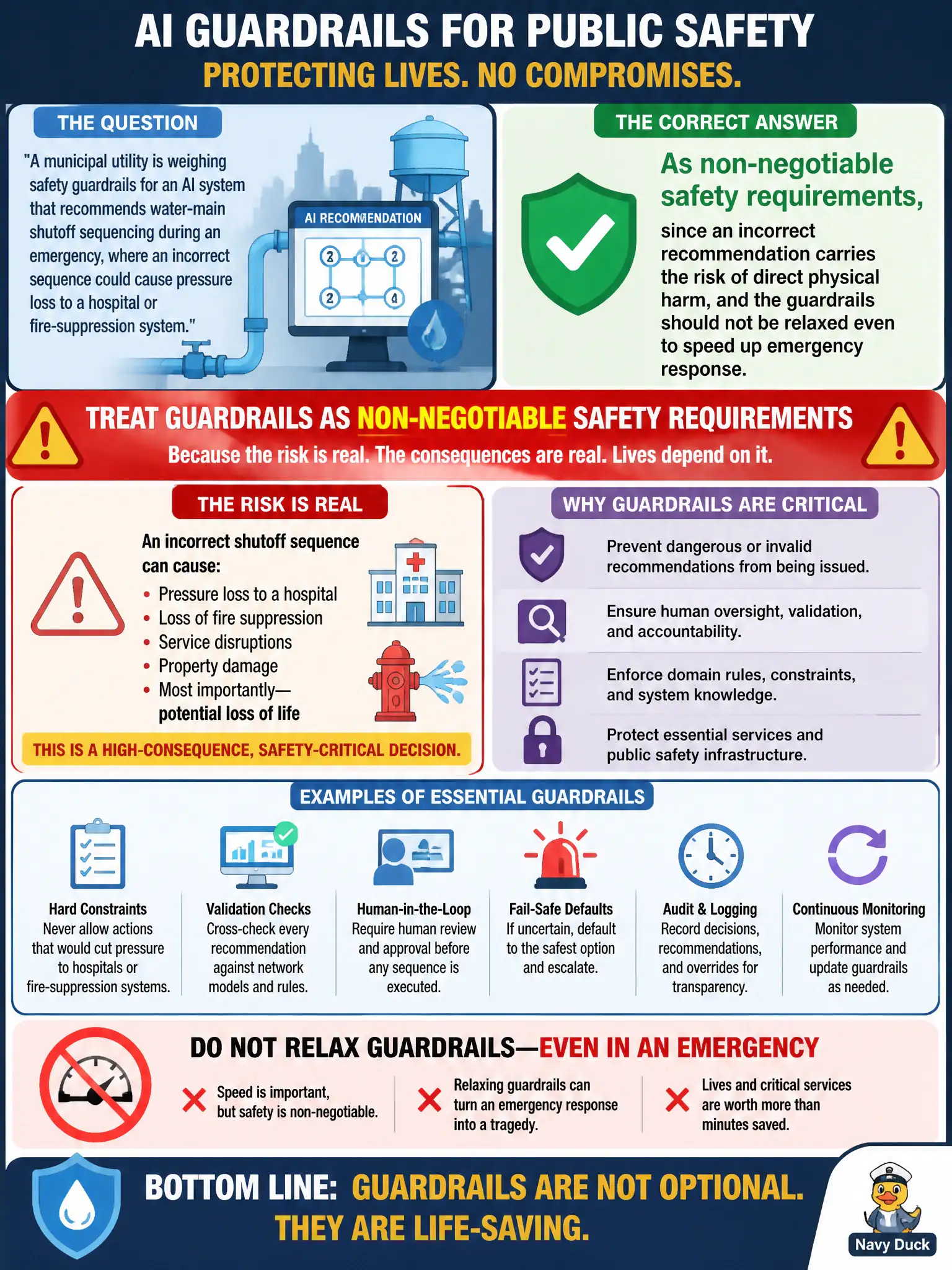
A municipal utility is weighing safety guardrails for an AI system that recommends water-main shutoff sequencing during an emergency, where an incorrect sequence could cause pressure loss to a hospital or fire-suppression system. How should the utility's leadership treat these guardrails?
Select an answer to reveal the explanation.
Short Explanation
Think about how a surgeon doesn't skip the safety checklist just because the patient's condition is getting worse by the minute; if anything, the pressure to move fast is exactly when you most need the checklist to hold. A water-main sequencing error can cut pressure to a hospital or a fire hydrant, so the safety guardrails around that recommendation aren't something you relax when things get urgent, they're the thing that keeps urgency from turning into a disaster.
Full Explanation
When an AI recommendation carries the potential for direct physical harm, safety guardrails have to be treated as fixed constraints that hold regardless of situational pressure, because the entire point of the guardrail is to prevent the AI from suggesting a sequence that endangers life-safety infrastructure like a hospital's water supply or a fire-suppression system, precisely in the high-stress moments when a bad recommendation is most likely to be acted on quickly. Loosening guardrails during the most time-critical incidents inverts the logic of safety design, since urgency increases the chance a flawed recommendation gets implemented without adequate scrutiny, which is exactly when the safeguard matters most. Treating guardrails as audit documentation rather than real operational constraints means they exist on paper but do nothing to actually stop a dangerous recommendation from reaching a field crew. Configuring guardrails once at deployment and not revisiting them ignores that infrastructure changes, like a new hospital connection or an altered pipe network, can shift which shutoff sequences are dangerous, so the safeguards need periodic reassessment, not a set-and-forget posture. A scope caveat: non-negotiable doesn't mean unchangeable forever, guardrails should be updated through a formal governance process as infrastructure changes, just never bypassed informally during a live emergency. A concrete check: confirm the AI system is configured to require explicit human confirmation before executing any shutoff sequence affecting a facility flagged as life-safety critical.