
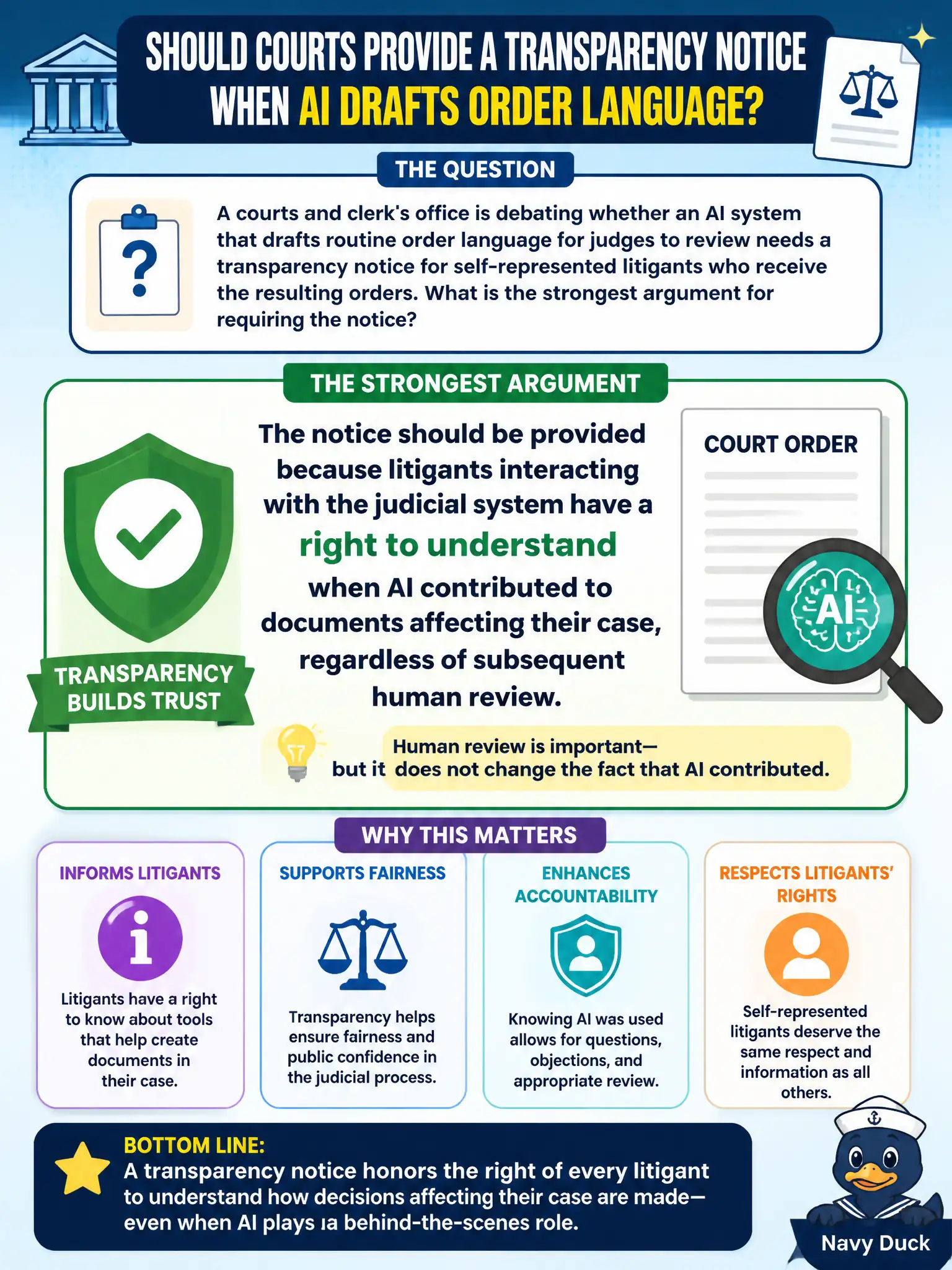
A courts and clerk's office is debating whether an AI system that drafts routine order language for judges to review needs a transparency notice for self-represented litigants who receive the resulting orders. What is the strongest argument for requiring the notice?
Select an answer to reveal the explanation.
Short Explanation
Think about a restaurant menu that discloses when a dish contains a common allergen, even after a chef has plated and inspected it: the disclosure isn't about whether the food is safe, it's about the diner's right to know what went into it. A litigant navigating the court system without a lawyer deserves that same kind of disclosure about an AI system's role in the document shaping their case, even if a judge signed off on it.
Full Explanation
Transparency in judicial-adjacent processes means disclosing AI involvement to the people affected by a document's content, independent of whether a human later reviewed it, because the disclosure serves the litigant's right to understand the process, not merely to verify the document's final accuracy. Arguing the notice is unnecessary because a judge reviews and signs the order conflates review with authorship transparency; a judge's sign-off addresses correctness, but litigants still have a legitimate interest in knowing an AI system contributed to the drafting itself. Making disclosure contingent on the litigant asking assumes self-represented litigants, who by definition often lack legal training, would know AI drafting tools exist in court workflows well enough to think to ask, which sets an unreasonably high bar for a right that should be proactively honored. Restricting the notice to internal staff on the theory that litigants can't interpret it is paternalistic and defeats the purpose of transparency, which is about disclosure of a fact, not requiring the recipient to have specialized expertise to receive it. A scope caveat: the appropriate form of the notice can be simple and plain-language, it doesn't need to explain the underlying technology, but omitting it entirely for public-facing judicial documents undercuts public trust in the courts. A concrete check: confirm any AI-assisted order template includes a standard, plain-language disclosure line before it's finalized for distribution to litigants.