
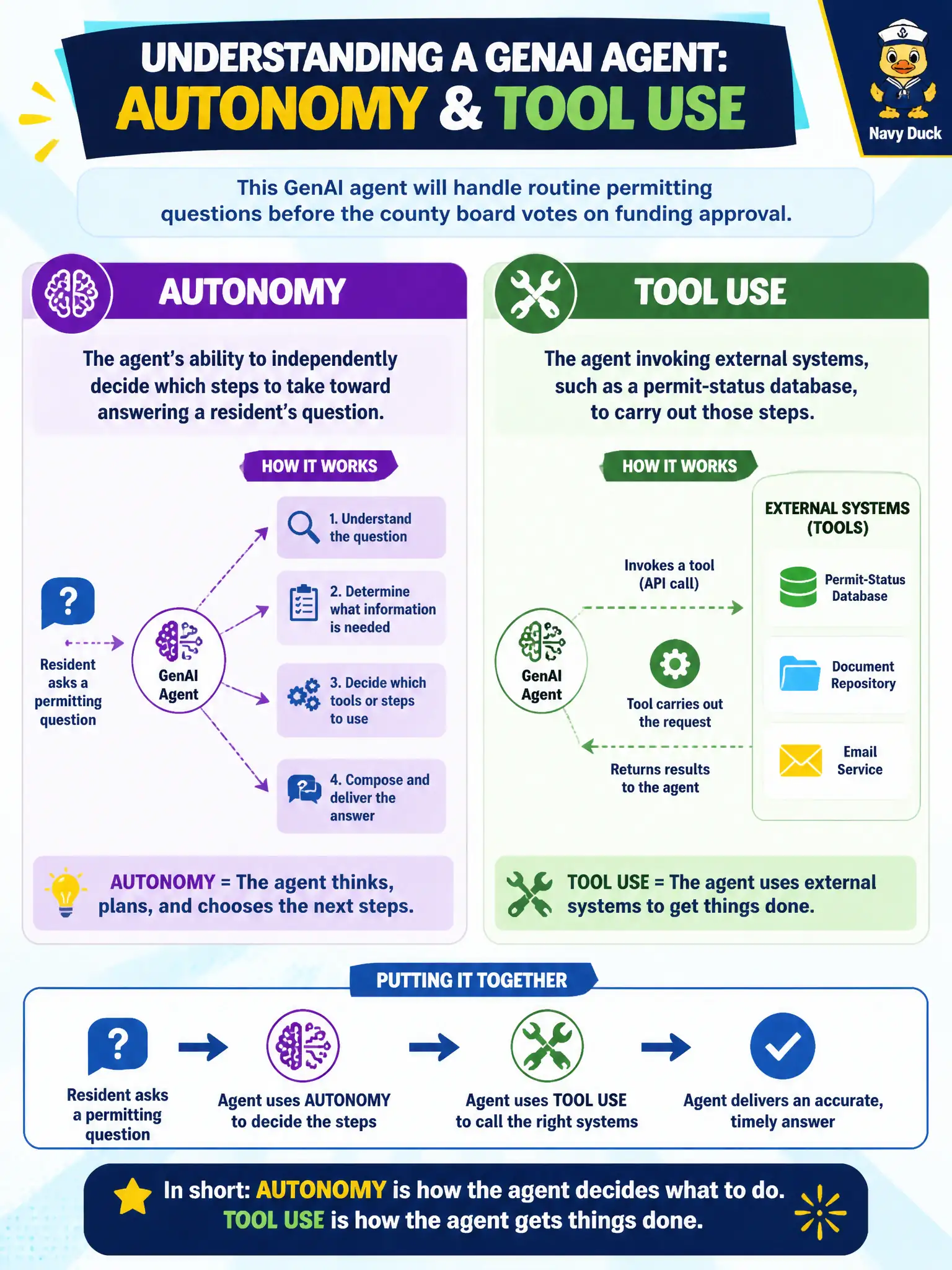
A county administrator's office is preparing to brief the county board on a proposed GenAI agent that will handle routine permitting questions before the board votes on funding approval. To set accurate expectations, the office needs to explain what the agent's "autonomy" and "tool use" actually mean in this context. Which statement correctly describes these two capabilities?
Select an answer to reveal the explanation.
Short Explanation
Think of the agent like a new staffer at the permit counter: autonomy is how much the staffer can decide on their own without asking a supervisor for every step, and tool use is them reaching for the permit lookup system instead of guessing. You're not describing how fast it types or which model trained it, you're describing what it's allowed to decide and what systems it's allowed to touch.
Full Explanation
In GenAI agent design, autonomy describes the scope of decisions the agent can make on its own path toward a goal, such as choosing to look up a permit record before drafting a reply, rather than following a single fixed script. Tool use describes the agent's ability to call external systems and data sources, like a permit-status database or a scheduling system, to gather information or take action instead of relying only on what it already knows from training. Confusing autonomy with an absence of governance conflates two separate questions, how much the agent decides for itself, and how much human review wraps around those decisions, which is a separate design choice the county still controls. Treating autonomy as a measure of fine-tuning depth mixes up training method with runtime behavior, since a heavily fine-tuned model can still be tightly scripted with no autonomy at all. Framing tool use as an interface for residents mistakes the agent's own actions for the resident-facing front end, a different layer of the system entirely. Before the board vote, the office should walk through one representative permit question and list, step by step, which decisions the agent makes unattended and which external systems it calls, since that concrete trace is what turns an abstract capability claim into something the board can actually approve.