
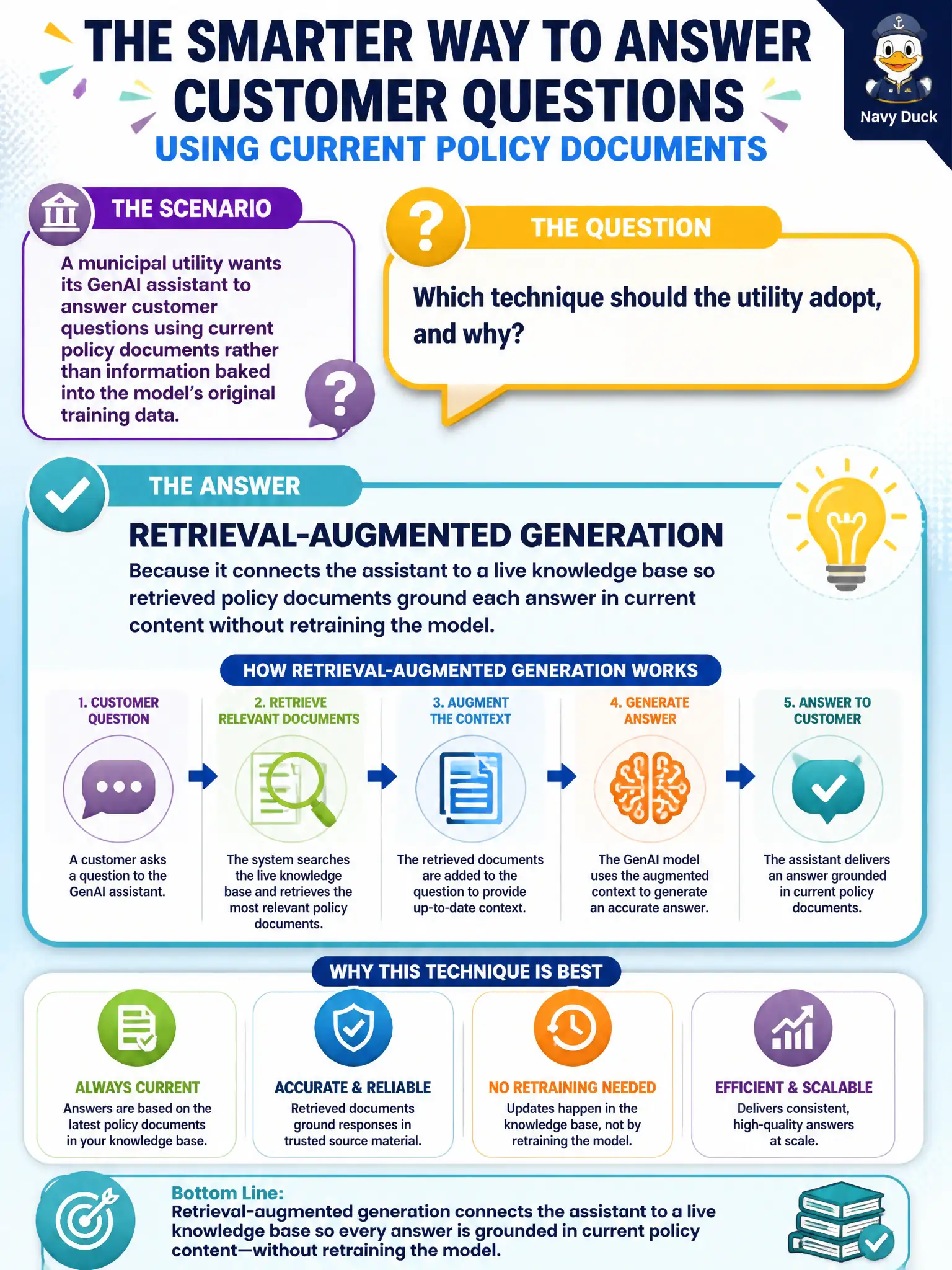
A municipal utility wants its GenAI assistant to answer customer questions using current policy documents rather than information baked into the model's original training data. Which technique should the utility adopt, and why?
Select an answer to reveal the explanation.
Short Explanation
It's like the difference between quizzing someone from memory and letting them check the current handbook before they answer: retrieval-augmented generation is the handbook check. The utility's policies keep changing, so the assistant needs to look things up, not just recall what it learned once.
Full Explanation
Retrieval-augmented generation works by fetching relevant content from a connected knowledge base at the moment a question is asked, then feeding that retrieved content to the model alongside the question so the answer reflects what is currently published rather than what the model happened to learn during training. That mechanism directly solves the utility's problem: policy documents can be updated in the knowledge base independently of the model, and the next answer reflects the change immediately. Prompt engineering alone fails by concept, because wording instructions more carefully cannot supply facts the model was never given access to — a well-worded prompt can shape how an answer is delivered, not what content it draws from. Fine-tuning on the historical archive fails for currency reasons: it bakes a point-in-time snapshot into the model's weights, so policy updates after that training run go unreflected until another costly retraining pass. A larger model with a longer context window addresses how much text can be processed at once, not where the facts come from, so it does not solve the grounding problem on its own. A scope caveat: retrieval quality depends entirely on how well the knowledge base is maintained, so stale or poorly indexed source documents undermine the technique. As an operational check, confirm who owns updating the connected knowledge base and how quickly a policy change propagates into it.