
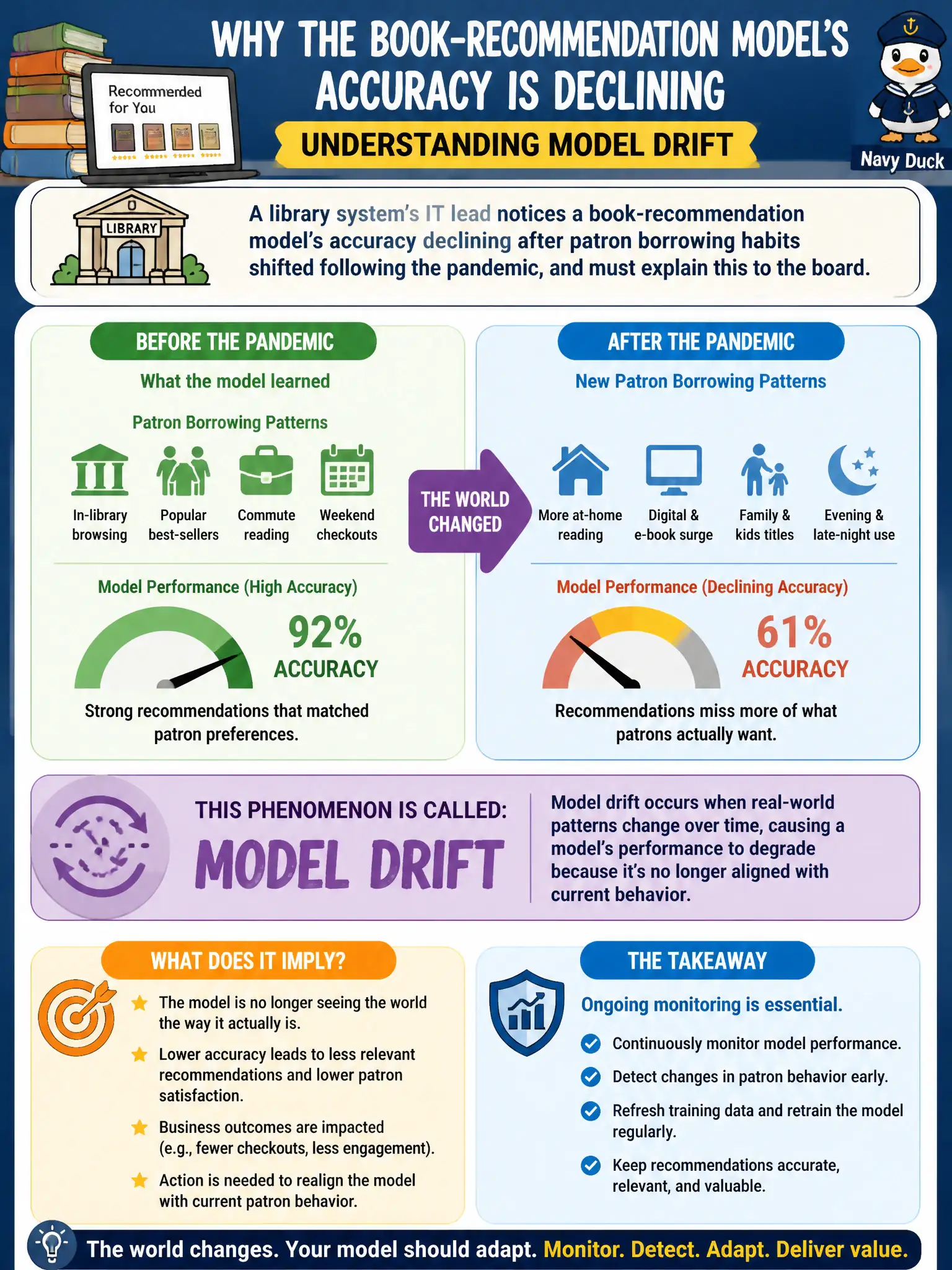
A library system's IT lead notices a book-recommendation model's accuracy declining after patron borrowing habits shifted following the pandemic, and must explain this to the board. What is this phenomenon called, and what does it imply?
Select an answer to reveal the explanation.
Short Explanation
The model learned what patrons liked back when the world looked different, and the world quietly moved on without telling it. That's model drift, and it's exactly why you don't just launch a model and walk away.
Full Explanation
Model drift occurs when the real-world patterns a model is being applied to shift away from the patterns it originally learned during training, so its predictions gradually become less accurate even though nothing about the model's code changed. A pandemic-driven shift in patron borrowing habits is a textbook trigger: the model still "believes" pre-pandemic borrowing patterns, while actual behavior has moved on. The core business implication is that any deployed model needs ongoing monitoring and periodic retraining, not a one-time build. Calling it a software bug misdiagnoses the cause; nothing is malfunctioning in the code, the model is functioning exactly as trained, just against data that no longer matches reality. Labeling it overfitting confuses a different failure mode, where a model fits its original training data too closely and never generalized well in the first place; here the model worked fine until conditions changed. Treating the decline as normal, unmonitored fluctuation ignores that a real behavioral shift, not random noise, is driving the accuracy loss, and dismissing it removes the very signal that should trigger retraining. Before the board meeting, the IT lead should pull a simple before-and-after accuracy comparison split at the point borrowing habits shifted, since that timeline is the clearest evidence that drift, not a bug, is the cause.