
An emergency management agency is coordinating several automated dispatch tools, and its director needs to understand "agent-to-agent communication" and "orchestration" before approving a multi-tool response system. What do these terms describe?
Select an answer to reveal the explanation.
Short Explanation
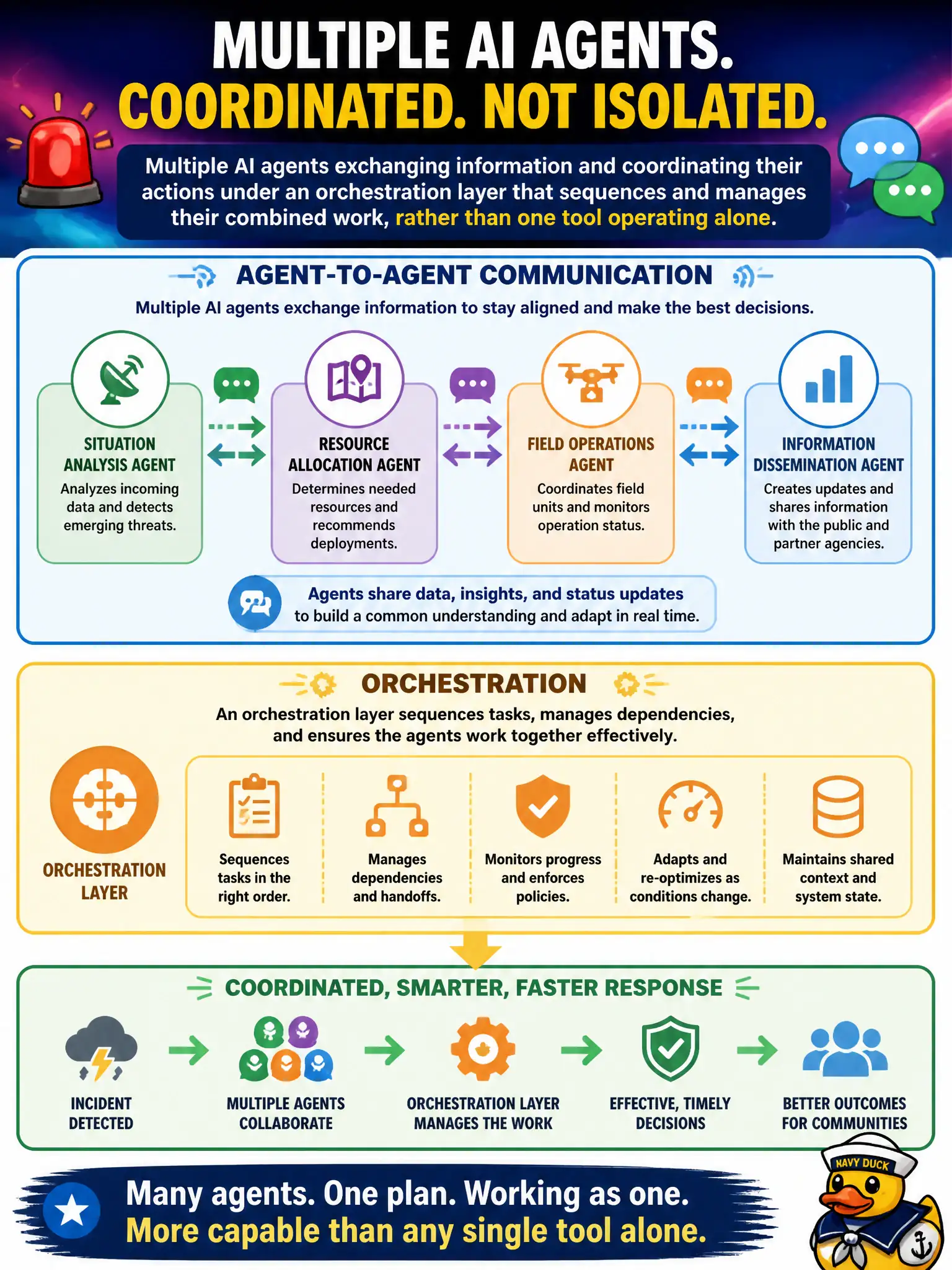
Picture a dispatch floor with several specialists, one who checks resource availability, one who maps routes, one who alerts field crews, all talking to each other and a supervisor keeping the whole shift on schedule. That supervisor role is orchestration, and the specialists comparing notes is agent-to-agent communication.
Full Explanation
Agent-to-agent communication describes multiple AI agents, each often responsible for a distinct task, exchanging information directly with one another, such as a resource-availability agent passing data to a routing agent. Orchestration is the layer above that coordination, sequencing which agent acts when, managing dependencies between their outputs, and keeping the combined multi-tool system working toward the same overall goal. Together, these describe a genuinely multi-agent system, which is different from any single tool acting alone. Describing a single agent handling every task without interacting with anything else is the opposite scenario, one agent with no peers to communicate with. Casting a human dispatcher as the relay mechanism between two systems describes manual integration, not agent-to-agent communication, since the coordination is happening through a person rather than between the agents themselves. Framing this as a backup process that only activates on failure misses that orchestration and agent communication are meant to operate continuously during normal operation, not only as a failover path. Before approval, the director should ask how the system behaves if one agent produces an unexpected or delayed output, since orchestration quality is best tested by how gracefully the coordinated agents handle a hiccup rather than by how well they perform under ideal conditions.