
Which approach best describes an effective way to improve solutions when tackling a practical machine learning problem from messy data through a deployable model?
Select an answer to reveal the explanation.
Short Explanation and Infographic
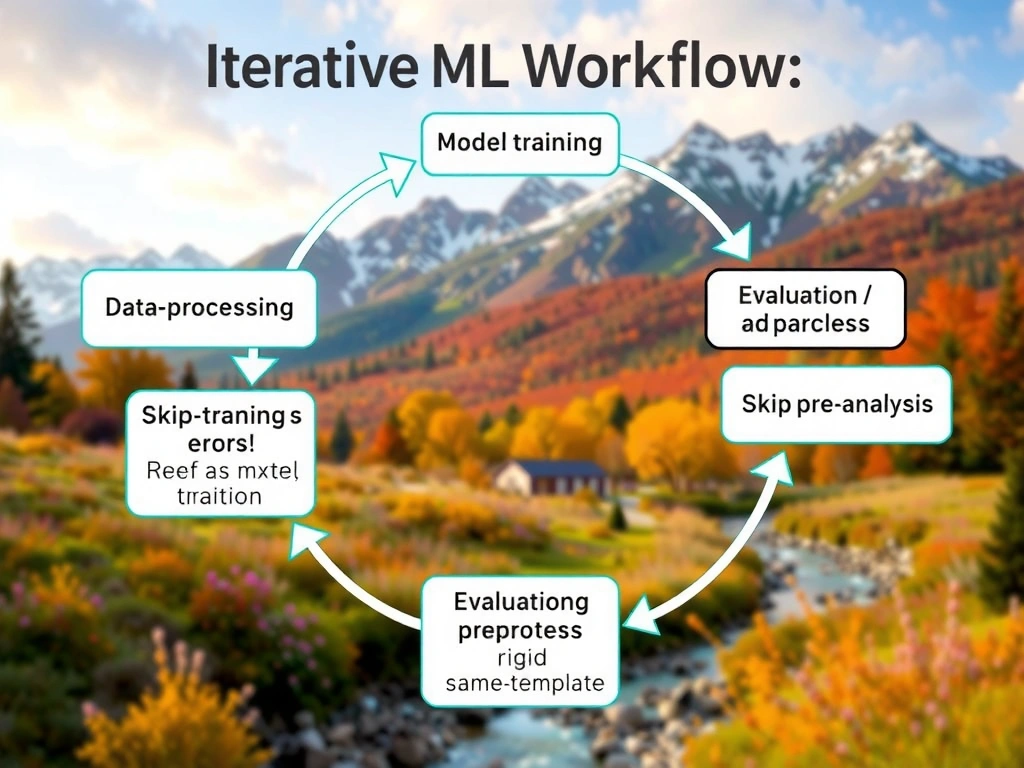
Check this out: solving an AI problem is not a straight line—it's a loop. You dig into the data, train something reasonable, evaluate hard, then go back and fix what broke. Maybe the features leak, maybe the class balance is wild, maybe the metric doesn't match the business. You adjust and run again. Think of it like tuning a race car: you don't drive one lap and declare victory—you measure, tweak, and retest. The exam loves to tempt you with "train once and ship," "skip cleaning," or "same template every time." Those are shortcuts that fail in the real world. Your boss wants better precision by Friday? You iterate: slice errors, fix data, retrain, re-measure. Land this takeaway: data analysis ↔ train ↔ evaluate, repeat. That's the craft. Keep practicing it on small projects until the loop feels automatic.
Full explanation below image
Full Explanation
Effective machine learning problem-solving is inherently iterative. Practitioners move repeatedly among understanding the data (exploratory analysis, quality checks, feature hypotheses), training candidate models under controlled experiments, and evaluating those models with metrics and error analysis that reflect the real objective. Findings from evaluation—systematic misclassifications, calibration issues, subgroup failures—feed the next round of data work or modeling choices. This cycle continues until performance, robustness, and operational constraints are acceptable.
A single training run with no follow-up experiments almost never yields a production-ready solution. Hyperparameters, feature sets, sampling strategies, and model families require comparison; early metrics often reveal that the problem framing or labels need revision. Skipping preprocessing is equally harmful: real datasets contain missing values, inconsistent encodings, outliers, leakage-prone fields, and scale mismatches. Those issues are discovered and fixed inside the same iterative workflow, not ignored. Using an identical rigid template for every problem also fails: a balanced binary classifier, a highly imbalanced fraud task, a forecasting series, and a ranking system need different metrics, validation schemes, and feature engineering.
Underlying principles include the scientific method applied to models (hypothesis, experiment, measure), separation of train/validation/test to avoid optimistic bias, and error analysis as a first-class activity rather than a final checkbox. Best practices include tracking experiments, versioning data and code, defining success criteria with stakeholders up front, and stopping iteration when gains fall below cost or risk thresholds—not when a single lucky run looks good.
On certification exams, the key step or mindset for "solving an AI problem effectively" is almost always the iterative loop among data work, training, and evaluation—not one-shot training, skipping cleaning, or blindly reusing a universal template. Remember the loop, justify each change with measured results, and you will both build better systems and answer these questions correctly. Hands-on practice on end-to-end mini projects cements the habit far better than memorizing algorithm names alone, because judgment about when to clean, reframe, or retrain only develops through repeated cycles of analysis and honest evaluation under realistic constraints and messy operational data realities over time.