
In supervised learning problem framing, how do regression and classification primarily differ?
Select an answer to reveal the explanation.
Short Explanation and Infographic
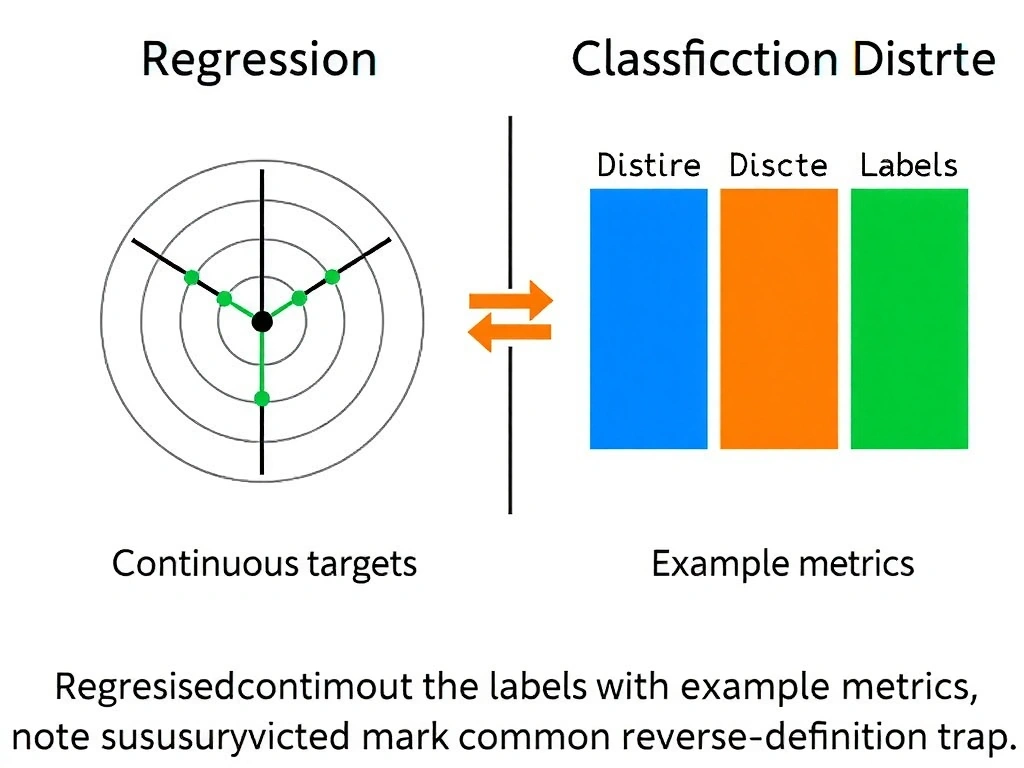
Pay close attention here, because this one bites people who rush the stem. Regression versus classification is about what you are predicting—not whether there is a teacher in the room. Both can be supervised. Regression? Continuous numbers: price, temperature, demand. Classification? Buckets: spam or not spam, disease present or absent, five star ratings as ordered classes when you treat them that way. Flip them and you are already wrong. Saying they are identical is the exam trap for people who never trained a model. Think of it like a mailroom: regression writes the exact weight on the package; classification stamps Air or Ground. Different stamp, different metric—MSE versus accuracy or F1. Nail that and a whole pile of algorithm questions gets easier. Got it? Keep practicing with real datasets.
Full explanation below image
Full Explanation
Regression and classification are the two primary supervised prediction settings distinguished by the nature of the target variable. In regression, the model estimates a continuous numeric quantity—examples include forecasting revenue, predicting remaining useful life in hours, or estimating a bounding-box coordinate. Typical losses include mean squared error or mean absolute error, and evaluation uses metrics such as RMSE, MAE, or R-squared. In classification, the model assigns inputs to discrete categories—binary (fraud versus legitimate), multiclass (which product family), or multilabel (tags). Losses often involve cross-entropy; metrics include accuracy, precision, recall, F1, ROC-AUC, and calibration measures depending on class balance and business cost. Getting the target type right drives algorithm choice, labeling guidelines, and success criteria from day one.
Both tasks are supervised when examples are paired with ground-truth targets. Calling regression unsupervised confuses the presence of labels with the type of label. Unsupervised learning instead includes clustering, dimensionality reduction, and density estimation without a designated prediction target. Reversing the definitions—claiming regression outputs categories and classification outputs continuous values—is a frequent error under time pressure. Treating the two as identical ignores differences in output heads (linear unit versus softmax or sigmoid), decoding (thresholding probabilities), and operational monitoring. Those mistakes cost points on fundamentals questions and cause real project thrash when teams pick the wrong loss and dashboard metrics.
Gray areas exist but do not erase the core split: ordinal regression and ranking sit between pure regression and pure classification; count models and survival models specialize continuous or time-to-event targets; you can discretize a continuous target into bins (turning regression into classification) or predict class probabilities as continuous scores (still fundamentally a classification problem). For problem framing, always ask: is the business decision about a number on a continuous scale or about membership in a set of labels? That single question selects algorithms, metrics, and data labeling guidelines. Memory aid: regression means how much or how many on a continuous scale; classification means which class or is it A or B. Mastering this distinction anchors supervised learning fundamentals tested throughout AI certification exams and keeps stakeholder conversations honest about what the model will actually produce.