
Leadership needs an AI solution delivered under severe schedule pressure. Which delivery strategy best protects on-time release without abandoning engineering discipline?
Select an answer to reveal the explanation.
Short Explanation and Infographic
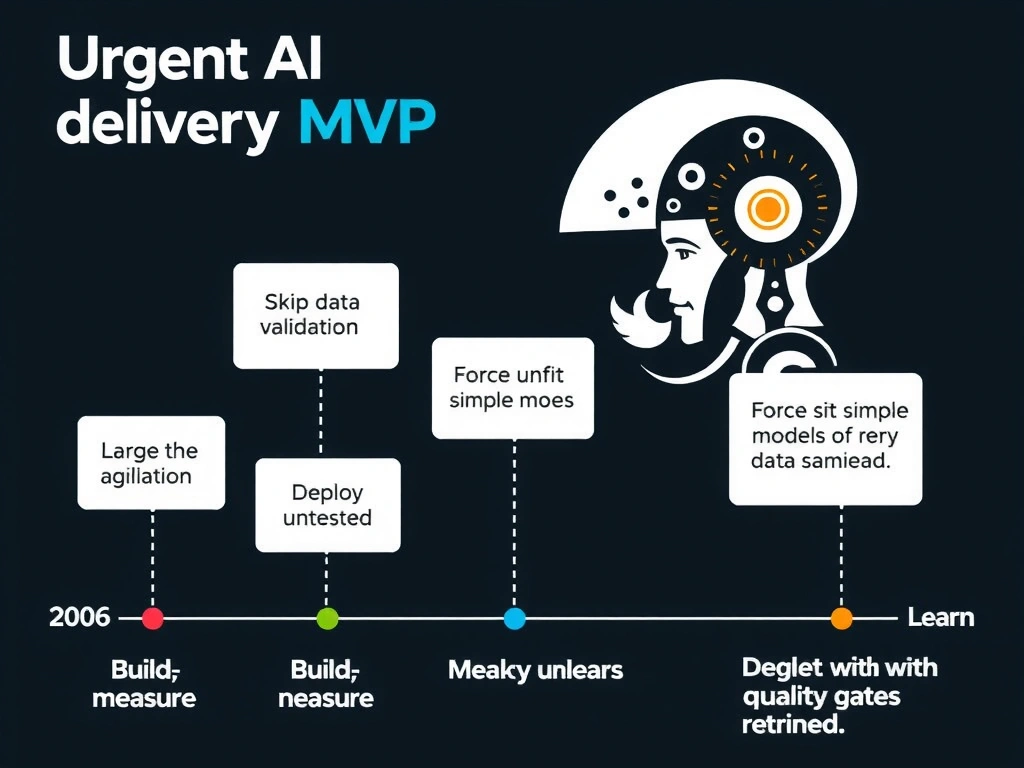
Okay, let us dive in. Boss walks in and says we need this AI live by month-end. Panic says skip validation, ship whatever trains, or jam a linear model into a nonlinear mess. Do not. The pro move is agile MVP—smallest thing that proves value, ship it, learn, iterate. Think of it like scaffolding a building: you do not finish the penthouse before the foundation, but you also do not skip the foundation inspection. Skipping data checks and tests feels fast until production lights on fire. A too-simple model that cannot hit the KPI is not early delivery—it is a dead end. Iterative delivery with a real MVP keeps scope tight and quality gates intact. That is how urgent projects actually land on time. You have got this—scope small, validate, release, improve.
Full explanation below image
Full Explanation
When an AI initiative is under severe time pressure, the reliable delivery pattern is an agile, iterative process organized around a minimum viable product (MVP): define the smallest user-visible capability that demonstrates value and can be measured, implement it end-to-end (data path, model, evaluation, and a controlled release path), then expand scope based on feedback and measured gaps. Short cycles expose data issues, label noise, integration friction, and metric shortfalls early—when there is still calendar room to correct course—rather than concentrating risk into a single late big-bang launch. Stakeholders see progress, engineers learn from real usage, and the critical path stays visible.
Skipping data validation is a false acceleration. Bad joins, leakage, skewed labels, or silent nulls produce models that look fine in a notebook and fail in staging or production, forcing emergency rework that often exceeds the time supposedly saved. Mandating an overly simple linear model regardless of problem complexity can be appropriate only when the task is approximately linear and the success bar is low; if the domain requires nonlinear interactions (complex vision, rich text, highly interactive features), an under-specified model will miss acceptance criteria and trigger re-architecture under even worse time pressure. Deploying without proper testing—unit checks on pipelines, offline holdout metrics, slice-based fairness or performance checks where relevant, and a basic rollout plan—converts schedule risk into operational and safety risk, including costly incidents and reputational damage. Exam distractors often dress these shortcuts as speed; in practice they delay trustworthy delivery.
Practical MVP discipline includes a crisp success metric, a frozen thin vertical slice of the pipeline, automated evaluation on a representative holdout, a documented rollback, and explicit non-goals for version one. Subsequent iterations add features, better models, monitoring, and scale. Memory aid for exams and delivery rooms alike: urgency favors iteration and a true MVP, not the omission of validation, testing, or fitness-for-purpose modeling. That combination is what actually improves the odds of an on-time, defensible release. Keep scope negotiations explicit so speed does not silently erase safety, privacy, or reliability requirements the business still expects after launch.