
A computer-vision team has tight funding and a short delivery window. Which approach is most practical for standing up a strong model quickly?
Select an answer to reveal the explanation.
Short Explanation and Infographic
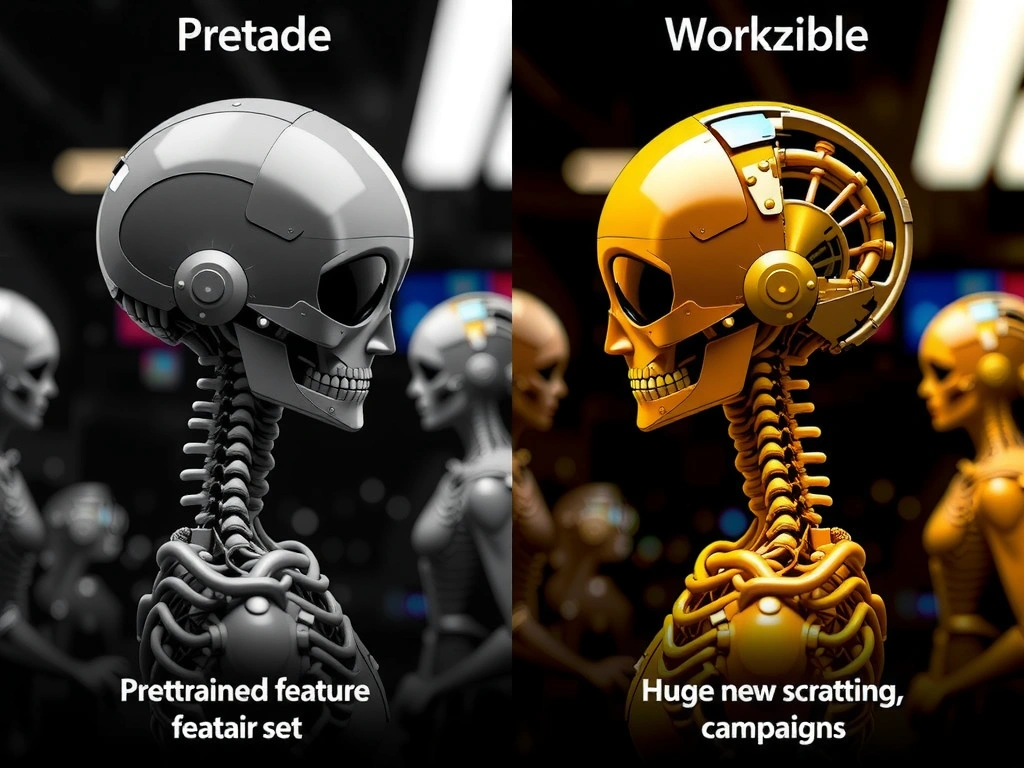
Here is the deal—when the boss says the vision demo is due Friday and the labeling budget is basically a coffee fund, you do not reinvent ImageNet from scratch. You grab a pretrained model and transfer-learn on your photos. Think of it like this: the network already knows edges, textures, and shapes; you are just teaching it your product SKUs or defect types. Rules engines sound simple until lighting changes. Huge new datasets sound thorough until Finance asks where the money went. Scratch training on a tiny set? That is how you burn weeks and still get mediocre accuracy. On the exam—and in production—transfer learning is the practical play for speed and cost. Got it? Sweet. Let us keep rolling.
Full explanation below image
Full Explanation
Under constrained time and budget, the dominant practical strategy in computer vision is transfer learning: initialize from a model pretrained on a large general corpus (for example ImageNet-scale classification or a strong self-supervised backbone), then adapt the final layers—and often fine-tune earlier layers lightly—on the project labeled images. Pretraining has already encoded generic visual structure such as edges, corners, textures, and object parts. That inductive head start reduces the amount of domain-specific labeled data required, shortens training wall-clock time, and usually improves accuracy and robustness compared with training an equivalently large network from random initialization on a small proprietary set. Teams that skip this step almost always pay for it later in schedule slips and weak metrics.
Hand-engineered rules (color thresholds, fixed templates, brittle heuristics) can work for highly controlled factory scenes, but they fail when scale, viewpoint, illumination, occlusion, or product mix shift. Building a multi-million-image labeled dataset from zero is scientifically ideal in the abstract and operationally disastrous when schedule and budget are fixed: collection, annotation quality control, and storage dominate cost long before the first useful model ships. Training complex architectures from scratch on limited labels invites severe overfitting or undertraining and consumes GPU hours that could have been spent on better evaluation, error analysis, and deployment hardening. Those three anti-patterns are common exam distractors because they sound thorough or pure while ignoring delivery constraints.
Best practice under pressure is therefore: choose a proven backbone appropriate to the task (classification, detection, segmentation), freeze early layers initially if labels are scarce, fine-tune with a modest learning rate, apply strong but standard augmentations, and validate on a held-out set that mirrors production conditions. If domain shift is large, progressive unfreezing or domain-adaptive pretraining can help—but the core idea remains reuse of pretrained representations. Memory aid: limited data plus limited time means transfer first, then collect more labels only where error analysis proves they are needed. This strategy is the standard industry path for quick, successful vision models and the answer certification exams expect when constraints are emphasized. Document assumptions, track slice metrics, and keep a thin path to production so the first usable model can iterate rather than restart from zero.