
In a typical end-to-end AI project workflow, when should data cleaning primarily be performed?
Select an answer to reveal the explanation.
Short Explanation and Infographic
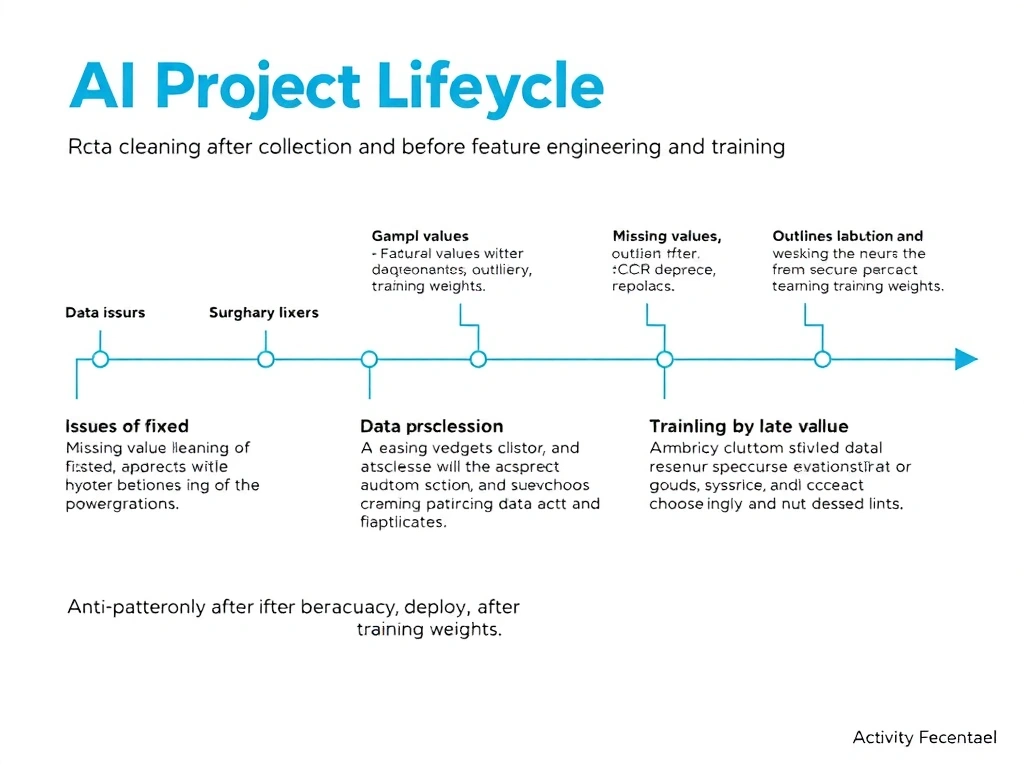
Let's keep this simple: clean the data before you teach the model bad habits. Here's the deal—after you collect or pull the data, you hunt missing values, broken formats, duplicates, impossible outliers, and labeling messes. Think of it like prepping ingredients before you cook. You don't wait until dinner is burned to wash the vegetables. Exam trap: "only clean when accuracy is low," or "clean after train/deploy." Those reverse the pipeline. Sure, production monitoring will catch new drift later, but the primary cleaning pass sits early—post-collection, pre-training—so every experiment starts from trustworthy tables. I remember projects where teams trained for weeks on misjoined IDs; one morning of cleaning would have saved the sprint. If your boss wants a model by Friday, push back gently on skipping hygiene. Garbage in still means garbage out—and the exam loves that timing question.
Full explanation below image
Full Explanation
Data cleaning is the set of practices that detect and correct—or carefully quarantine—quality problems in datasets used for machine learning. Typical work includes handling missing values, standardizing formats and units, resolving duplicates and entity mismatches, correcting or flagging label errors, treating impossible outliers, reconciling schema drift across sources, and documenting assumptions. Because supervised and unsupervised algorithms learn statistical structure from whatever they are given, dirty inputs produce brittle features, biased estimates, and misleading evaluation metrics. Cleaning therefore belongs early in the project lifecycle: after data are collected or extracted, and before extensive feature engineering and model training lock in bad patterns.
The correct answer places cleaning as an early step following collection. That sequencing does not mean cleaning is purely one-and-done; production systems also need ongoing data-quality monitors, contracts between producers and consumers, and refresh pipelines. Still, the foundational pass that makes a training corpus trustworthy is performed before modeling iterations dominate the calendar. Teams that postpone hygiene until accuracy is low often discover that weeks of hyperparameter search were spent fitting noise, leakage, or broken joins. Deploying first and cleaning later risks harming users and creating compliance exposure. Attempting to "clean" after training by editing weights confuses data quality with model editing; parameters reflect whatever data were supplied and are not a substitute for fixing the corpus.
Best practices include profiling distributions, tracking null rates and category cardinalities, validating referential integrity, sampling for human review of labels, and versioning cleaned datasets so experiments are reproducible. Separate train, validation, and test cleaning policies carefully: fit imputation statistics on training data only, then apply them to held-out sets to avoid leakage. Automate checks in the pipeline so new batches fail fast when quality regresses. On exams, associate data cleaning with the early preprocessing stage of the ML lifecycle—not with post-deployment firefighting alone, and not with post-training parameter surgery. Strong models start with trustworthy data, and the timing of cleaning is as important as the techniques used.