
A marketing team relies on a generative AI system to draft campaign copy at scale. What is the main ethical and practical risk they must manage?
Select an answer to reveal the explanation.
Short Explanation and Infographic
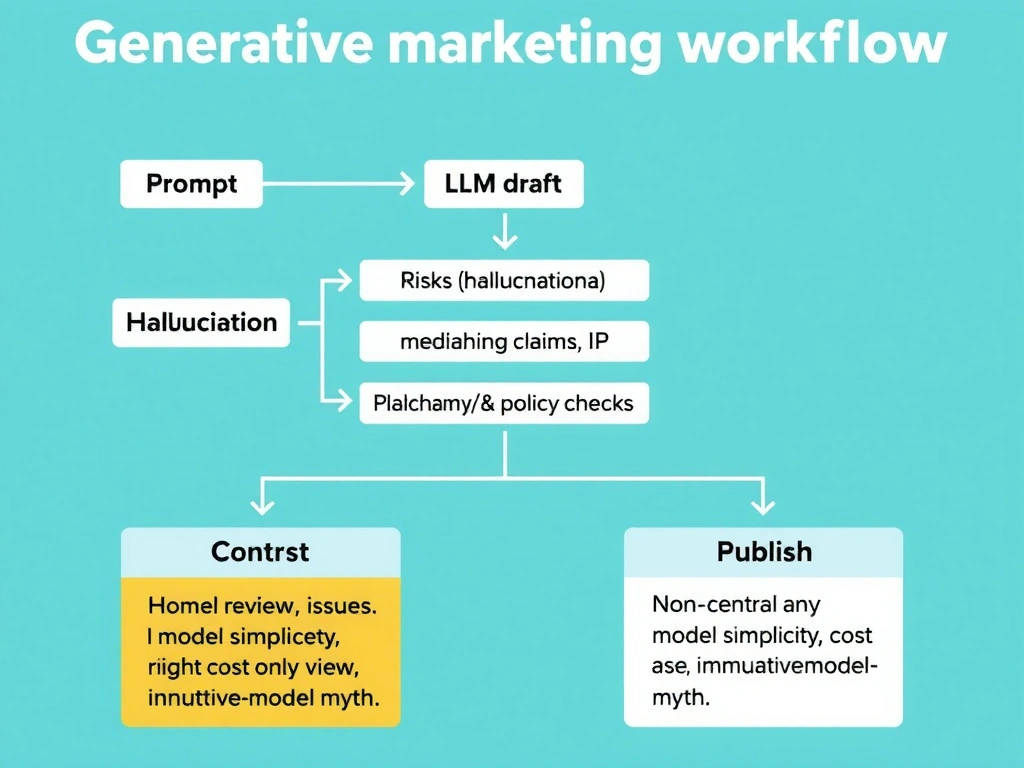
Here's where it gets interesting for you. Marketing wants a thousand product blurbs by Friday—generative AI can do it. The catch? It can also invent stats, oversell claims, or spit out copy that smells like someone else's work. That's not a 'model is too simple' problem, and it's not mainly about free compute or models you can never change. Think of it like a junior writer who never sleeps and never admits uncertainty—you still need an editor. Exam trap: picking cost or architecture trivia when the stem screams ethics and real-world risk. Human review, brand guidelines, plagiarism checks, and clear disclosure policies keep you out of trouble. Manage the misleading and unoriginal content risk first. You've got this—apply that filter every time gen AI writes for customers.
Full explanation below image
Full Explanation
Generative AI systems that produce marketing text introduce a distinctive combination of ethical and practical challenges centered on content integrity. Large language models generate fluent language by predicting likely continuations; they do not inherently verify facts, respect brand claims policy, or guarantee originality relative to copyrighted or third-party material. Consequently, outputs may include hallucinations (confident but false statements), misleading product promises, biased or inappropriate tone, and passages that substantially resemble training data or existing publications. For a company publishing campaign copy, those failures translate into regulatory risk, customer distrust, legal exposure, and brand damage.
The correct answer therefore focuses on the risk of generating misleading or plagiarized (or otherwise unoriginal) content. That risk is both ethical—duty of honesty to customers and respect for creators' rights—and practical—review workflows, compliance sign-off, and crisis response when bad copy ships. Organizations typically mitigate it with human-in-the-loop editing, claim libraries and approved product facts, style and safety filters, originality or similarity checks, logging of prompts and outputs, and clear ownership of who is accountable for published text. Disclosure policies and internal guidelines for acceptable AI assistance further reduce ambiguity.
Distractors miss the point of the scenario. Claiming the model is too simple contradicts the premise that generative systems already draft marketing text at scale; fluency is usually abundant, while reliability and provenance are scarce. Low compute cost may or may not hold depending on volume and model choice, but cost is an economic factor, not the main ethical challenge. The idea that generative models cannot be updated or replaced is false; continuous improvement, fine-tuning, retrieval augmentation, and model swaps are standard practice and do not define the core content-risk problem.
A useful framing for exams is to separate capability risks (what the model can wrongly say) from infrastructure myths (simplicity, free compute, immutable models). When the stem involves generative content for external audiences, prioritize truthfulness, non-deception, IP respect, and governance controls. Memory aid: 'Fluent is not verified—review before you publish.' That principle aligns AI ethics and governance expectations with day-to-day marketing operations and with responsible ML deployment more broadly, where technical power without oversight produces organizational liability faster than most teams expect when volume scales overnight across channels and regions without editorial guardrails in place.