
During an AI project lifecycle, what is the main goal of the deployment phase?
Select an answer to reveal the explanation.
Short Explanation and Infographic
Let me show you how this works in the real world. You've trained, tuned, and evaluated—now what? Deployment is the handoff into the wild: the model has to answer real requests. Think of training as building the engine and evaluation as the dyno test; deployment is putting the car on the road so customers can drive it. Cleaning data and training weights happen earlier. Offline metrics matter a lot, but staring at a test-set score isn't deployment—serving predictions is. Exam trap: stacking every lifecycle step into 'deploy.' Keep them separate: prepare → train → evaluate → deploy → monitor. When your boss asks whether the model is live, they mean inference is available. That's the goal. Nice and clean.
Full explanation below image
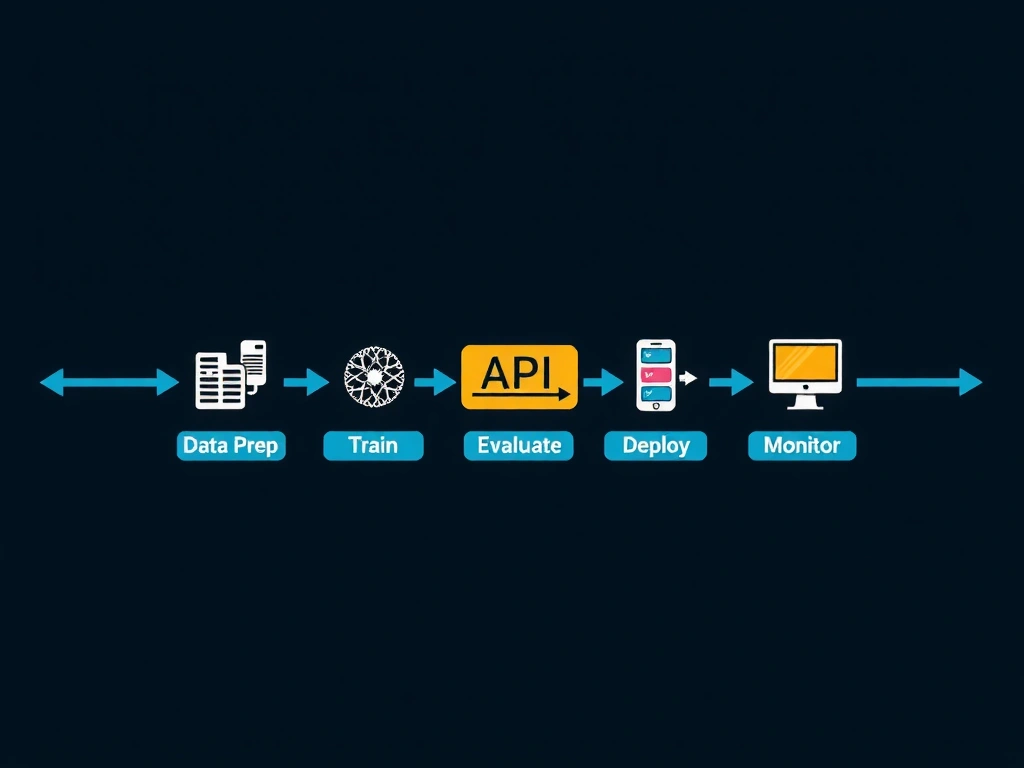
Full Explanation
The AI project lifecycle typically includes problem framing, data collection and preparation, model development and training, evaluation and validation, deployment, and ongoing monitoring with feedback for retraining. Within that sequence, the deployment phase has a specific objective: make a trained model available so that end users or other software systems can request predictions—that is, perform inference—in the intended production or operational environment. Availability may take many technical forms: a REST or gRPC endpoint, a batch scoring job, an embedded on-device model, a stream processor, or integration inside a larger application. Regardless of pattern, the defining outcome is operational access to model outputs for real work.
This goal is distinct from earlier phases. Cleaning and preprocessing transform raw data into usable training and evaluation inputs; those steps enable learning but do not constitute deployment. Training optimizes parameters and produces candidate models; it creates the artifact that may later be deployed. Evaluation quantifies performance on held-out data, checks fairness or robustness criteria, and often provides a go/no-go signal for promotion. Evaluation is a gate and a quality control activity, not the same as placing the model into service. Conflating these phases leads to incomplete systems—excellent notebooks that never serve users, or rushed launches without metrics discipline.
Successful deployment further includes packaging (containers, model formats), infrastructure (scaling, latency, GPUs if needed), configuration management, security and access control, logging, and rollback plans. Many organizations use staged rollout strategies after an initial deployment path exists. Still, the primary objective remains serving the model for inference. Monitoring then watches live health and data drift, feeding the next iteration of the lifecycle.
For exams and interviews, map each distractor to its correct phase: data prep, training, evaluation, versus deployment-as-availability. A concise memory aid is 'train builds it, evaluate judges it, deploy serves it.' Teams that keep those responsibilities clear communicate better across data science and platform engineering and avoid shipping confusion. When stakeholders ask whether a project is 'deployed,' they are asking whether authorized consumers can obtain predictions from the approved model under operational constraints—not whether someone cleaned a CSV or completed a training epoch. That clarity is the professional standard for MLOps lifecycle questions, and it prevents treating notebooks as finished products when business value only appears once inference is reliably available in production environments at the scale and reliability the organization actually needs.