
In an AI engineering workflow, what is the primary role of a Data Version Control (DVC) system?
Select an answer to reveal the explanation.
Short Explanation and Infographic
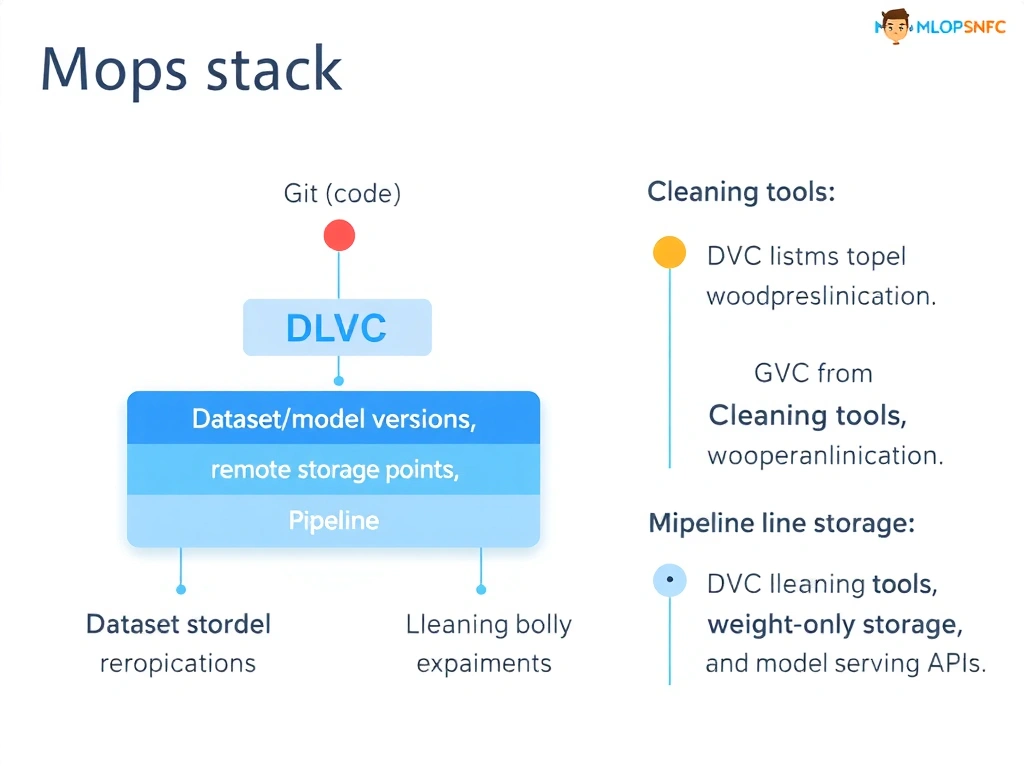
Check this out—your teammate trains a model last month that crushed the leaderboard, and now nobody can recreate it. Painful. That's where DVC earns its keep. Think of it like Git, but for the giant datasets and models that Git alone chokes on. You version the data, the pipeline steps, and the artifacts so when the boss asks, 'Which dataset trained v3?' you actually know. DVC isn't the cleaner, isn't just a weight locker, and it doesn't host your API. Exam trap: mixing DVC up with preprocessing tools or deploy targets. Remember: DVC = track versions of big data and ML stuff so runs are reproducible. Practice naming data versions like you name code branches—you'll thank yourself later.
Full explanation below image
Full Explanation
Data Version Control (DVC) addresses a fundamental reproducibility problem in machine learning: models depend not only on source code and hyperparameters but also on large datasets, intermediate features, and trained artifacts that traditional Git repositories handle poorly because of size and binary nature. DVC systems track versions of those large assets, often storing content in remote object storage while keeping lightweight metadata and pointers in Git. The result is a lineage link between a code commit, the exact data snapshot used, the pipeline definition, and the produced model or metrics.
The main purpose, therefore, is to manage and version large datasets and machine learning models (and related pipeline outputs) so teams can reproduce experiments, audit what changed, roll back bad data drops, and collaborate without silently training on mismatched files. This capability is central to MLOps: without data and model versioning, 'it worked on my machine' becomes institutional, and debugging regressions becomes guesswork.
Distractors reflect category errors. Data cleaning and preprocessing are essential pipeline stages, but they are implemented by transformation code and tools—not by the version-control layer itself. DVC may track cleaned datasets as versioned outputs, yet its job is not to clean data. Likewise, storing model weights is part of artifact management, but characterizing DVC as only a weight store understates its role in dataset versioning, pipeline tracking, and experiment reproducibility. Finally, production deployment—exposing models via APIs, scaling inference, and routing traffic—is the domain of serving and release platforms; DVC supports the path to deployment by making which model and data were used auditable, but it does not replace the serving stack.
In practice, teams combine Git for code, DVC (or equivalent) for data and model artifacts, experiment trackers for metrics, and CI/CD for tests and promotion. When an evaluation score drops, the first forensic questions are which code, which data version, and which training config produced the previous good model—questions DVC is designed to answer. Exam takeaway: associate DVC with versioning and managing large datasets and ML models for reproducibility, not with cleaning, pure storage-only semantics, or live inference hosting. That distinction keeps MLOps tooling roles clear under interview and certification pressure, and it prevents treating version control as a substitute for either data engineering quality work or production serving architecture when systems grow.