
An enterprise plans to roll out a new AI-powered recommendation service company-wide. Leadership asks why the team should run a limited pilot before full production launch. What is the primary reason?
Select an answer to reveal the explanation.
Short Explanation and Infographic
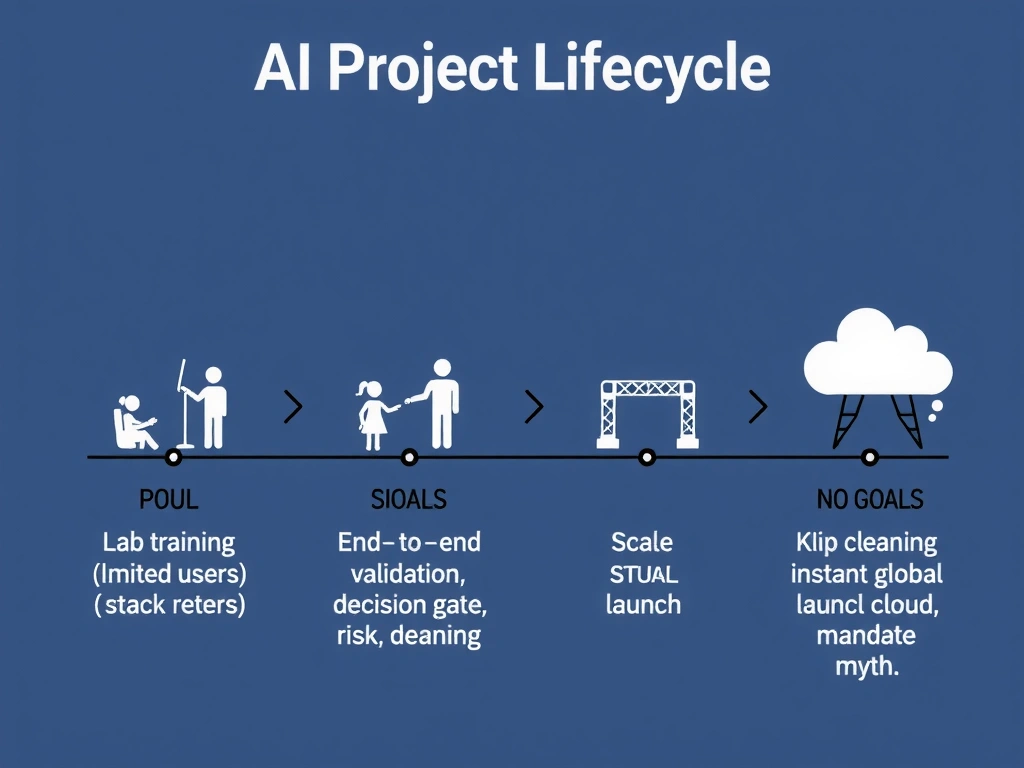
Here's the deal: your boss wants the new recommender live for everyone by next week. Tempting, right? Don't do it. A pilot is your dress rehearsal—small audience, real traffic, full stack. You watch latency, wrong recommendations, broken APIs, and weird data before the whole company depends on it. Think of it like test-driving a car on a quiet road instead of jumping onto the freeway at rush hour. Skipping the pilot doesn't skip data cleaning, and no cloud vendor forces you to pilot—you do it so production doesn't become the first real test. Exam trap: people confuse pilot with 'go live everywhere now' or with training steps. Remember: pilot = controlled real-world end-to-end check before scale. Got it? Sweet. Let's keep rolling.
Full explanation below image
Full Explanation
In practical AI delivery, a pilot project is a deliberate, limited release of a trained model and its supporting system into a real operating environment with constrained scope, users, or traffic. The core purpose is to validate end-to-end performance—not only offline accuracy metrics from a notebook, but also serving latency, integration with upstream and downstream services, monitoring hooks, failure modes, user experience, and operational cost under conditions that resemble production. Laboratory success is necessary but insufficient; production introduces distribution shift, concurrency, messy inputs, network timeouts, and human behavior that static test sets rarely capture fully.
Running a pilot before large-scale deployment reduces risk. Defects found when only a fraction of users or regions are exposed are cheaper and safer to fix than defects that hit the entire customer base. Pilots also create feedback loops: product and engineering teams can measure business KPIs, gather qualitative feedback, tune thresholds, and confirm that SLAs are achievable before committing irreversible organizational dependency on the system.
The correct option emphasizes this controlled, realistic, end-to-end validation. Distractors encode common misconceptions. Pilots do not remove the obligation to clean and govern data; data quality remains foundational in every lifecycle stage. Immediate company-wide launch maximizes adoption only if the system works—otherwise it maximizes incident impact. Cloud providers may offer tooling for staged rollouts, but they do not universally mandate pilots as a contractual step for every AI workload; the practice is driven by sound engineering and risk management, not by a fixed cloud rule.
Best practice is to define pilot success criteria in advance (accuracy bands, latency budgets, error rates, escalation paths), instrument the stack thoroughly, and plan a clear go/no-go gate before expansion. Canary releases, shadow traffic, and A/B tests are related techniques that serve the same underlying goal: learn under real load with limited blast radius. On certification exams, associate pilot work with pre-scale validation of the whole system in a controlled real-world setting, not with skipping quality steps or with mandatory vendor checklists. That framing separates mature MLOps from 'ship it and hope,' which is a pattern that consistently fails under production stress when stakes, scale, and user trust all rise together.