
In a large AI engineering program, what is the primary role of MLflow?
Select an answer to reveal the explanation.
Short Explanation and Infographic
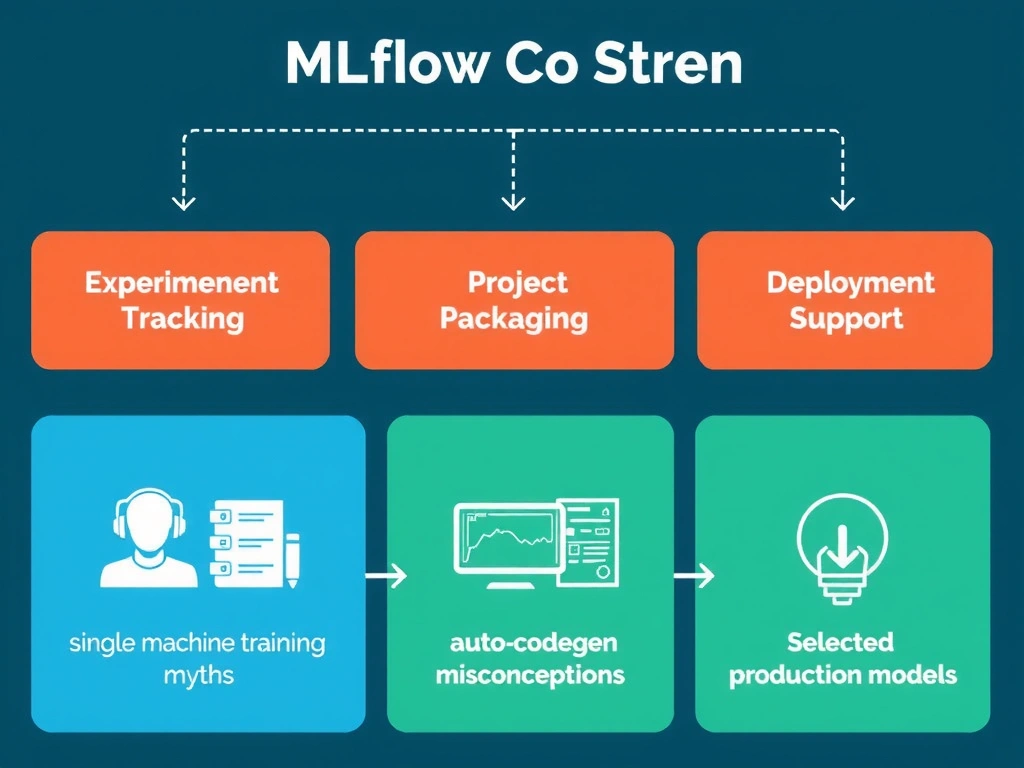
Okay, let's dive in. MLflow is your MLOps Swiss Army knife—not a data lake and not a magic code writer. Check this out: imagine five engineers training slightly different models and nobody can answer which run used which params. Chaos. MLflow tracks experiments, packages projects so runs are reproducible, and helps you register and ship models through a controlled lifecycle. Trust me on this—when your boss walks in asking "which checkpoint went to prod last Tuesday?" you want tracking and a registry, not a folder of mystery pickles. It doesn't force single-machine training, and it doesn't invent your architecture for you. Use it to keep the lifecycle honest: compare runs, package consistently, deploy with eyes open. That's the exam and production angle. Keep rolling.
Full explanation below image
Full Explanation
MLflow is an open-source platform widely used in AI engineering and MLOps to manage stages of the machine learning lifecycle. Its core capabilities typically include experiment tracking (logging parameters, metrics, tags, and artifacts for each run), project packaging for reproducible execution, a model format and registry-oriented workflows for versioning and promoting models, and integrations that help teams deploy models into serving environments. In large-scale programs with many concurrent experiments, teams, and environments, these capabilities reduce tribal knowledge and make it possible to compare runs, reproduce results, and hand models off from research to production with clearer lineage.
The correct answer reflects that lifecycle focus: track experiments, package projects, and support deployment-related model management. Engineers log hyperparameters and evaluation metrics during training, attach artifacts such as plots or model binaries, and later select a champion run for registration and staged promotion. Packaging conventions help others re-run training with the same entry points and dependencies. Together these practices improve collaboration, auditability, and operational discipline without locking the organization into a single training framework, because MLflow integrates with many popular libraries.
Storing all raw enterprise data is not MLflow's primary purpose. Organizations rely on object stores, warehouses, lakes, and feature platforms for durable data management; MLflow may record dataset references or small artifacts, but it is not a substitute for a data platform. Likewise, MLflow does not restrict training to a single machine. Runs can execute locally, on clusters, or in cloud jobs while still reporting metrics back to a tracking server. Finally, MLflow does not automatically write complete model code. Practitioners still design features, architectures, training loops, and evaluation logic; MLflow records and organizes what those runs produce.
In practice, teams combine MLflow with source control, CI/CD, infrastructure-as-code, and monitoring. Best practices include consistent naming and tagging of experiments, logging enough context to reproduce a run months later, separating experimental playgrounds from production registries, and defining promotion criteria before models move toward live traffic. Understanding MLflow's role—and what it is not—helps candidates design lifecycle tooling that scales with organizational complexity while remaining focused on reproducibility, comparison, and controlled delivery of machine learning systems in real engineering organizations over multi-team programs and multi-year model portfolios.